He Cried When They Told Him She Was Dead
The body-camera footage is grainy and clinical, the kind of video never meant for public consumption. A police officer stands close by. A doctor speaks carefully, choosing words designed not to shatter a man already on the brink. Then comes the sentence that splits Brendan Banfield’s life in two: Your wife has died.
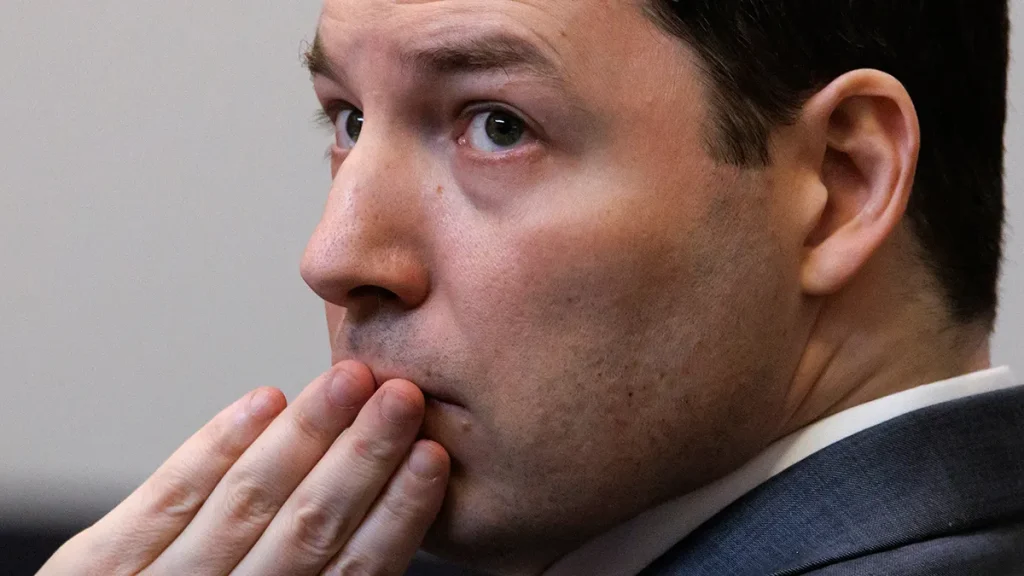
In the courtroom, nearly three years later, Banfield bows his head. His shoulders tremble. He wipes his eyes as jurors watch him watch himself — a man receiving the worst news imaginable. It is the kind of moment true crime audiences are trained to read as raw truth. Grief, unscripted. Devastation, undeniable.
But prosecutors say the scene is not what it appears. They argue the tears are part of a longer performance — one that began months earlier, online, in private messages, and in a suburban Virginia bedroom remodeled not for comfort, but for silence.
A Crime Scene Without a Stranger
On February 24, 2023, Fairfax County police responded to a call at a tidy home in a leafy Washington, D.C. suburb. Inside, they found two victims: Christine Banfield, a 37-year-old mother of one, and Joseph Ryan, a man with no prior connection to the family.
Christine had been stabbed in the neck. Ryan had been shot.
Banfield, then 40, an IRS special agent trained in forensic awareness and financial investigations, was still alive. He told police an intruder had attacked his wife and that he had acted in self-defense. At first glance, it sounded like a home invasion gone horribly wrong.
But almost immediately, the story began to strain.
Ryan, investigators learned, had not forced his way inside. He had been invited.
The Plot, According to Prosecutors
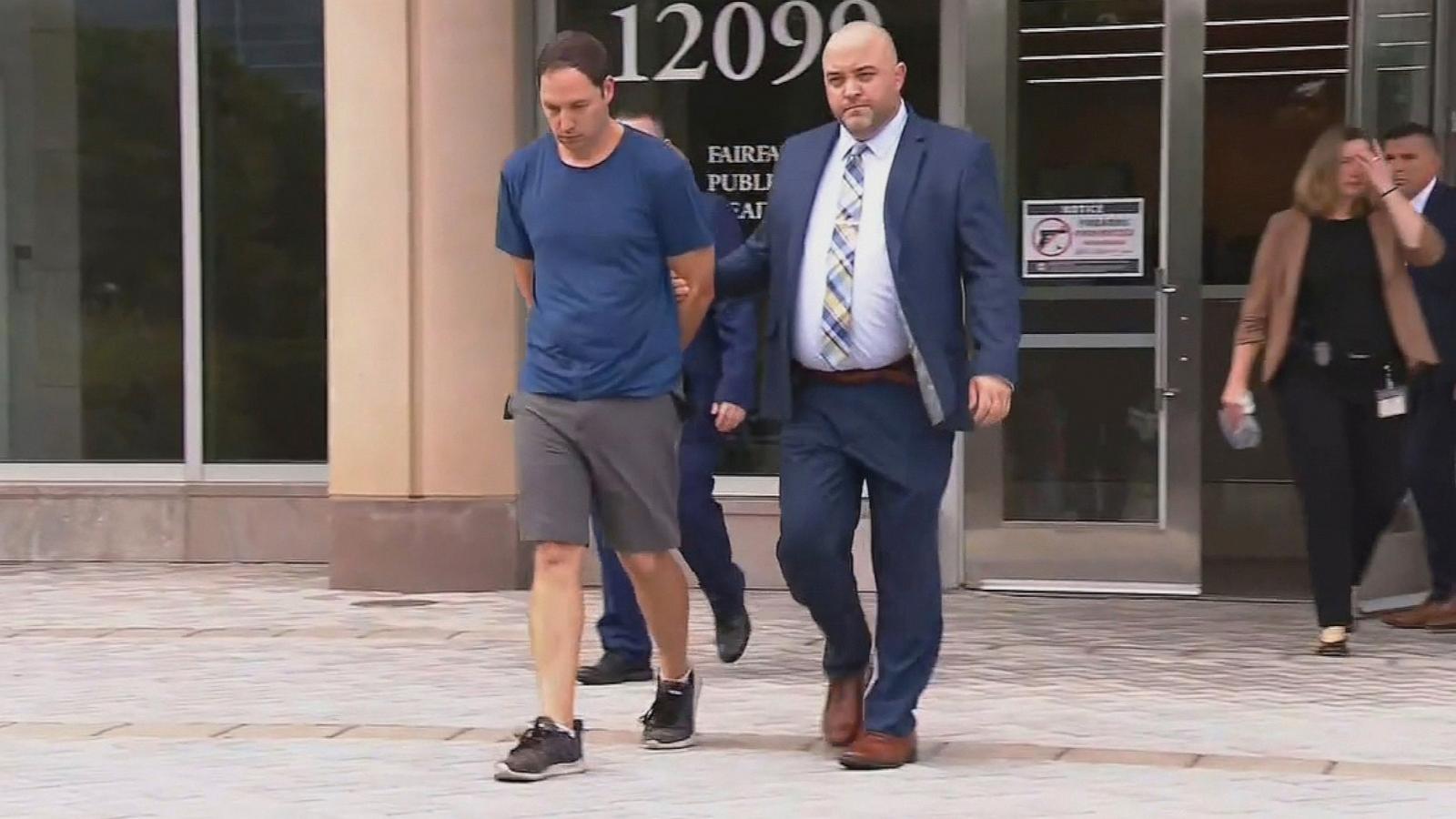
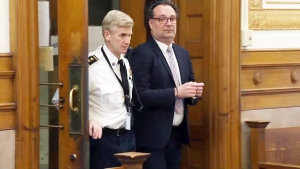
Brendan Banfield is led by investigators outside a Fairfax County facility following his arrest in connection with the 2023 killings of his wife, Christine Banfield, and Joseph Ryan.
The prosecution’s theory is as disturbing as it is intricate. They allege Banfield orchestrated his wife’s murder so he could begin a new life with the family’s Brazilian au pair, Juliana Peres Magalhães, then 25.
According to court testimony, Banfield and Magalhães created a fake online profile for Christine on a fetish website — one advertising a rape fantasy. Ryan responded. He believed he was entering a consensual role-play scenario.
Instead, prosecutors say, he walked into a trap.
The plan, they allege, was to lure Ryan into the home, kill him, and stage the scene so it would appear he had murdered Christine during a sexual assault gone wrong. Banfield, the grieving husband, would emerge as the lone survivor.
Magalhães has already pleaded guilty to manslaughter. She testified that the plot was Banfield’s idea.
Banfield has pleaded not guilty to all charges.
Performance Versus Proof
In court this week, Banfield’s defense team played the body-camera footage not to dispute the facts of Christine’s death, but to humanize the man accused of causing it.
The doctor’s voice in the video is steady, compassionate. He explains catastrophic blood loss. He tells Banfield there was nothing more to be done.
Banfield sobs. Loudly.
“I was trying to apply pressure,” he says in the recording, interrupting the doctor, as if to insist — to someone, to anyone — that he tried.
The moment is powerful. It is also, prosecutors argue, misleading.
They say Banfield’s knowledge of the crime far exceeded what he let on. They point to forensic timelines, ballistic evidence, and digital communications that place him at the center of the planning — not the periphery of the tragedy.
True crime thrives on these moments: the tearful confession, the trembling hands, the cracked voice. But courts are trained to ask a colder question — not how does it look, but what does it prove?
The Digital Trail
Unlike crimes of earlier decades, this case does not hinge on a single eyewitness or a disputed confession. It hinges on data.
Messages between Banfield and Magalhães chart an emotional and sexual escalation. Selfies show them posing together while Christine was still alive. In one image shown to jurors, Magalhães gushes about being “incredibly in love.”
Investigators say that after Christine’s death, Magalhães moved her lingerie into the master bedroom. Family photos disappeared. New ones replaced them.
These are not crimes in themselves. But prosecutors argue they reveal motive — a desire to erase one life and install another.
The internet, had it discovered these details first, might have framed them as obvious proof. In court, they are presented more carefully: not as certainty, but as pattern.
The House That Didn’t Hear Anything
One of the strangest details of the case involves renovations.
Prosecutors allege Banfield installed triple-glazed windows in the home shortly before the murders — windows designed to block sound. They argue the upgrades were not about energy efficiency or comfort, but concealment.
The defense disputes this interpretation, noting that soundproofing alone does not equal intent.
Still, the detail lingers. True crime stories are built on such specifics — the object that seems too deliberate, too symbolic to be coincidence. Whether a jury sees foresight or projection remains an open question.
A Co-Conspirator Who Turned State’s Witness
Magalhães is central to the prosecution’s case — and its biggest vulnerability.
She admitted her role. She accepted a plea deal. And she now testifies against the man she once planned a future with.
Defense attorneys portray her as self-serving, unreliable, and motivated by survival. Prosecutors counter that her testimony is corroborated by physical evidence and timelines independent of her words.
In true crime lore, accomplices who testify are often treated as either heroes or villains. In reality, they are something murkier: compromised narrators whose truth must be weighed, not embraced.
The Child at the Center

Banfield allegedly murdered his wife, Christine, the mother of their 4-year-old daughter.
Almost absent from courtroom discussion, but impossible to ignore, is the Banfields’ young daughter.
She lost her mother. Her father now faces the possibility of life in prison.
True crime rarely lingers on children, because they resist neat narrative framing. There is no moral lesson that makes sense of their loss. No plot twist that redeems it.
Watching Ourselves Watch Him
When Banfield cried in court, cameras captured it. Headlines followed. Social media dissected it.
Was it real? Was it rehearsed? Did it matter?
The modern true crime ecosystem is built around these questions. We are conditioned to believe that emotion equals truth — or that its absence signals guilt. But courts, unlike audiences, are not meant to be persuaded by tears.
They are meant to be persuaded by evidence.
That tension — between how a moment feels and what it means — is the engine driving this case.
Where Things Stand
As of January 2026, Banfield’s trial is ongoing. The jury has seen the footage. They have heard Magalhães testify. They have reviewed the messages, the photos, the forensic reports.
What they have not been given is a simple story.
There is no masked intruder to fear. No clear monster. Just a suburban home, a dead mother, a dead stranger, and a man whose grief may be genuine — or may be part of something far darker.
In true crime, ambiguity is often framed as mystery. In real courtrooms, it is something else entirely.
It is reasonable doubt.
The Digital Fingerprint: Forensic Linguistics
Forensic linguistics treats word choice as a biological marker. Every person possesses an "idiolect"—a unique pattern of vocabulary, grammar, and punctuation that is difficult to mask.
In cases where a digital profile is created in a victim's name, investigators analyze the "linguistic fingerprint" of the posts to see if they align with the victim's known writing style or that of the accused.
Experts scrutinize minute details that a casual observer would miss. This includes the frequency of "function words" like the, and, or but, as well as specific habits in capitalization and emoji usage.
If Christine Banfield never used Oxford commas in ten years of emails, but her "fetish profile" used them consistently, it suggests an outside author. Conversely, if the profile shared the same idiosyncratic spelling errors found in Brendan Banfield’s private texts, the digital trail becomes a direct link to the plotter.
This analysis extends to the rhythm of the sentences. Investigators use computational tools to measure "mean word length" and "syntactic complexity."
By comparing the suspicious messages against thousands of verified samples from both the husband and the wife, linguists can provide a statistical probability of authorship. In a trial built on performance, these cold, mathematical comparisons of grammar often prove more resilient than the most convincing display of courtroom emotion.
In the Banfield case, forensic linguistics centers on the digital "catfish" profile used to lure Joseph Ryan. Prosecutors argue this profile was a fabrication—a script written not by a woman seeking a fantasy, but by a husband seeking a victim.
The power of this science has been proven in several landmark cases where language evidence led to a conviction:
-
The Unabomber (Ted Kaczynski): This remains the most famous application. The FBI’s James Fitzgerald identified specific, archaic phrases in Kaczynski’s 35,000-word manifesto—such as "chicks" and "broads"—and "Theodorisms" like "analyse" (British spelling). These matched letters Kaczynski had sent to his family.
-
The Chris Coleman Case: In 2009, Coleman claimed his family was murdered by an intruder who left spray-painted threats on the walls. Forensic linguists noticed the graffiti used "U" instead of "YOU." By analyzing Coleman’s private emails, they found he consistently used that same shorthand, while his wife used the full word.
-
The Derek Bentley Case: Decades after Bentley was hanged, an analysis of his "confession" revealed it used "the gun" instead of "a gun." This subtle shift proved the police had likely prompted the answer, as a person speaking naturally would not use a definite article for an object they didn't know existed.
In the Banfield trial, the defense has challenged this "catfishing" theory, arguing that it remains unsubstantiated by direct forensic links. However, the prosecution continues to rely on the pattern of digital communication—the "lusty selfies" and private messages—to argue that the man sobbing in the body-cam footage was the same man meticulously typing out a death trap.