Understand Your Rights. Solve Your Legal Problems


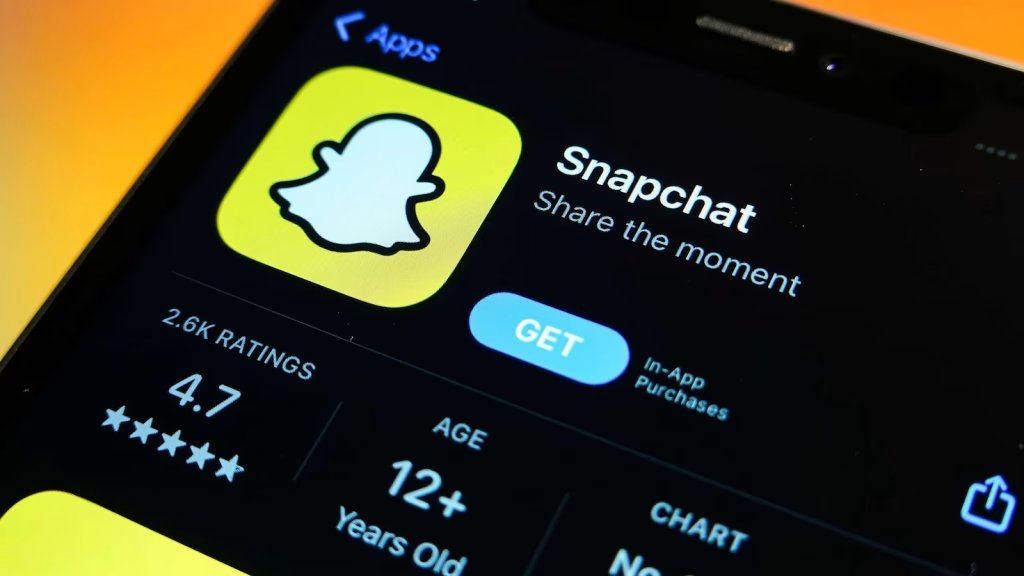
Snapchat requires users to be at least 13 to hold an account, but app-store ratings and device settings still allow many children to download the app on phones and tablets.
Snapchat states in its terms of service that people must be at least 13 years old to use the service, mirroring age thresholds used by other major social media platforms and influenced by children’s privacy laws such as the U.S. Children’s Online Privacy Protection Act (COPPA).
Yet the Snapchat app remains visible and downloadable for younger users in Apple’s App Store, where it is listed with a 12+ content rating.
Parents in the United States, the United Kingdom and other countries often discover that a child can install Snapchat even though they are technically too young to hold an account.
This gap between platform rules and app availability has become more visible as regulators push for stronger protections for minors online.
Countries such as Australia have moved toward stricter account-based rules for social media, while app-store policies and device-level parental controls remain largely unchanged.
The result is a complex system in which children can still download Snapchat, and responsibility for enforcement is split between platforms, device makers, governments and families.
Snapchat’s minimum age requirement appears in its terms of service and help materials, which state that users must be at least 13 years old to use the platform.
The threshold is designed to align with child-privacy rules, particularly COPPA in the United States, which limits the collection of personal data from children under 13 without verifiable parental consent.
When people sign up, Snapchat asks for a date of birth and uses this to determine eligibility.
If Snapchat later identifies an account as belonging to a child under 13, it can disable or remove that account under its policies.
However, this rule is enforced on Snapchat’s systems, not in the app store or on the device itself.
The requirement applies to account creation and use, not to the act of downloading or installing the application.
Apple assigns age ratings to every app in its App Store, using categories such as 4+, 9+, 12+ and 17+.
These ratings indicate the suitability of app content rather than legal or contractual age limits set by developers. Snapchat is classified as 12+, meaning Apple’s review process considers its content appropriate for users aged 12 and above.
This 12-plus rating determines whether Snapchat appears when a child browses the App Store, and it also interacts with Apple’s Screen Time feature, which allows parents to limit apps by age rating.
Unless parents manually change these settings or block app installation altogether, children who use an Apple ID can still see and download Snapchat despite Snapchat’s own 13-plus policy.
App stores and platforms operate separate systems. Apple and Google manage app distribution, while Snapchat controls user accounts and personal data.
App-store operators do not see the dates of birth that users enter when they sign up for Snapchat, nor do they access Snapchat’s internal records of who is allowed to have an account.
That information is handled by the platform itself in accordance with its privacy and security policies.
Because app stores are not integrated with Snapchat’s account database, they cannot automatically block a download based on the age a user has given to Snapchat.
Likewise, Snapchat cannot change whether the app appears in the store; it can only restrict access once the app is installed and a user attempts to create or maintain an account.
In the United States, COPPA and related guidance focus on how services handle data from children under 13 rather than banning children from downloading apps.
Platforms such as Snapchat set their own minimum ages and are responsible for enforcing them at the account level.
There is no nationwide rule that prevents a child from installing a social media app, although some U.S. states have considered or passed social media age-verification laws that are still being tested in the courts.
The United Kingdom’s Online Safety Act, together with the Information Commissioner’s Office’s Children’s Code, imposes duties on platforms to consider children’s rights and safety, but it does not set a universal minimum age for downloading social apps.
The focus is on design, transparency and content controls. In both the U.S. and U.K., this means that a child can often install Snapchat on a device, but Snapchat remains responsible for ensuring that under-13 accounts are not allowed to exist.
Australia has taken a different approach by amending its online safety framework to introduce a higher minimum age for social media accounts, typically set at 16 for services including Snapchat.
The reforms place legal obligations on platforms to take reasonable steps to verify user ages and prevent children under 16 from maintaining accounts, with penalties for non-compliance.
Even under this stricter regime, the legislation targets account access rather than app-store listings. Apple and other app-store operators are not required to remove Snapchat or hide it from younger users.
Instead, the burden falls on Snapchat and similar platforms to screen users and close accounts that do not meet the higher age threshold.
This underlines that even strong national rules may not change whether children can download the app in the first place.
Because neither Snapchat’s 13-plus rule nor national laws automatically block app-store access, parents and guardians remain the last line of control on many devices.
On Apple devices, adults can use Screen Time to restrict apps by age rating, disable app installation entirely, or require approval for every download made with a child’s Apple ID.
Similar tools exist on Android devices through Google Play and family-control settings.
For older teenagers who meet Snapchat’s minimum age but whose usage still raises concerns, families can combine device-level controls with platform tools, such as Snapchat’s Family Center, which allows linked accounts and some oversight of interactions.
These measures help bridge the gap between platform policies, laws and day-to-day use.
Why can my child download Snapchat even though they are under 13?
Because Snapchat’s 13-plus rule applies to accounts, while Apple’s 12-plus rating keeps the app visible in the store unless parents change device settings.
Is Snapchat breaking the law if under-13s download the app?
Downloading the app is not the focus of most laws; Snapchat is expected to block under-13 accounts and comply with child-privacy rules, particularly on data collection.
Can Apple stop children from downloading Snapchat automatically?
Apple provides age ratings and parental controls, but it does not enforce Snapchat’s internal age rules by default; parents must enable restrictions.
Does Australia block under-16s from using Snapchat?
Australia requires platforms to prevent under-16s from having accounts on designated services, but it does not require app stores to remove or hide those apps.
What is the most effective way to stop a child from getting Snapchat?
The most direct method is to use device-level parental controls to disable app installation or restrict apps by age rating, combined with monitoring of app usage.
Children are still able to download Snapchat because the company’s age rule governs who may hold an account, while app stores decide only how the app is displayed.
Snapchat screens users when they sign up, but Apple’s age rating keeps the app visible unless a parent changes device settings.
In the United States, the United Kingdom and Australia, most rules focus on how platforms manage children’s information and access not on whether the app can be downloaded.
In practice, it is parents and guardians who must rely on device controls and platform tools to decide whether Snapchat is available on a child’s phone.
👉 Snapchat Age Crackdown Begins Ahead of Australia’s Under-16 Social Media Ban 👈
Should App Stores Block Social Media Apps More Strictly for Children?