Understand Your Rights. Solve Your Legal Problems


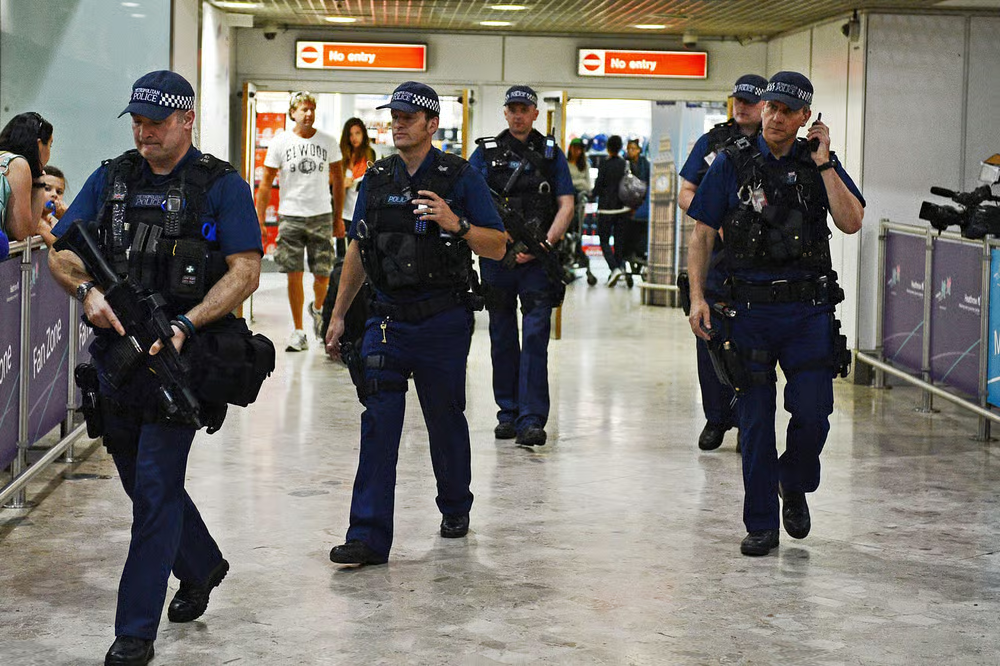
Emergency services, including armed police and multiple medical teams, are responding to an incident involving a chemical irritant in a Heathrow Terminal 3 car park, leading to treatment for several people and causing travel delays around the airport.
Emergency services were called to Heathrow Airport on Sunday morning after several individuals were exposed to a chemical irritant in the Terminal 3 multi-storey car park. One man was arrested, and police said additional suspects fled before officers arrived.
The affected individuals received on-site treatment and were taken for further medical assessment. Initial reports indicate the injuries were minor.
The incident has drawn attention because chemical irritants are classified as prohibited weapons in the United Kingdom, requiring immediate law-enforcement intervention. Large transport hubs such as Heathrow operate under strict safety and access protocols, and even limited events can disrupt passenger flow. The response underscores how airport policing and emergency coordination continue to evolve in line with UK security standards.

Armed police on scene
Police said the incident involved a group of men in the Terminal 3 car park shortly after 8 a.m. A chemical irritant—described as a form of pepper spray—was discharged, and the group dispersed before officers reached the scene. One man was detained nearby on suspicion of assault. Detectives have begun reviewing CCTV footage and interviewing witnesses to identify the remaining individuals.
Officers stated that the incident appeared to stem from a dispute among people known to one another, based on early accounts. There is no indication of a broader threat to airport operations, and no terrorism link has been identified by investigators.
Police are focused on confirming the identities of the remaining suspects and establishing how the irritant was deployed.
Our teams are currently responding to an incident involving the emergency services in the Terminal 3 multi-storey car park. Passengers are advised to allow extra time when travelling to the airport and to check with their airline for any queries.
— Heathrow Airport (@HeathrowAirport) December 7, 2025
Chemical irritants such as pepper spray prompt a coordinated response from police, ambulance and fire services under standard UK hazardous-material protocols. Paramedics typically prioritise washing the affected skin and eyes, assessing breathing, and preventing further exposure. Fire crews assist with ventilation in enclosed areas to reduce lingering airborne particles.
Large airports prepare for such scenarios through regular multi-agency exercises aligned with Civil Aviation Authority guidance. These drills help minimise operational disruption and ensure that emergency teams can act quickly despite the complex layout and heavy footfall typical of major terminals.
Established safety procedures enable emergency teams to contain chemical-exposure risks while sustaining airport operations.
Terminal 3 remained open, but police temporarily restricted nearby road access, contributing to delays on approaches connecting the airport to the M4 corridor. Rail services experienced minor disruption while the area was secured. Such interruptions are consistent with UK aviation-security requirements, which prioritise controlled movement around sensitive infrastructure during live investigations.
Airports maintain contingency plans that allow airlines to continue processing passengers while specific areas are cordoned off. Heathrow advised travellers to allow additional travel time and check airline updates throughout the morning.
Disruption was localised, but access routes and transport links experienced delays as safety checks were completed.
Pepper spray is banned in the United Kingdom and classified as a Section 5 prohibited weapon under the Firearms Act 1968. Possession, use or distribution without lawful authority constitutes a criminal offence. Police investigations typically focus on how the substance was obtained and whether its use was intentional.
Courts have consistently treated possession of prohibited sprays as a serious matter, with sentencing dependent on intent, risk to the public and prior offences. Assault charges may also apply when exposure results in physical harm.
Takeaway: Anyone found responsible for deploying pepper spray in a public setting faces significant criminal penalties under UK firearms legislation.
While irritant-spray incidents at airports are uncommon, each event contributes to ongoing evaluations of public-safety procedures. Airports follow the National Aviation Security Programme, which requires regular reassessment of risk controls, CCTV coverage and incident-response coordination.
Events triggering emergency deployment often prompt reviews by airport management and law enforcement to ensure that future responses remain proportionate and effective. Such assessments play a role in maintaining public confidence in aviation security across the UK.
This incident will likely inform future updates to Heathrow’s safety planning and broader UK airport-security assessments.
Are police still searching for the Heathrow pepper spray attackers?
Yes. Police have confirmed that enquiries are ongoing to identify and locate additional suspects connected to the Terminal 3 incident.
How severe were the injuries from the Heathrow pepper spray incident?
Authorities report that all known injuries were minor and not life-threatening, with patients assessed and treated by ambulance crews.
Was the Heathrow Airport incident linked to terrorism?
No. Police have stated there is no evidence suggesting a terrorism-related motive, and the investigation is being treated as an assault case.
Did flights or Heathrow Airport operations shut down after the incident?
No. Terminal 3 continued operating throughout, though road access and nearby transport routes experienced short-term delays while emergency teams secured the area.
Is carrying pepper spray legal in the UK, including at airports?
No. Pepper spray is classified as a prohibited weapon under Section 5 of the Firearms Act 1968, and possession or use in any public setting—including airports—is a criminal offence.
The Heathrow pepper spray incident highlights how prohibited irritant sprays can trigger rapid multi-agency responses, even when injuries are limited. Passengers and airport staff experienced localised disruption, and police are continuing efforts to identify all individuals involved.
Because Heathrow is one of the world’s busiest transport hubs, the event renews focus on how UK airports manage small-scale security incidents. As the investigation continues, authorities will review procedures to ensure ongoing safety around Terminal 3 and across the wider airport estate.
📝👉 Essential Reading: Understanding Duty of Care — The Hidden Legal Principle That Protects You Every Day