Understand Your Rights. Solve Your Legal Problems



Samsung has officially taken the next step in foldable design, introducing the Galaxy Z TriFold — its first device with a triple-hinge, multi-fold architecture. The company is launching the phone in South Korea on December 12, with international rollouts following through early 2026, including a U.S. release in the first quarter. The debut comes as rivals — particularly Chinese brands — move aggressively into the premium foldable space.
Samsung positions the TriFold as both a technology showcase and a strategic preview of where its flagship mobile design may be heading.
The Galaxy Z TriFold is Samsung’s first device to bring three folding panels together in a single consumer-ready product. When fully expanded, the device opens into a 10-inch display with a 2160 × 1584 resolution — a format that’s closer to a compact tablet than a stretched-out smartphone. It’s slightly smaller than Apple’s current 11-inch iPad but intentionally more portable.
To achieve this, Samsung uses twin inward-folding hinges, allowing the device to collapse into a rectangular shape that measures 12.9 mm thick when folded. That’s marginally thicker than the Galaxy Z Fold6 but noticeably slimmer than the first generation of tri-fold prototypes shown in recent years by various manufacturers.
Internally, Samsung includes 16GB of RAM and 512GB of storage, packaged into a single configuration priced at ₩3,594,000 ($2,449).
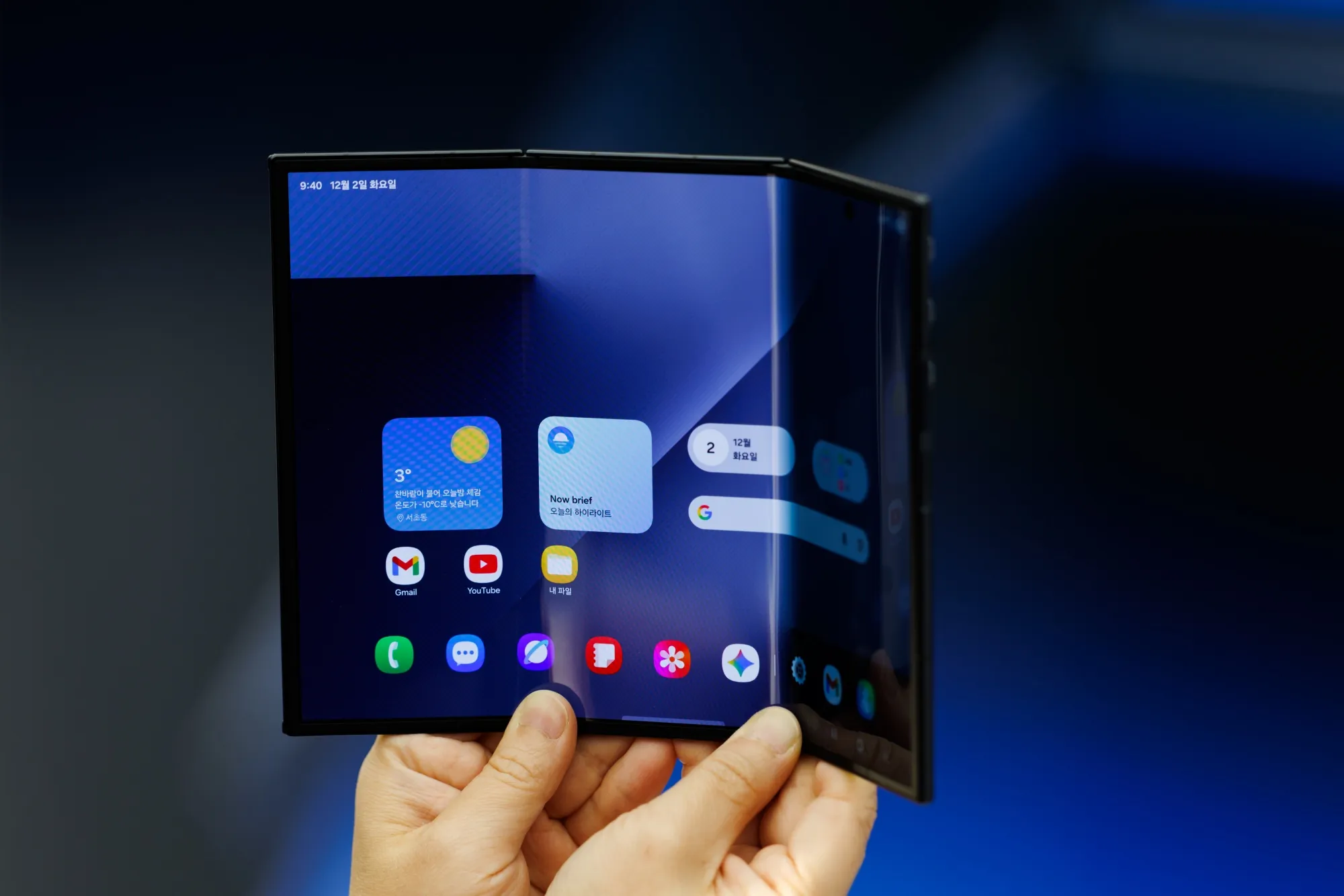
A hands-on demonstration shows the Samsung Galaxy Z TriFold fully expanded, revealing its triple-hinge 10-inch display at the Seoul launch event.
The timing is not accidental. Samsung has dominated the early years of the foldable category, but the landscape has shifted quickly. Chinese manufacturers — including Huawei, Honor and others — have released thinner, lighter foldables that have begun to pressure Samsung’s long-held lead.
According to Liz Lee, Associate Director at Counterpoint Research, the Galaxy Z TriFold is not designed to ship at mass scale. Instead, it acts as a pilot device, allowing Samsung to refine hinge durability, test new UI modes, and observe how different markets respond before committing to wider production.
Lee also notes that Apple’s expected entry into the foldable segment in 2026 has accelerated competitive timelines. Samsung’s approach appears to be: show the engineering capability now, refine aggressively, and set the narrative before Apple stakes its claim.
While few outside Samsung have tested the TriFold extensively, the company spotlighted several features during its media demonstration in Seoul:
Open fully, the device’s 10-inch panel becomes a workspace for multitasking, content editing, and entertainment. The resolution isn’t pushing extremes, but the screen real estate is the real story.
Users can run three apps vertically, side by side — something no current Fold, Flip, or slab-style phone can replicate at this scale.
Samsung demonstrated a DeX-style interface that can be activated without an external display, turning the TriFold into a portable micro-workstation.
Samsung says this is its largest battery ever fitted into a foldable. Super-fast charging reportedly reaches 50% in 30 minutes, though exact wattage numbers were not disclosed.
Samsung has confirmed the following rollout plan:
South Korea: December 12, 2025
China, Taiwan, Singapore, UAE: late December through early January
United States: Q1 2026 (specific date to be announced)
Only one model will ship globally — black, 16GB/512GB — positioning it securely at the premium end of the foldable market.
Counterpoint’s Liz Lee says the TriFold is primarily a real-world testing platform. The objective isn’t high-volume sales — it’s data gathering. Samsung wants to measure:
hinge fatigue over time
user demand for a three-panel workflow
whether consumers treat the device like a primary phone, a tablet replacement, or something in between
This approach mirrors Samsung’s earlier strategy with the first Galaxy Fold in 2019: lead with engineering, learn from early adopters, and refine quickly.
Huawei recently released its second-generation tri-fold model in China, measuring 12.8 mm when folded — roughly in line with Samsung’s thickness. However, due to geopolitical constraints, its international availability remains limited.
Honor, now independent from Huawei, continues to target international markets with competitively priced foldables that challenge Samsung’s designs and dimensions.
Where Samsung maintains an advantage is ecosystem consistency. Despite the new hinge architecture, the TriFold supports Samsung’s existing app optimisations, cloud sync tools, and accessory compatibility.
The Galaxy Z TriFold is clearly not intended for mainstream buyers — at least not yet. Its high price, limited launch volume, and experimental hinge design position it closer to a technology preview than a mass-market flagship.
However, early adopters and productivity-focused users may find it compelling, especially if Samsung delivers on durability. For everyone else, the more polished successors expected in 2026–27 may be the devices worth waiting for.
It’s Samsung’s first triple-hinge foldable smartphone, expanding into a 10-inch display and closing down into a more compact rectangular form.
Samsung says the U.S. release is scheduled for the first quarter of 2026, with full details to come.
Samsung says durability testing is ongoing. The device uses two inward hinges designed for repeated folding, but long-term performance will depend on real-world usage.
The phone launches at ₩3,594,000 (~$2,449) for the 16GB/512GB model.
Samsung’s Galaxy Z TriFold marks a significant moment in the foldable market. While still experimental in many ways, it signals the next phase of smartphone evolution — where portability, screen size and productivity blend into a single adaptive device. With Apple’s expected entry imminent and Chinese brands accelerating their own efforts, 2026 is shaping up to be the most competitive year yet for foldables.
👉 Further Reading: CNBC – Samsung Launches Its First Multi-Folding Smartphone 👈