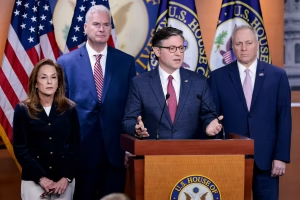
Speaker Johnson urges Republicans to keep internal disputes private
Public disagreements among House Republicans are affecting coordination on legislative scheduling and party strategy.
House Speaker Mike Johnson has called on Republican lawmakers to raise concerns within the conference rather than through public statements or social media, following a recent increase in intra-party criticism. The appeal comes as the House faces a crowded legislative calendar and operates with one of the narrowest majorities in modern congressional history.
The development is significant because visible divisions can limit leadership’s ability to control the floor, negotiate with the Senate, and prepare for policy deadlines. With several competitive districts up for election in 2026 and more retirements than usual for a majority party, internal cohesion has become a central factor in how effectively the House can advance its legislative agenda.
Public disputes challenge leadership’s ability to coordinate
Johnson’s remarks reflect a broader trend in which disagreements that once played out in private conference meetings increasingly emerge in public venues. Such disputes can undermine leadership’s authority under House rules, which rely heavily on majority-party unity for structuring debate and limiting procedural delays. Analysts note that public rifts complicate the whip count process and weaken the party’s negotiating posture across chambers.
Why disputes are surfacing under a narrow majority
The Republican majority holds only a small advantage, making internal cooperation essential for passing party-line legislation. Historically, narrow majorities—as in 2001, 2011, and 2023—experienced heightened internal pressure because just a few defections can block procedural motions. This environment has pushed some lawmakers to use public messaging to influence negotiations, a tactic that becomes more common when committee priorities or regional interests diverge.
Takeaway: A slim majority gives individual members greater leverage, increasing visible friction.
Discharge petitions reemerge as a tool of member frustration
Several recent initiatives have moved forward through discharge petitions, a procedure governed by House Rule XV allowing 218 members to compel a floor vote. While rarely successful, notable past examples include the 2015 petition to revive the Export-Import Bank and earlier bipartisan efforts on campaign finance. Their renewed use signals dissatisfaction with leadership’s gatekeeping role over the floor schedule, especially when bipartisan coalitions form around issues stalled in committee.
Takeaway: The rise in discharge petitions indicates pressure on leadership-controlled processes.
Electoral pressures heighten internal disagreements
Republicans face a challenging 2026 midterm environment shaped by competitive suburban districts, demographic shifts, and several announced retirements. Historically, majority parties entering midterms with numerous open seats—such as in 1994 and 2018—have encountered greater difficulty retaining control. Members concerned about district-level dynamics are increasingly vocal about the need for legislative messaging that supports economic, fiscal, and national security priorities.
Takeaway: Political uncertainty is intensifying member expectations for strategic clarity.
Committee workflow affected by competing priorities
As committees advance unrelated policy initiatives, disagreements over timing and jurisdiction have become more visible. Recent debates over labor policy, appropriations sequencing, and national security authorizations have highlighted how fragmented priorities strain coordination between leadership offices and committee chairs. Under House rules, committees provide the primary venue for drafting legislation, but leadership must still align competing calendars to maintain momentum.
Takeaway: Differing committee priorities increase the difficulty of maintaining a unified legislative strategy.
Questions people are asking
Why is Speaker Johnson asking Republicans to keep disputes private?
Because public disagreements complicate internal vote counting, weaken negotiating leverage, and disrupt leadership’s control of the legislative schedule.
What is a discharge petition?
A House mechanism under Rule XV that allows 218 members to bypass leadership and force a vote on a bill.
How does a narrow majority affect party discipline?
With such slim margins, a small number of dissenting members can halt or reshape legislation, increasing internal leverage and tension.
Are these disputes unusual?
Periods of narrow control—under either party—typically see more public disagreements because individual members have greater influence.
Final public-interest takeaway
Speaker Johnson’s call for private dispute resolution reflects rising concern about the House’s ability to function smoothly under a narrow majority. Public disagreements influence everything from scheduling to committee workflow and bipartisan negotiations. As the 2026 elections approach, the effectiveness of Speaker Johnson in maintaining internal cohesion will help shape legislative output, institutional stability, and the majority party’s strategy for the next Congress.