Understand Your Rights. Solve Your Legal Problems


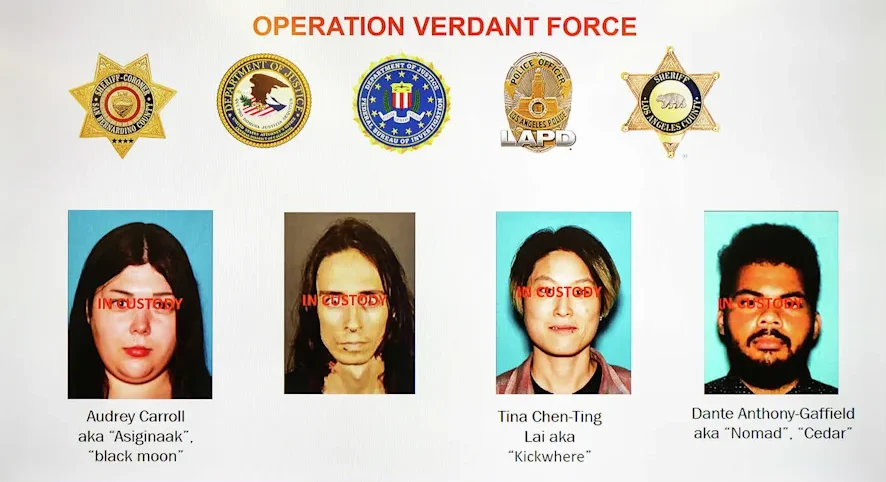
Federal authorities say four Southern California residents were arrested before an alleged plan to use explosive devices on New Year’s Eve could be carried out.
Federal prosecutors announced Friday that four people were arrested in the Mojave Desert after investigators concluded they were preparing improvised explosive devices for coordinated attacks in the Los Angeles metropolitan area on New Year’s Eve.
The arrests followed a multi-agency investigation led by the FBI and involved suspects from Los Angeles, Torrance, and Glendale.
Court documents allege the group intended to target two U.S. companies and later discussed potential attacks on federal immigration officers and vehicles.
The development matters because New Year’s Eve is one of the busiest public-gathering periods in Southern California, placing heightened demands on emergency services and public safety agencies.
Under U.S. law, pipe bombs and similar devices are classified as “destructive devices,” and even incomplete or unregistered devices can trigger serious federal charges.
Officials said the case underscores ongoing domestic extremism risks and the legal threshold at which planning and preparation for violence become prosecutable offenses.
According to a sworn affidavit filed in federal court, the investigation focused on an organization calling itself the Turtle Island Liberation Front, which investigators say promoted anti-government and anti-capitalist views online.
One defendant allegedly circulated an eight-page handwritten plan in late November 2025 describing a coordinated bombing operation intended to begin at midnight on New Year’s Eve.
Prosecutors allege the plan called for backpack-style devices placed at five or more locations associated with two U.S. companies in the greater Los Angeles area.
The document reportedly included instructions for constructing pipe-bomb-type explosives and guidance on avoiding forensic identification.
Investigators say the group later traveled to a remote area of the Mojave Desert, a region spanning parts of San Bernardino County, to assemble and test components.
FBI agents arrested the suspects on December 12 before any fully functional explosive device was completed.
Federal officials said the arrests disrupted what they described as a planned act of domestic terrorism timed for New Year’s Eve, a period marked by large public gatherings.
Attorney General Pamela Bondi said prosecutors and the FBI intervened to prevent violence, emphasizing that the investigation targeted alleged criminal conduct rather than ideology.
FBI Director Kash Patel said investigators observed actions consistent with explosive construction, including the acquisition of materials and discussions about test detonations, and credited encrypted communications monitoring and inter-agency cooperation for the early intervention.
Assistant Attorney General for National Security John A. Eisenberg said the case underscores the legal boundary between holding extreme views and preparing acts of violence.
First Assistant U.S. Attorney Bill Essayli for the Central District of California said coordination between federal and local agencies helped prevent harm in Southern California.
Authorities confirmed no injuries were reported and said there was no ongoing threat following the arrests.
For the public, the case highlights how law enforcement agencies increase surveillance, patrols, and intelligence sharing ahead of major holidays such as New Year’s Eve, when crowd density raises safety risks.
It also reflects how federal law allows intervention at early stages of alleged bomb-making activity, with conspiracy and material acquisition alone sufficient to trigger charges under explosives statutes.
Federal prosecutors have charged the four defendants with conspiracy and possession of an unregistered destructive device, offenses brought under Title 18 of the U.S. Code and the National Firearms Act.
Under federal law, pipe bombs are classified as destructive devices and cannot be legally manufactured or possessed by private individuals.
If convicted, the conspiracy charge carries a statutory maximum sentence of five years in federal prison, while the destructive-device charge carries a potential sentence of up to 10 years.
Any sentence would be determined by a federal judge applying the U.S. Sentencing Guidelines and other statutory factors.
The investigation was led by the FBI’s Joint Terrorism Task Force, a nationwide partnership that includes federal, state, and local law enforcement agencies focused on terrorism-related threats.
The defendants - Audrey Illeene Carroll, 30, of South Los Angeles; Zachary Aaron Page, 32, of Torrance; Dante Gaffield, 24, of South Los Angeles; and Tina Lai, 41, of Glendale were scheduled to make initial appearances Friday afternoon in U.S. District Court in downtown Los Angeles.
Federal court hearings are generally open to the public unless a judge orders otherwise, and case filings can be accessed through the PACER system in accordance with standard court access rules.
The defendants’ initial court appearances will focus on detention decisions and early procedural issues. Prosecutors may ask a federal grand jury to return indictments, a required step for felony charges to move forward.
If indictments are issued, the case would proceed through pretrial motions, possible plea discussions, or trial.
Any sentencing would occur only after a conviction and would be determined by a federal judge.
The case highlights how federal authorities use conspiracy and explosives statutes to intervene before planned attacks can be carried out.
It has direct relevance for communities in Southern California, particularly during major public events that draw large crowds.
The allegations also underscore the legal line between constitutionally protected expression and criminal preparation for violence.
Observers will be watching how the case develops in federal court and whether additional evidence is disclosed through verified filings.
👉 Further Reading: What We Know About the Bondi Beach Shooter 👈