Mitch Winehouse’s Lawsuit Over Amy’s Auctioned Wardrobe Becomes Emotional Battle for Her Legacy in Court
Mitch Winehouse has sued two of Amy Winehouse’s long-time friends, alleging they sold the late singer’s clothing at U.S. auctions without proper authority. The High Court case now focuses on ownership, estate rights and the handling of memorabilia linked to the Grammy-winning artist. A ruling is expected as the trial concludes this week.
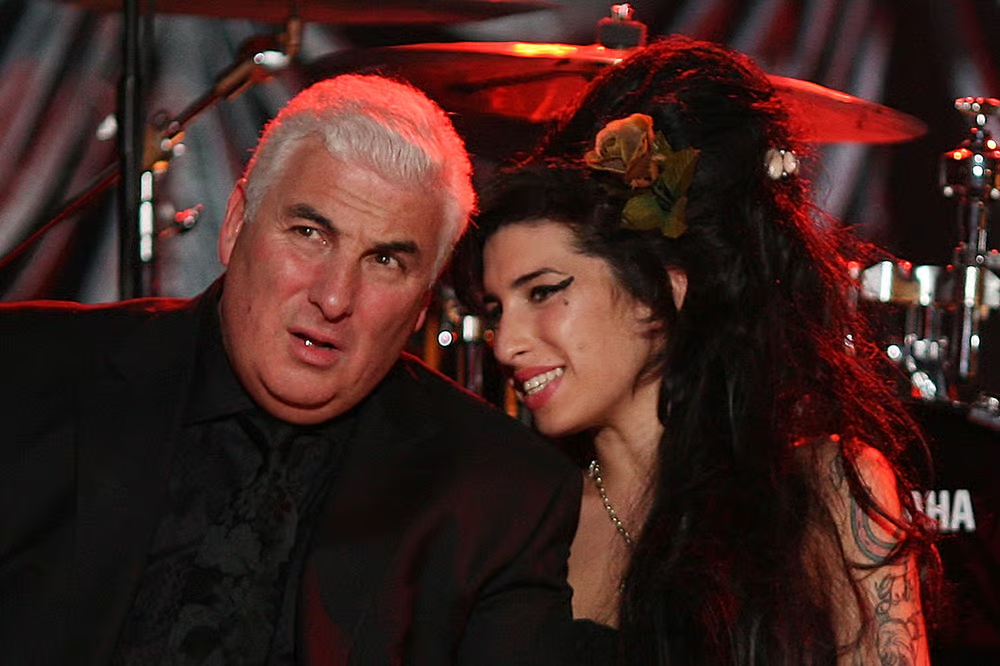
Mitch Winehouse and Amy Winehouse.
Breaking news
The central question driving today’s headlines—why is Mitch Winehouse suing over Amy’s clothing auctions?—was answered directly in the High Court this week, where a deeply personal dispute has transformed into a high-stakes legal confrontation.
Mitch, serving as administrator of his daughter’s estate since her 2011 death, alleges that two of Amy’s close friends, Catriona Gourlay and stylist Naomi Parry, consigned items of the singer’s clothing to U.S. auctions in 2021 and 2023 without proper estate authorisation. The filings describe a conflict that blends grief, legacy protection and the commercial value attached to celebrity artefacts.
The case unfolded in London as lawyers outlined how auction houses, charitable intentions and disputed ownership intersected across several years. At the emotional core is a father attempting to safeguard the physical remnants of a career cut tragically short at age 27, while legally the matter turns on what constitutes a valid lifetime gift. With nearly $1 million in damages sought and closing arguments scheduled by Thursday, the proceedings show how even intimate personal belongings become contested territory once a public figure’s estate enters the legal arena.
What we know so far
Court documents show that auctioneer Darren Julien initially approached Mitch with a proposal to sell Amy’s belongings for charitable benefit, but he declined. According to filings, Parry later revived the idea and introduced Mitch to Julien, eventually leading to a 2021 memorabilia auction billed with charitable intent.
After the sale, Julien’s Auctions informed the estate that a number of items had been consigned under Parry and Gourlay’s names. Both women told the auction house the items were gifts from Amy during her lifetime. A second auction in May 2023 reportedly included additional items linked to the singer, some previously offered in 2021.
Mitch disputes that these belongings were gifted in a legal sense and now seeks more than $975,000 in damages. The High Court confirmed the trial is scheduled to conclude on 11 December.
The legal issue at the centre
This is fundamentally a civil property and estate administration dispute, governed by rules determining who owned personal items at the time of Amy’s death. Under English law, most belongings become part of the estate unless they were transferred through a valid lifetime gift. Courts typically examine three elements:
• Intention — did the owner intend to give the item away permanently?
• Delivery — was the item handed over or placed in the donee’s control?
• Acceptance — did the recipient knowingly accept it?
Celebrity estates often face heightened scrutiny because items can hold substantial market value, and even informal exchanges between friends may later require evidential clarity. Courts in such cases focus only on ownership, documentation and chain of custody—not on personal dynamics between those involved.
Key questions people are asking
Is anyone facing jail time?
No. This is a civil dispute involving financial remedies and property clarification. Civil courts assess rights and obligations, not criminal guilt or punishment.
What determines whether an item belonged to Amy or her friends?
Courts look for proof of a valid lifetime gift. Evidence such as written communication, witness accounts, or consistent possession patterns can support or challenge a claim, but the legal test remains the same in all estate-property cases.
Could the case affect future auctions of Amy Winehouse memorabilia?
Potentially. A ruling that clarifies ownership may require more stringent provenance verification for any future items coming to market.
Why do auctions of celebrity belongings attract legal disputes?
Because emotional significance, financial value and legacy management collide. Without clear documentation, disagreements frequently arise about whether an item was borrowed, gifted or retained as estate property.
What this means for ordinary people
This case highlights a universal estate-law principle: ownership follows evidence, not assumptions. After a person dies, their belongings typically cannot be sold or transferred unless ownership is clearly documented. Items shared casually, loaned or believed to be gifted often generate disputes when an estate is administered.
The Winehouse proceedings also demonstrate how estate administrators must protect assets. Their legal duty includes recovering property believed to be part of the estate and ensuring it is accounted for correctly—especially when charitable purposes are mentioned.
Possible outcomes based on current facts
Best-case procedural scenario
The court issues a clear ruling establishing ownership of the disputed items and orders any necessary restitution or accounting, resolving the matter efficiently.
Worst-case procedural scenario
The court requires extended evidence, further disclosure or valuation assessments, prolonging proceedings and increasing the complexity for all parties.
Most common procedural pathway in similar cases
Civil courts generally provide a declaratory judgment followed by any financial or administrative orders needed. Outcomes typically focus on clarity and estate compliance rather than punitive measures.
Frequently asked questions
Does this case impact Amy’s music rights or royalties?
No. This dispute is limited to physical items. Intellectual property rights, recording agreements and royalties operate separately.
Is the Amy Winehouse Foundation a party to the lawsuit?
No. The Foundation appears in the narrative because early discussions involved potential charitable fundraising, but the legal claim concerns ownership of physical belongings.
Can personal relationships influence the legal decision?
Courts consider relationships only if they help determine whether a valid gift occurred. Otherwise, decisions rest strictly on evidence and property law.
How long could a case like this last?
Civil matters vary widely, but when evidence is well-defined, proceedings may resolve quickly. Appeals or valuation disputes can extend timelines.
Final Takeaway
The lawsuit underscores how even everyday belongings become legally sensitive once an artist’s estate is involved, especially when commercial value and sentimental meaning collide.
As the High Court approaches its final day of hearings, the central issue remains whether disputed items were lifetime gifts or estate property. The ruling is likely to shape not only the future handling of Amy Winehouse memorabilia but also broader conversations about how celebrity legacies are preserved, protected and monetised. Whatever the outcome, the case shows that estate clarity is essential—not only for families, but for the integrity of a public figure’s legacy.
👉👉 Read Next: Boy George Regrets "Not Very Nice" Comment on Liam Payne, Moved by His Father's Actions 👈👈