Judge Susan Worthington Under Scrutiny as Oklahoma Teen Rape Case Ends in Probation
A Stillwater teen convicted of sexual assault and domestic abuse remains on probation, prompting debate over judicial discretion and victims’ rights in Oklahoma.
A Payne County judge has allowed an 18-year-old Stillwater resident convicted of sexual assault, strangulation and domestic abuse involving two high school students to continue serving a probation sentence under Oklahoma’s youthful offender law.
The defendant, Jesse Mack Butler, pleaded no contest earlier this year to multiple felony charges stemming from incidents that occurred when he was 16 and 17.
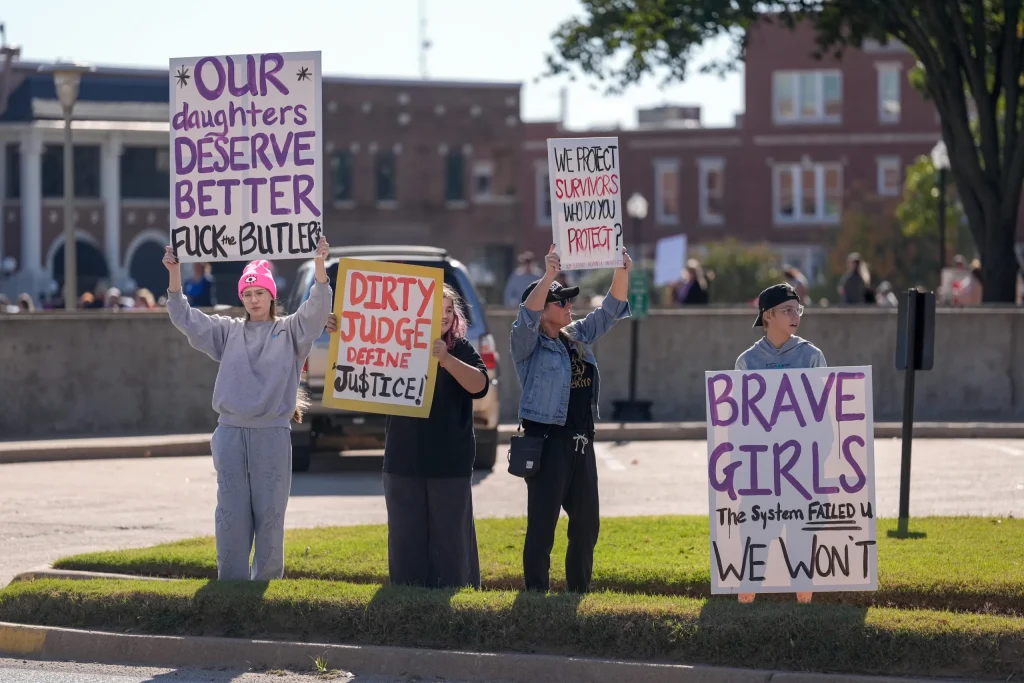
His case returned to court during a scheduled review hearing in Stillwater, where a district judge determined he remained compliant with the strict rehabilitation plan imposed during sentencing. Demonstrators again gathered outside the courthouse as the ruling was announced.
The outcome has renewed public scrutiny of how Oklahoma courts apply the youthful offender statute in cases involving serious violence. Advocates have raised questions about transparency, victim notification and the perception of conflicts of interest, particularly because Judge Susan Worthington, the special judge who granted youthful offender status in July, previously earned two degrees from Oklahoma State University, where the defendant’s father once worked in athletics administration.
The case also interacts with Oklahoma’s constitutional victims’ rights amendment, which requires reasonable efforts to keep victims informed of major developments.
How the Case Reached a Probation Outcome
The investigation began after two Stillwater High School students separately reported sexual and physical abuse by Butler to school authorities in 2024.
Police affidavits detail repeated assaults, forced sexual acts and a strangulation incident that one victim said rendered her unconscious. Investigators later reported finding video on Butler’s phone that aligned with one of the reported attacks.
Both relationships were described as dating relationships that had become coercive and violent.
Prosecutors charged Butler in adult court with multiple felonies, including sexual assault–related offenses, domestic abuse and strangulation.
At the time charges were filed, the potential adult sentence could have resulted in many years of imprisonment.
In July 2025, however, Special Judge Susan Worthington reclassified the case under Oklahoma’s Youthful Offender Act, a law created in the late 1990s to handle serious juvenile cases through a blended system focused on treatment, oversight and a suspended adult sentence.
That change paved the way for the August 25 sentencing, which placed Butler on supervised probation rather than in state custody.
The terms include mandatory weekly counseling, sex-offender–specific treatment, regular reporting to a probation officer and additional behavioural restrictions enforced through the court until he turns 19.
Community and Official Reactions Following the Ruling
Public demonstrations have unfolded repeatedly outside the Payne County Courthouse.
Participants have called attention to the violence described in affidavits and have voiced frustration that such conduct resulted in probation rather than incarceration.
Signs carried at recent protests referenced both Judge Worthington and the court’s handling of the plea agreement.
The Payne County District Attorney’s Office has affirmed that the plea requires strict adherence to treatment and monitoring.
Prosecutors noted that if Butler fails to comply with any part of the rehabilitation plan, the court may revoke youthful offender status and impose a prison term.
Victims’ advocates, however, have said families were not sufficiently informed about the likelihood of a probation-based outcome, raising concerns about how constitutional notification requirements are implemented in practice.
Community members have also questioned whether local institutional connections, involving both the judge and the defendant’s father—contributed to perceptions of leniency, even though no evidence suggests those ties affected the formal legal decision.
Advocates argue that perceived conflicts alone can weaken public confidence in the justice system.
What the Sentencing Decision Means for the Public
For the victims, the defendant’s continued presence in the community may affect their sense of safety and emotional recovery.
For parents and students more broadly, the case has highlighted concerns about reporting processes for sexual and dating violence and about how schools and courts respond when allegations involve teenagers.
The ruling also influences how Stillwater residents perceive fairness in local courts. Cases involving youthful offenders often result in community-based rehabilitation rather than incarceration, but many people are unfamiliar with how the law operates or why judges may choose that path.
Without consistent public understanding, sentencing decisions in violent cases can appear unpredictable or mismatched with expectations.
Statewide, the case contributes to rising public attention on teen dating violence.
Surveys in Oklahoma and nationally have found that a significant share of high school students experience unwanted sexual contact or coercive behavior, yet many do not report incidents because they fear disbelief or social consequences.
High-profile outcomes such as this one may affect willingness to come forward.
Practical Information for Victims and Families
Oklahoma permits victims to sign up for notifications about court hearings, probation reviews and custody changes through statewide alert systems.
Parents and survivors can also review public court dockets for Payne County to track upcoming proceedings and filing updates related to the case.
Confidential support is available through local crisis centers, hotlines and school-based counseling services.
These resources help victims manage safety planning, emotional recovery and any additional steps they may choose to take in the legal system.
Families with questions about victims’ rights can consult county victim-services offices, which assist with guidance, documentation and access to state-funded support programs.
Some residents have expressed interest in raising concerns about youth-justice policy more broadly.
State agencies periodically hold public meetings in which individuals can comment on how sentencing practices, including youthful offender procedures, affect their communities.
What Comes Next for Supervision and Court Oversight
The court will continue holding periodic compliance reviews to monitor Butler’s progress.
These hearings allow the judge to adjust conditions, respond to any reported violations and determine whether the defendant remains on track with his rehabilitation plan.
When Butler turns 19, the court will evaluate whether he has satisfied all requirements or whether additional action is needed.
If probation officers report serious violations, the district attorney may request that the court revoke youthful offender status. In that event, an adult prison sentence could be imposed.
All such decisions must occur in open court and would appear in updated public records.
Public Importance of the Case
This case shows how Oklahoma applies its youthful offender laws when serious sexual assault and domestic abuse involve teenagers on both sides. It has prompted questions about whether the state’s current framework strikes the balance communities expect between rehabilitation and accountability.
Judge Susan Worthington’s decision to reclassify the case has brought added attention to judicial discretion, transparency and how victims’ rights are upheld in practice.
For Stillwater residents and the wider public, the outcome is a reminder that understanding the youthful offender system is key to understanding how sentencing decisions are reached.
The case also reinforces the need for clear communication with victims and stronger support structures for young people navigating sexual and dating violence.