Girlfriend, 'left to freeze to death' in -20C cold on Austrian mountain by her boyfriend heads to Austrian court
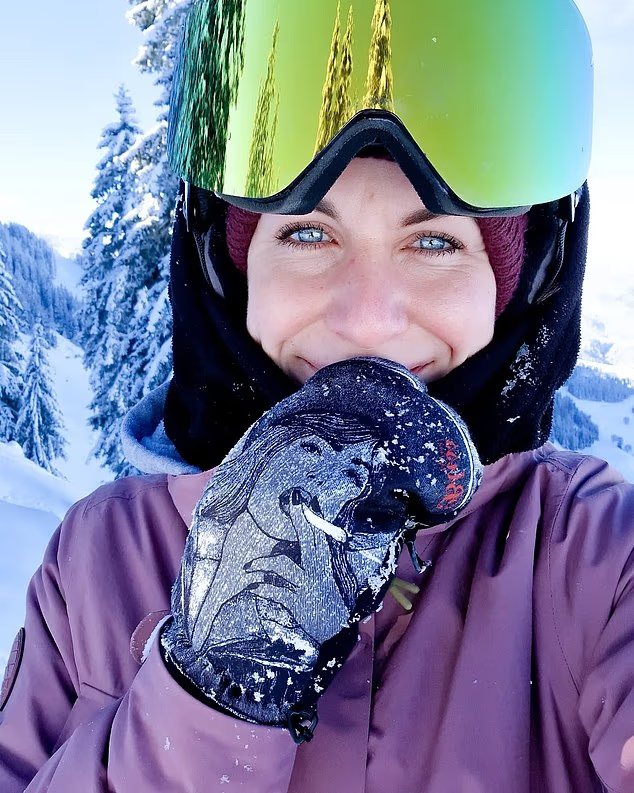
Austrian investigators say 33-year-old Kerstin Gurtner froze to death roughly 150 feet below the 12,460-foot summit of Grossglockner during a January 2024 ascent as wind-chill conditions neared –20C. Her partner, 39-year-old Thomas Plamberger, has been charged with negligent homicide after prosecutors alleged he left her weakened, hypothermic and disoriented in the darkness while he descended alone.
Austrian prosecutors have charged a 36-year-old man with grossly negligent homicide after his 33-year-old girlfriend was left to freeze to death near the summit of Grossglockner, the country’s highest mountain, during a winter ascent in January 2024.
Investigators say the pair were caught high on the 3,798-meter (12,460-foot) peak in strong winds and wind-chill temperatures close to –20C when the woman, identified by local media as Kerstin Gurtner of Salzburg, became unable to continue. She was found dead about 50 meters below the summit cross after rescue teams reached the area the following morning.
Authorities allege her partner, experienced mountaineer Thomas Plamberger, left her in an exposed location while he descended alone to seek help and delayed making an emergency call.
He denies wrongdoing and maintains that the incident was a tragic accident. The charge, filed by the Innsbruck public prosecutor’s office, carries a maximum three-year prison sentence and has drawn national attention to the responsibility experienced climbers bear when leading less-skilled partners into winter alpine terrain.

Her partner, 39-year-old climber Thomas Plamberger, has been charged with negligent homicide after prosecutors said he left her exhausted, hypothermic and disoriented in the dark while descending on his own.
How a girlfriend was left to freeze to death on Grossglockner
According to the indictment, the couple began their ascent on 18 January 2024 via the Stüdlgrat ridge, a route that requires sustained winter mountaineering skills.
Prosecutors say the tour started roughly two hours late, leaving the pair high on the ridge after dark at a time of year when temperatures drop steeply after sunset. By around 2 a.m., investigators allege, Plamberger continued downhill alone and left Gurtner “exhausted, hypothermic and disoriented” just below the summit.
Gurtner was wearing soft snowboard boots for the ascent, which alpine specialists consider insufficient for steep, icy sections at nearly 3,800 meters. Rescue teams reached her late the next morning, but she had already succumbed to the cold. The court will examine whether the decision to leave an inexperienced partner without shelter or emergency gear meets the legal definition of gross negligence.
The allegations focus on a late start, unsuitable equipment and a decision to continue alone despite dangerous conditions.

Webcam footage published by local media shows the headlamps of the two climbers glowing on the slope around 6 p.m. on 18 January.
What investigators say went wrong on the mountain
The Innsbruck prosecutor’s office says its conclusions stem from phone data, sports watch logs, photographs and an alpine-technical assessment.
Investigators report that the climbers continued toward the summit as winds strengthened to around 74 km/h and temperatures fell to roughly –8C, creating a wind-chill near –20C. Authorities argue the pair should have turned back much lower on the route once it became clear the timing and conditions were deteriorating.
Prosecutors also contend that Plamberger carried inadequate emergency equipment, did not move Gurtner to a wind-sheltered position and waited until 3:30 a.m. to call for help.
Alpine police tried repeatedly to contact him by phone, including during a helicopter overflight at around 10:50 p.m., but investigators say his device was on silent and stored away.
The prosecution’s case relies on a reconstructed timeline showing missed chances to withdraw or seek assistance earlier.

Her boyfriend, 39-year-old Thomas Plamberger, is now facing a negligent homicide charge.
How Austrian law treats grossly negligent homicide in the mountains
Austrian criminal law allows for charges of grossly negligent homicide when a person fails to act with the care expected in a dangerous situation and that failure results in a death.
In mountaineering incidents, courts typically evaluate the climbers’ relative experience, the difficulty of the chosen route, prevailing weather forecasts and whether standard emergency measures were available.
When an experienced climber invites a less experienced partner on a demanding winter ascent, courts may treat that individual as the de facto tour leader, even on recreational outings. Previous rulings in avalanche and crevasse cases have emphasized early turnaround decisions, appropriate equipment, awareness of weather bulletins and prompt contact with rescue services.
The legal test is whether Plamberger’s actions deviated significantly from what a reasonably prudent mountaineer would have done in similar conditions.
Safety lessons from Grossglockner and European winter ascents
Grossglockner is a major mountaineering destination with thousands of visitors each year, though winter climbs remain inherently high-risk. The Austrian Alpine Club and regional rescue services regularly warn that late departures, unsuitable winter footwear and reliance on snowboard or splitboard equipment for ascents can increase exposure to sudden weather shifts.
Across the Alps, national rescue agencies have reported rising winter emergencies linked to cold exposure, poor timing and underestimation of terrain difficulty.
Incidents on Mont Blanc and in the Bernese Alps have contributed to updated guidance emphasizing conservative turnaround times, carrying bivouac sacks, packing additional insulating layers and ensuring headlamps and communication devices have spare batteries.
Authorities are renewing calls for stricter preparation and early-day scheduling during winter mountaineering.
How Austrian rescue agencies respond to high-altitude emergencies
High-altitude emergencies in Austria are coordinated by Alpine Police units and mountain rescue teams with support from helicopter crews when weather allows.
Nighttime air rescues are limited by visibility and wind, meaning that delayed distress calls can force rescuers to wait until morning. In this case, strong winds prevented a dawn helicopter landing, requiring teams to approach on foot before locating Gurtner.
Austria collaborates with neighboring alpine nations in cross-border rescue exercises and shares accident data to refine training standards. Lessons from fatal incidents influence public safety campaigns encouraging climbers to prepare for unplanned overnight exposure, regardless of forecast or intended pace.
Takeaway: Rescue capacity is strong but constrained by weather and darkness, making timely emergency calls essential.
What the upcoming trial could mean for climbers and tourism
The Innsbruck Regional Court is scheduled to open the trial on 19 February 2026. A conviction could shape expectations around experience-level management in mixed-ability climbing parties and influence insurance considerations for independent and guided tours. It may also prompt alpine organizations to expand education about gear requirements, winter-specific planning and responsibilities assumed by experienced partners.
Tourism officials monitor such cases closely because winter mountaineering contributes to local economies but also generates safety concerns that affect public messaging. Regardless of the verdict, the case is expected to be used in future awareness campaigns to illustrate the consequences of misjudging weather, equipment and timing on high-altitude routes.
Takeaway: The case may set a reference point for future guidance on winter climbs and shared responsibility in the Alps.
Questions people are asking
1. What happened on Grossglockner in the incident where a girlfriend was left to freeze to death?
Prosecutors say 33-year-old Kerstin Gurtner died during a January 2024 winter ascent after being left in severe cold near the summit, leading to a grossly negligent homicide charge against her partner.
2. Who is the climber facing charges in the Grossglockner death case?
The defendant is 36-year-old Austrian mountaineer Thomas Plamberger, who authorities describe as the more experienced member of the climbing pair.
3. What were the weather and mountain conditions at the time of the Grossglockner incident?
Investigators report winds around 74 km/h, temperatures near –8C and wind-chill values close to –20C during the overnight hours.
4. Why do prosecutors believe negligence occurred on Grossglockner?
They argue that Plamberger continued the ascent late in the day, used inadequate equipment, left his partner exposed near the summit and delayed calling for help despite worsening conditions.
5. What sentence does the Grossglockner homicide charge carry in Austria?
Grossly negligent homicide is punishable by up to three years in prison, though sentencing depends on the court’s assessment of the circumstances.
Takeaway
The Grossglockner case, in which a girlfriend was left to freeze to death during a winter ascent, highlights how decisions about timing, equipment and emergency communication can become matters of criminal liability.
It underscores the responsibilities held by experienced climbers and the limits of rescue operations when calls for help come too late. As the trial proceeds, authorities and alpine organizations are expected to reassess guidance for winter mountaineering. The outcome will shape public understanding of safety obligations and legal accountability on one of Austria’s most visited peaks.