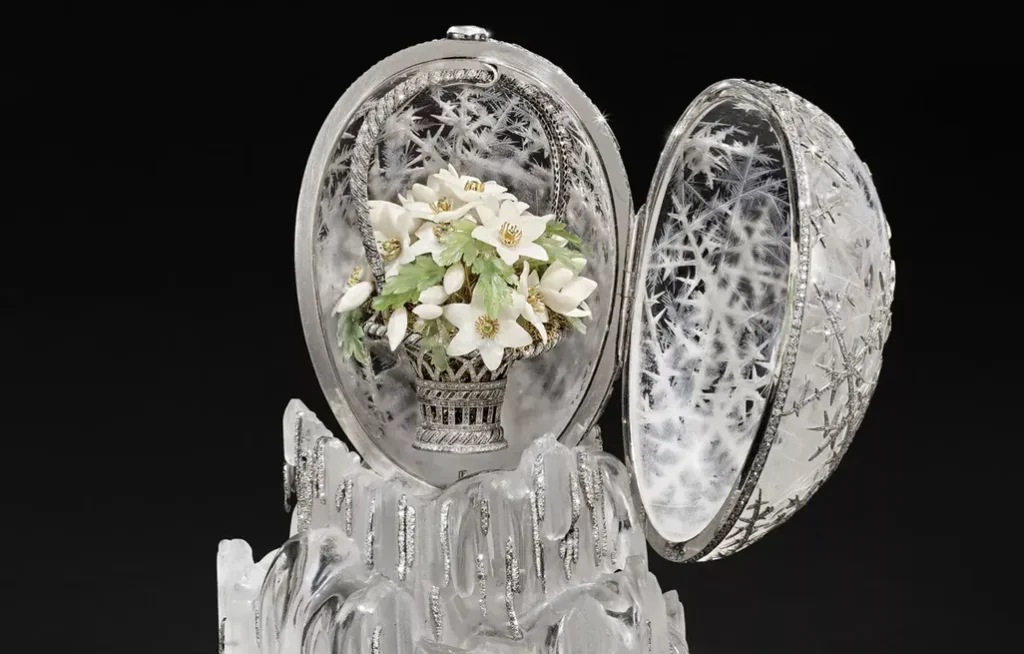
Fabergé Winter Egg sets new £22.9m record at London auction
The sale sets a new high for any work by Fabergé and affects collectors, museums and cultural institutions seeking access to surviving imperial-era artworks.
The Imperial Winter Egg, one of the most technically complex objects produced by the House of Fabergé, reached £22.9 million at a London auction on Tuesday, according to Christie’s.
The piece, created in St Petersburg in 1913 for Tsar Nicholas II as a gift to his mother, Empress Maria Feodorovna, drew international attention because only a small number of imperial eggs remain in private ownership.
The final price represents the highest publicly recorded figure for any Fabergé object and signals continued demand for items linked to the Romanov court.
The sale matters beyond the collecting world. Fabergé eggs rarely surface on the open market, and museums have long argued that private sales limit public access to decorative-arts works of national and historical significance.
The record result also comes at a time when global demand for heritage objects ranging from Renaissance manuscripts to Qing dynasty artworks, has intensified across Europe, the United States and East Asia.
With only seven imperial eggs in private hands, each auction shapes the long-term visibility of the surviving collection.
What we know
Christie’s confirmed that the 8.2-centimetre egg was purchased by an unidentified bidder during its winter decorative-arts sale in London.
Created by Carl Fabergé’s workshop from rock crystal, platinum and approximately 4,500 diamonds, the piece follows Alma Theresia Pihl’s design featuring carved frost patterns and a concealed basket of quartz flowers.
Imperial eggs were produced annually between 1885 and 1917, first for Alexander III and later for Nicholas II. Of the original 50, many are now held by state collections including the Kremlin Armoury Museum in Moscow and the Virginia Museum of Fine Arts in the United States.
The previous auction benchmark for a Fabergé imperial egg was £8.9 million in 2007, meaning Tuesday’s figure more than doubled the standing record.
The sale confirms the Winter Egg as the highest-priced Fabergé object ever auctioned.
Community and official response
Christie’s said the result underscores growing global interest in imperial-era craftsmanship, noting that attendance and remote bidding for Russian decorative arts have risen year-on-year.
International museum curators, speaking broadly in prior public interviews, have consistently described Fabergé eggs as culturally significant because they document court life in the final years of the Romanov dynasty.
Collectors on major art forums responded to the sale by highlighting the rarity of Pihl-designed works and noting that few imperial eggs feature transparent crystal construction.
Several commentators also expressed concern that the object may now be held privately for years.
Audience impact and media context
While Fabergé works are not broadcast assets, high-profile art sales influence public access. When imperial eggs are held privately, exhibitions often depend on voluntary loans, which can be infrequent.
Long-term museum holdings, by contrast, typically allow permanent display and conservation access.
The result also aligns with broader market patterns: art analysts have reported rising competition between U.S., European and Asian buyers for historic luxury objects.
Comparable spikes have occurred in categories such as Impressionist paintings and early Cartier jewellery.
Expert or data insight
Public data from global auction trackers, including Artprice and Artnet, show that Russian imperial decorative arts have increased in value over the past two decades, with Fabergé ranking among the strongest performers.
Industry analyses also indicate that objects with full, documented imperial provenance typically command premiums far above equivalent non-imperial works.
How to watch or listen
Christie’s continues to publish digital catalogues and condition reports for its decorative-arts sales, including rotating 360-degree photography for high-value lots.
Replays of the auction livestream are available on the auction house’s website, and the Winter Egg’s sale entry remains searchable for those reviewing the provenance, materials and bidding history.
Because the buyer’s identity is not public, exhibition availability will depend on whether the new owner chooses to loan the piece to a museum.
Questions people are asking
Why is the Winter Egg considered significant?
The egg represents one of Fabergé’s most technically ambitious designs, combining rock crystal carving, diamond settings and a mechanical opening mechanism. Its 1913 date places it in the final years of imperial Russia, a period that has heightened historical interest.
How many Fabergé imperial eggs still exist?
Fifty were created; most survive, though several are missing and a few surfaced only recently through rediscovery. Many are in museum collections, while only a small number remain in private ownership.
Who designed the Winter Egg?
The design is attributed to Alma Theresia Pihl, one of the few women to serve as a workmaster in Fabergé’s St Petersburg workshop. Her designs are recognised for their refined winter-themed motifs.
How does this price compare to other decorative-arts records?
While the £22.9m figure is high for objets d’art, it remains below the top results for fine art categories. However, it is the highest recorded price for anything produced by the House of Fabergé.
Will the egg go on public display?
There is no confirmed plan. Public access depends on owner loans, which can vary widely between collectors.
The next chapter for the Winter Egg
Christie’s will now complete the formal sale and export steps required for a cultural object of this kind, while the future of the Winter Egg largely depends on the private buyer’s plans for display, loan or resale.
Museums that catalogue surviving imperial Fabergé eggs will update their public records once ownership is confirmed, but the record-setting price also underscores how rarely such works reach audiences outside major exhibitions.
With only a handful of imperial eggs remaining in private hands, institutions face increasing difficulty securing long-term access to pieces that document the final years of the Romanov court.
Attention will now turn to whether the new owner ultimately makes the Winter Egg available for public viewing.
UK - For readers following legal issues: 👉 Has Your Reputation Been Attacked? UK Defamation Law Explained for the Public