Understand Your Rights. Solve Your Legal Problems



DC Studios has released the first official look at Jason Momoa as Lobo, marking his transition into the rebooted DC Universe. The reveal arrives inside the new Supergirl teaser, offering fans a clearer sense of what James Gunn’s reimagined franchise will look like as it heads toward its 2026 slate. Anyone tracking the DCU’s emerging tone will find this reveal especially telling.
The first Supergirl teaser has landed, and it brings more than an introduction to Milly Alcock’s take on Kara Zor-El. It delivers the long-awaited reveal of Jason Momoa as Lobo — a character DC has attempted to bring to the screen for years but struggled to fit into earlier continuities.
With principal photography wrapped in May 2025 and the film now shifting toward post-production, DC is beginning to define the visual language of its rebuilt universe.
The teaser signals a franchise leaning into bold, comic-forward aesthetics while preserving a cinematic groundedness that wider audiences can connect with. For fans accustomed to the tonal swings of past DC eras, Lobo’s live-action design represents an early marker of how different — and how ambitious — the new DCU intends to be.
With the Supergirl teaser now out in the world, audiences get their first real glimpse of Kara Zor-El’s standalone journey — and, just as notably, a full look at Jason Momoa stepping into the DCU as the notorious intergalactic bounty hunter Lobo (see below).
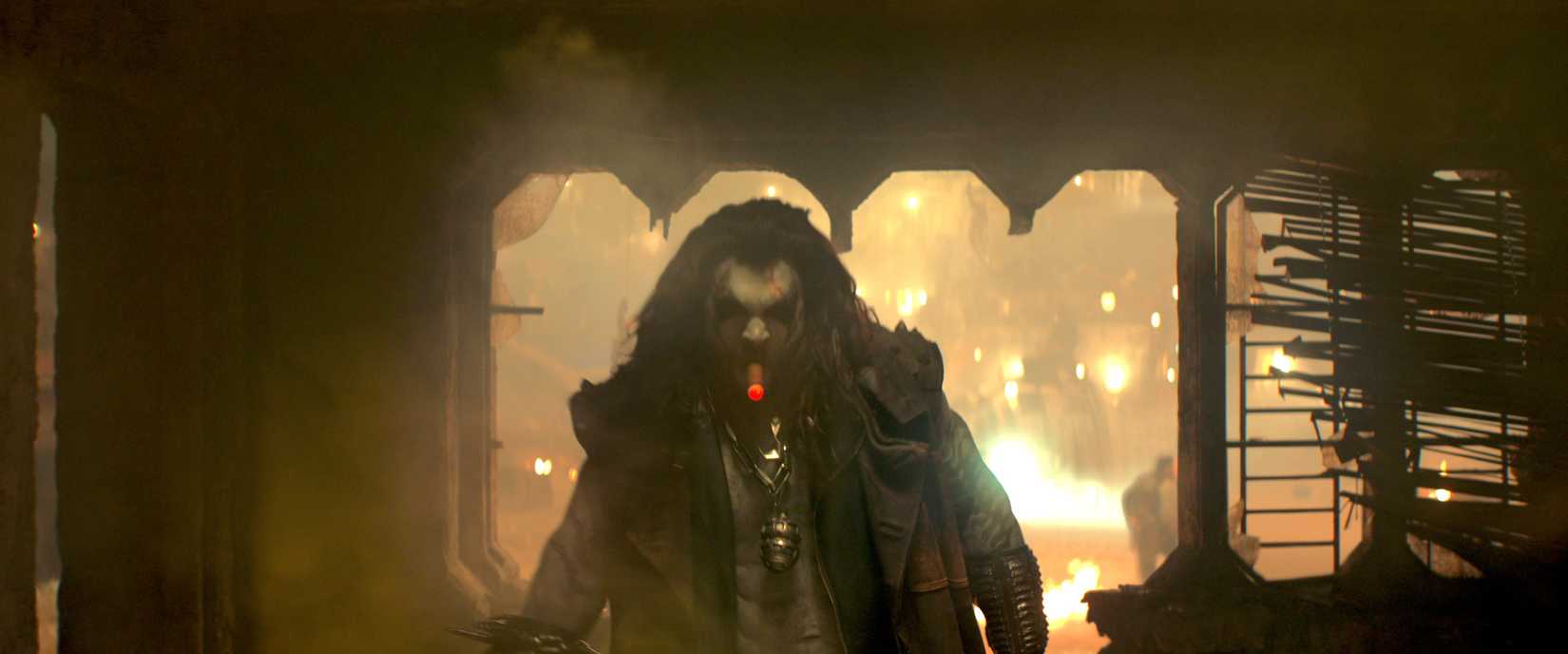
Jason Momoa stepping into the DCU as the notorious intergalactic bounty hunter Lobo.
Lobo’s design, revealed within seconds of the teaser, stays remarkably loyal to the character’s classic comic-book styling. While DC hasn’t issued a formal breakdown of costume details, the look emphasizes the essentials: chalk-white skin, heavy facial markings, oversized leather gear, and a physical presence tailored to the character’s reputation as an intergalactic brawler.
The notable shift here is contextual. This is Momoa’s first role in the new DCU, a clean break from the DCEU’s Aquaman saga, which concluded with Aquaman and the Lost Kingdom. The visual approach suggests DC is using Supergirl as an opportunity to introduce characters who can expand the universe outward — tonally and narratively — from its earliest chapters.
Hollywood’s relationship with shared universes has changed dramatically over the past decade, and studios are now more selective about which characters anchor long-term world-building. Lobo is a case study in these shifting strategies.
After years of early-stage development — with filmmakers like Guy Ritchie, Brad Peyton and Michael Bay circling the character — no adaptation materialised under the old DC regime.
TV attempted a smaller-scale version through Krypton’s second season, but the planned spinoff dissolved when the series was cancelled.
Now, with James Gunn and Peter Safran steering the DCU reboot, the character arrives within a more coherent storytelling blueprint.
Chapter 1, “Gods and Monsters,” leans heavily into cosmic terrain, which naturally opens space for a character defined by excess, irreverence and unpredictable allegiances.
The design reveal therefore serves two functions: it showcases Lobo, and it signals a new willingness at DC Studios to embrace comic-book maximalism without diluting it through overly realistic adaptation filters.
Since the film has not yet premiered, audience experience is limited to what the teaser shows — but even that snapshot offers meaningful clues.
Lobo appears imposing but not dominant, consistent with Momoa’s own comments that he appears briefly and the story remains centered on Kara.
His physicality plays as a visual contrast to Alcock’s more grounded performance style, giving the film room to balance grit, humor and tension.
The costuming also appears designed for clarity: sharp silhouettes, readable textures and colour contrasts that hold up across dim and bright environments.
These choices matter for mainstream audiences who must instantly understand who a character is, even with minimal exposition.
Supergirl is scheduled for release in 2026 as part of the DCU’s early rollout phase. The studio has not announced international release patterns, premium digital timelines or streaming windows. As with other recent Warner Bros. titles, those details will likely be confirmed closer to launch.
The teaser trailer is publicly available across official DC platforms, including YouTube and social channels, with no region-locking noted at this stage.
Because no external analysts or technical leads have commented publicly on the design, the only verified source is Jason Momoa himself.
Speaking to ScreenRant earlier this year, he described Lobo as the role he always hoped to play and emphasized that the look is “pretty dead on” to the comics.
Momoa’s remarks reflect a broader adaptation trend: fidelity is once again becoming a competitive advantage in comic-book franchises. As studios chase audience trust in an era of reboot fatigue, accurate visual translation — rather than reinvention — can function as a signal of creative confidence.
Compared to previous attempts, this Lobo arrives with the benefit of scale and narrative clarity. The Krypton version, played by Emmett J. Scanlan, leaned understandably on television constraints — limited effects budgets, simplified costuming and reduced physicality.
In contrast, the DCU’s Lobo is positioned to operate within a full cosmic framework and a much wider tonal range.
Relative to Marvel’s portfolio, the closest analogues might be characters like Yondu or Cable: abrasive figures who oscillate between antagonist and reluctant ally. But Lobo’s brand of chaotic independence places him in a category few major franchises currently occupy — an advantage if DC chooses to build on it.
From a franchise perspective, Lobo’s introduction signals that the DCU is planning a broader canvas than grounded Earth stories alone. Viewers who enjoy cosmic antiheroes, high-contrast visuals and characters with unpredictable ethics may find this direction compelling.
Those who prefer traditional superhero narratives may see Lobo more as a disruptive flavour than a foundational pillar.
For now, his role is limited in Supergirl, but the reveal suggests the studio is keeping its options open for future expansion.
What role does Lobo play in Supergirl?
DC has not released specific plot details. The teaser confirms he appears briefly, and Momoa has clarified that this is primarily Supergirl’s film, with Lobo contributing a small but notable presence.
Is Jason Momoa officially recast in the new DC Universe?
Yes. Momoa’s DCU debut as Lobo is separate from his past role as Aquaman in the former DCEU continuity.
Will Lobo get his own movie or series?
No standalone project has been announced. While the character has been discussed for film development in prior years, the new DCU has not confirmed future plans.
Is the new Lobo design accurate to the comics?
Based on teaser footage and Momoa’s comments, the live-action interpretation closely matches classic Lobo artwork, maintaining signature elements such as his monochrome skin, facial markings and rugged aesthetic.
Lobo’s reveal in Supergirl represents more than a character debut — it marks an early declaration of how the DCU intends to distinguish itself from its predecessors. The studio is leaning into ambitious, stylised world-building that respects comic origins while building a cinematic identity of its own.
As DC’s 2026 slate approaches, Lobo’s introduction hints at a universe where cosmic characters, bold visual design and tonal experimentation will sit alongside more traditional hero arcs. It’s a sign that the reboot isn’t just a reset — it’s a recalibration with a wider creative horizon.