Understand Your Rights. Solve Your Legal Problems


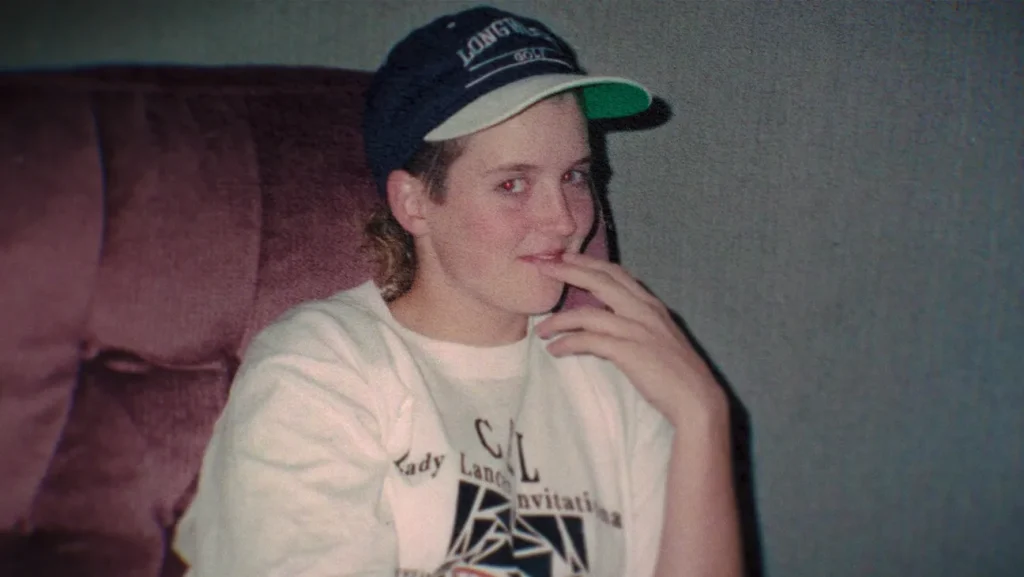
There’s a moment that hits almost everyone who finishes Netflix’s Amy Bradley Is Missing: that unsettling pause when you realise the documentary ended, but the mystery itself never came close to being solved.
Three episodes, dozens of interviews, twenty-seven years of clues — and you’re left with more questions than you started with. Did Amy fall? Was she taken? Was she trafficked off the ship before sunrise? Or — the most sensitive question of all, avoided entirely by Netflix — is it possible she chose to disappear?
It’s a question the series doesn’t even acknowledge, even though the documentary quietly reveals things about Amy that complicate the narrative. She was 23, exploring her identity, including a same-sex relationship she hadn’t discussed widely. She was uncomfortable with parts of her life path. She was struggling with expectations. Yet the documentary lets those details float by without ever connecting them to the larger psychological picture.
What Netflix also avoids, deliberately or not, are the structural failures that shaped the case: the gaps in 1990s maritime law, the lack of enforced missing-person procedures, the contradictory witness timeline, the unregulated security environment, the parents’ desperate reliance on outside help, and the devastating Navy SEAL scam that swallowed hundreds of thousands of dollars and poisoned the early investigation.
What follows isn’t a recap of the documentary; it’s a deeper look at the parts it brushed past — the legal gaps, psychological factors, investigative missteps, and structural failures that shape the case far more powerfully than any single interview or piece of footage ever could.
This isn’t a retelling of the documentary.
It’s the deeper analysis people have been searching for since the day Amy vanished.
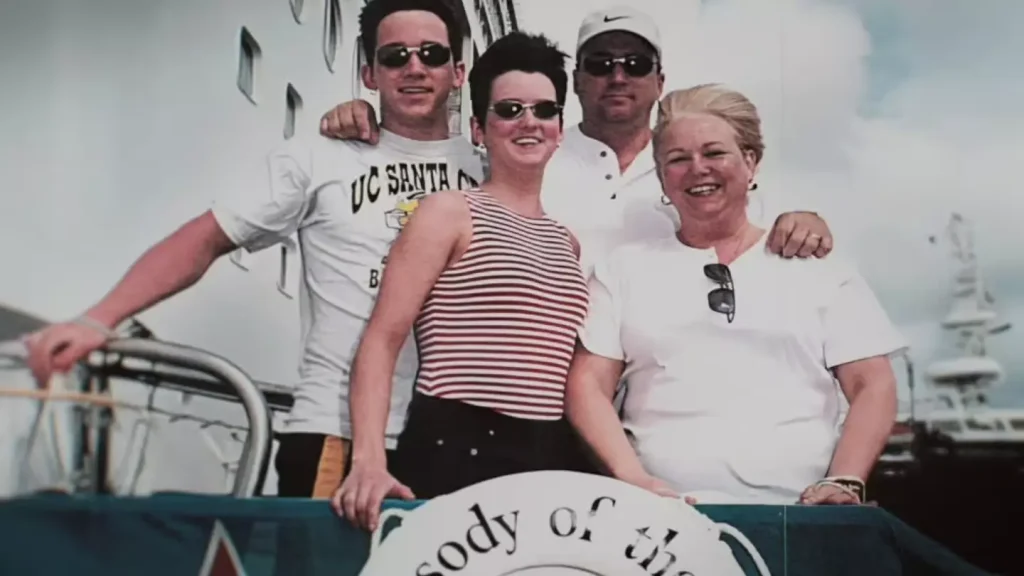
Amy Bradley was 23 when she vanished from a family cruise in 1998 — a disappearance still unresolved nearly three decades later.
Some disappearances fade. This one doesn’t — and it’s not because of the documentary.
It’s because Amy’s story hits a rare combination of emotional relatability and investigative impossibility. She wasn’t hitchhiking across a desert or backpacking through unregulated wilderness. She was on a family vacation, sleeping on a cabin balcony, surrounded by thousands of people, with crew members working around the clock and CCTV cameras pointed at nearly every public space.
And still — she vanished.
To understand why the mystery refuses to settle, you have to look squarely at the pressures that pulled the case off course from the start.
Cruise ships in the late 1990s operated as floating jurisdictions where rules were flexible, accountability was uneven, and missing passengers could be treated as misunderstandings rather than emergencies. Amy stepped into that vacuum at the worst possible time.
Compounding that problem was a witness timeline that bends under scrutiny. The performer known as “Yellow” recalls events differently from his roommate. Crew statements drift over the years. Passengers remember pieces of conversations without context. With almost no CCTV to anchor those recollections, the truth became a moving target before investigators even arrived.
And layered over all of this was an investigation shaped — and sometimes distorted — by forces outside official channels. The FBI’s hands were tied by jurisdiction, the islands had limited resources, and the family was forced into the role of investigator long before they understood how vulnerable that position made them.
The documentary is careful and emotional, but it avoids critical context that completely changes how the case should be understood.
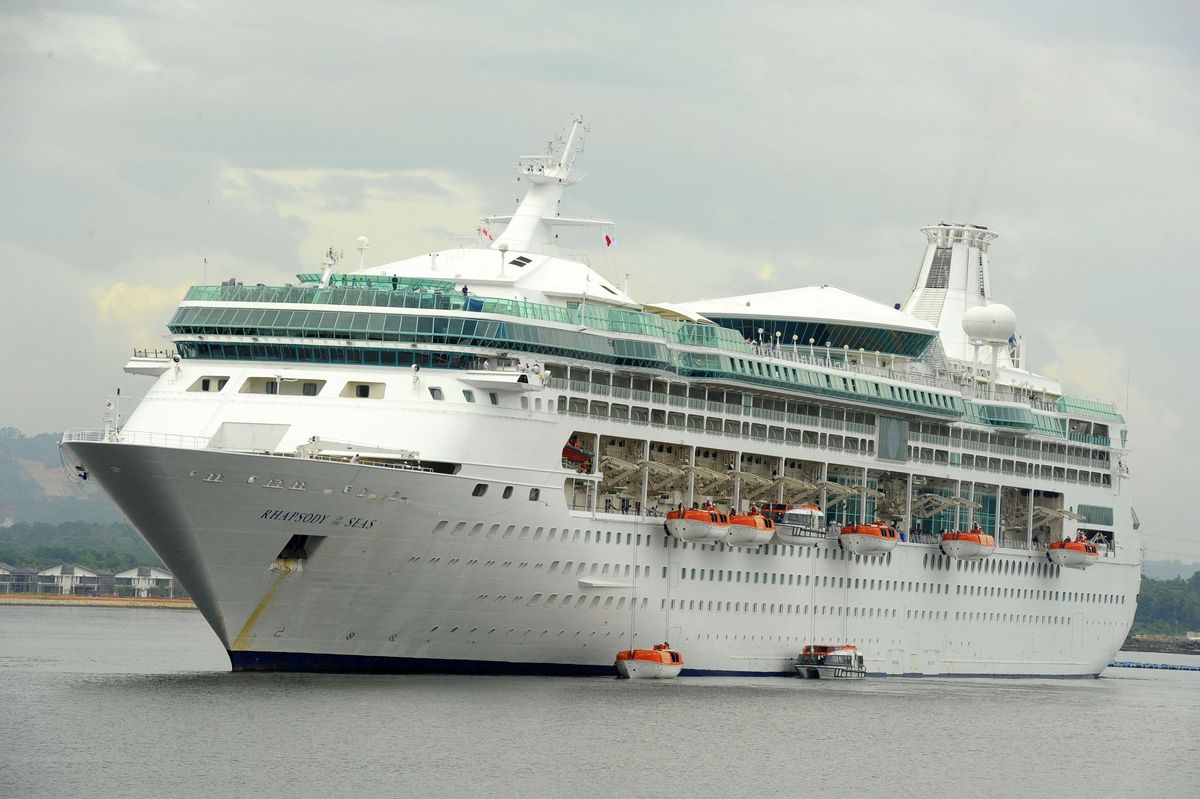
Amy disappeared from the Rhapsody of the Seas, a ship operating under 1990s maritime rules that lacked modern security requirements.
This question frustrates viewers more than any other — and Netflix’s explanation barely scratches the surface.
Back in 1998, cruise ships were under no legal obligation to secure exits, lock gangways, make public announcements, or preserve potential forensic scenes when a passenger was reported missing. There were no standardised protocols. No mandated lockdown. No requirement to alert other passengers or delay disembarkation.
Everything depended entirely on the captain’s discretion.
When the Bradleys begged the crew to keep passengers onboard and issue an announcement, they were told it would “cause panic.” So the ship continued operating as though nothing had happened. People disembarked freely. Crew members walked off. Luggage rolled down conveyor belts. Critical windows for locating a missing person — or preventing the removal of a kidnapped one — closed minute by minute.
If Amy was taken, or if she wandered off the ship in a disoriented or drugged state, that unregulated stretch of time between sunrise and docking was the moment she vanished into a jurisdictional abyss.
Netflix shows the chaos, but it never explains the structural failure behind it — the maritime laws that allowed a missing woman to slip through the cracks without a single mandatory safeguard in place.
Many viewers finish the documentary wondering why Amy’s family didn’t simply remain on Curaçao and search until they found her. The reality is far more complicated than Netflix suggests.
The Bradleys tried — at least in those early days — but the island was not legally, culturally, or practically accessible to a private American family with no jurisdictional authority.
They couldn’t knock on doors or search private property. They couldn’t interrogate crew members or suspected traffickers. They couldn’t walk into businesses, bars, or brothels demanding information. They had no legal right to access ports, marinas, or immigration records, and no ability to compel local authorities to share evidence. Even basic investigative steps — following a lead into a remote area, engaging with criminal networks, or tracing alleged sightings — required permissions they did not have, and would have put them at personal risk.
The FBI, operating under its own constraints, told the family early on that Amy was unlikely to still be on the island. Curaçao’s police were sympathetic but chronically understaffed, and the Bradleys quickly learned that moving through Caribbean jurisdictions without local political backing can close more doors than it opens. Several private investigators warned them explicitly that probing too aggressively into trafficking circles without official protection could escalate danger, not reduce it.
Staying indefinitely on the island would not have expanded their investigative reach. It would have left them isolated, vulnerable, and no closer to accessing the information they needed. The choice wasn’t between staying and “finding Amy,” but between staying and becoming powerless spectators in a foreign jurisdiction.
Netflix presented the emotional weight of the Bradleys’ search — but not the legal and territorial barriers that shaped it. That silence leaves viewers with a question that feels simple, when the truth was anything but.

Curaçao became the centre of the Bradley family’s search, but jurisdictional limits and limited local resources quickly complicated the investigation.
There is one chapter in the Amy Bradley investigation that alters the entire logic of the case, and yet the Netflix series glanced past it so lightly that most viewers never grasp its significance.
Shortly after Amy vanished, the Bradleys were approached by a man named Frank Jones, who presented himself as a former Navy SEAL turned elite private security specialist. He told the family exactly what desperate parents fear and hope in equal measure: that he had a surveillance team on Curaçao, that his operatives had eyes on a compound used by traffickers, and that Amy was alive inside it.
Jones spoke in the language of authority. He described “safe houses,” “extraction windows,” “intercepts,” and “mission timing” with the kind of technical confidence that erases doubt. He sent photos. He forwarded detailed reports, complete with GPS coordinates and sketches of buildings. He claimed his team had seen a young woman with tattoos matching Amy’s. He drew maps, annotated surveillance routes, and promised that a rescue operation was already taking shape — but needed funding to move forward.
The Bradleys wired the money. Then more. Then more.
More than $200,000 of personal savings and nonprofit donations went into this supposed mission. For months, Jones fed the family a perfectly crafted illusion: operatives who didn’t exist, surveillance that never happened, intelligence reports fabricated from scratch. The “compound” he claimed to be watching was simply a house he had seen from a distance. The photos were staged. The entire story was theater.
Jones was eventually charged and convicted of mail fraud. He went to prison. But the true damage wasn’t the financial loss — it was the contamination of the case itself.
His deception didn’t simply mislead the Bradleys; it reinforced the trafficking narrative with false certainty. It created emotional truth without factual grounding. And it pushed investigators, journalists, and even the family into a tunnel where every new detail was interpreted through the lens of a story Jones had manufactured.
Netflix’s decision to gloss over this episode creates a profound distortion. Viewers finish the series assuming that the trafficking theory rests on untainted evidence and consistent witness accounts. In reality, the early investigation was clouded by one of the most manipulative scams ever inflicted on a missing-person case.
Understanding this matters.
Grasping this early contamination isn’t just helpful — it’s essential. It reshapes how every later sighting, rumour, and theory should be interpreted.
To understand what happened to Amy Bradley, you have to understand the legal vacuum she disappeared into.
In 1998, the protections people now assume exist on cruise ships simply didn’t.
There was no Cruise Vessel Security and Safety Act. Cruise lines were not legally required to report serious crimes or missing persons to the FBI. Crew members weren’t subject to independent vetting or background checks. CCTV was patchy at best — often functioning more as a customer-service tool than a forensic one as documented in a Government Accountability Office report on cruise crime, cruise lines routinely underreported incidents…
And when a passenger vanished, cruise corporations typically handled matters internally, sometimes framing disappearances as misunderstandings or intoxication rather than potential crimes.
International law added another layer of instability. Jurisdiction bounced between the ship’s flag state, the corporation’s home country, and the next port of call. That meant no one agency held clear authority in the first critical hours — a structural problem that legal scholars have long described as a “floating corporate jurisdiction,” where schedules and profits routinely outweighed transparency.
It wasn’t until years after Amy vanished — through congressional hearings, lobbying by families of missing passengers, and a wave of similar cases — that the U.S. began reshaping maritime security.
Between 2006 and 2010, her case became part of the public record used to justify reforms: mandatory reporting of disappearances, improved CCTV retention, greater cooperation with federal agencies, and eventually the requirement for independent security officers on U.S.-connected vessels.
Netflix hints at this background, but never explains that Amy’s disappearance occurred before any of these safeguards existed, and that her case directly helped build the laws meant to prevent it from happening again.
Without this context, viewers are left to interpret her fate as an isolated mystery, when in reality she vanished inside a system designed — intentionally or not — to give families like hers almost no power, no clarity, and no meaningful recourse.

Jurisdiction on cruise ships is notoriously fragmented — one reason the first 24 hours of Amy’s disappearance were so chaotic.
Experts in missing-person investigations, maritime law, psychology, and trafficking often evaluate cases like Amy’s through four core questions:
Most data shows adults who voluntarily disappear:
have a history of planning,
leave financial or digital breadcrumbs,
face pressures they want to escape,
or exhibit behaviours in the days or weeks prior.
Amy’s life had normal stresses — identity exploration, relationship uncertainty — but nothing pointing to long-term disappearance planning. Still, the documentary fails to examine this angle at all, despite including a quiet but revealing detail: a former girlfriend describing an hour-long kiss in her car. Netflix adds it, then drops it — even though identity, autonomy, and emotional complexity are common factors in adult disappearances.
Cruise ships in the 1990s were extremely vulnerable:
dark decks
open railings
alcohol
predatory staff interactions
limited CCTV
unregulated staff access to passenger cabins
Amy stood out. She was athletic, outgoing, photographed repeatedly.
Criminologists often say:
Visibility is vulnerability.
Nearly every recollection shifts over time.
That’s normal — but it complicates everything.
The bartender’s account.
Yellow’s account.
His roommate’s account.
The dancer’s account.
The “Señorita kidnapped” bar server account.
Experts highlight that contradictory timelines aren’t a sign of conspiracy — they’re a sign of chaos.
Yes.
Trafficking in port cities happens in hours, not days.
Especially when crew members are involved.
But proof? Still missing.
👉👉 Related: Inside the Search for Amy Bradley How Trafficking Investigations Work When the Victim May Still Be Alive
Netflix should have included more context about long-term adult disappearances. Not because these cases resemble Amy’s exactly, but because they broaden what seems possible.
Long-term disappearances involving adults are rare, but when they do occur, their stories reveal patterns that feel disturbingly relevant to Amy’s case. The following survivors show how a young adult can vanish, remain unseen for years, and re-emerge under circumstances no one could have predicted.
When people talk about the possibility of Amy Bradley surviving past the first critical hours, they often dismiss it as unrealistic. But history has repeatedly shown that adults — especially young women with complicated emotional lives, fractured identities, or sudden trauma — can disappear for years and resurface alive under circumstances no one predicted. And some of those cases involve women very close to Amy’s age.
One of the closest parallels is Colleen Stan, who was twenty years old when she disappeared in 1977. For seven years, she lived under the control of a married couple in California who kept her locked inside a wooden box for most of each day.
Yet she also had periods of relative freedom: she visited her family, she performed chores outside, she interacted with strangers. People who later admitted they had seen her never once recognised that anything was wrong.
Her captivity ended only when her captor’s wife — after years of manipulation — finally helped her escape. Stan’s story matters here because she vanished abruptly, at the same age as Amy, and remained hidden for nearly a decade even though she was repeatedly visible to the public.
Another deeply relevant case is Michelle Knight, who was twenty-one when she went missing in 2002. For eleven years she lived inside the Cleveland home of Ariel Castro, only a few miles from where she was last seen. Neighbours barbecued in the garden while she remained inside. Visitors came and went.
Police responded to unrelated calls next door. No one realised an adult woman was being held captive for more than a decade. Knight later described how trauma, isolation, and psychological domination made resistance feel impossible — even on the rare days when she had the physical opportunity to escape. Her case demonstrates something the public often misunderstands: captivity doesn’t always look like chains and cages. Sometimes it looks like paralysis, fear, and an internalised belief that escape will make things worse.
The third case that echoes the complexities of Amy’s disappearance is Amanda Berry, who vanished the year after Knight.
Berry wasn’t a minor for long — she turned eighteen while in captivity — and her eventual escape at twenty-six remains one of the most studied adult-survival disappearances in modern U.S. criminal history. She was seen by neighbours, heard by visitors, even watched through windows.
Yet no one intervened. When she finally broke free and called 911, she did it during a tiny, unpredictable window when her captor left a door unlocked. Berry later explained that escape was never simply a matter of walking out — it was a matter of surviving long enough to find a moment where risk and opportunity briefly converged.
Taken together, these cases show something essential for evaluating the Bradley case honestly: adults can vanish for years, even decades, and remain alive in circumstances far stranger and more complex than most people imagine. They can be controlled without handcuffs, silenced without prisons, and hidden without ever being locked away.
And critically, these survivors were not found because investigators followed a clean trail of evidence. They were found because of luck, timing, confession, human error, or a single moment of opportunity — the kind that might come once in ten years.
None of these cases prove what happened to Amy Bradley. But they do dismantle the easy assumptions — the ones that say, “She would have escaped,” or “Someone would have seen her,” or “She couldn’t survive this long.”
History shows that adults have disappeared under pressure, under threat, or by choice, and resurfaced only when their circumstances finally shifted enough to let them be seen.
1:00 a.m. — Amy dances with “Yellow” in the ship’s lounge.
~3:30 a.m. — She returns to her cabin. Brad sees her on the balcony.
~5:15 a.m. — Ron believes he sees her asleep on the balcony.
6:00–7:00 a.m. — She is gone. Shoes left behind. No CCTV trace.
7:00–9:00 a.m. — Passengers disembark. No lockdown.
Later that day — Island searches begin, limited in scope and time.
There are only three credible theories.
This remains the most plausible scenario (roughly 55%).
Not because of dramatic witness accounts — many are questionable — but because:
the ship didn’t lock down,
crew interactions with Amy were suspicious,
port cities have documented trafficking corridors,
and the environment allowed for fast removal.
Possible (roughly 25%).
Adults sometimes walk away from their lives.
Amy was exploring her identity and could have been overwhelmed.
But there is no evidence of planning. She left behind money, documents, ID, shoes, jewellery.
Voluntary disappearances almost always involve preparation.
Hers did not.
Still possible (roughly 20%).
But accidents typically leave evidence — clothing, blood smears, items drifting.
None were found.
And strong swimmers rarely fall from balconies without climbing.
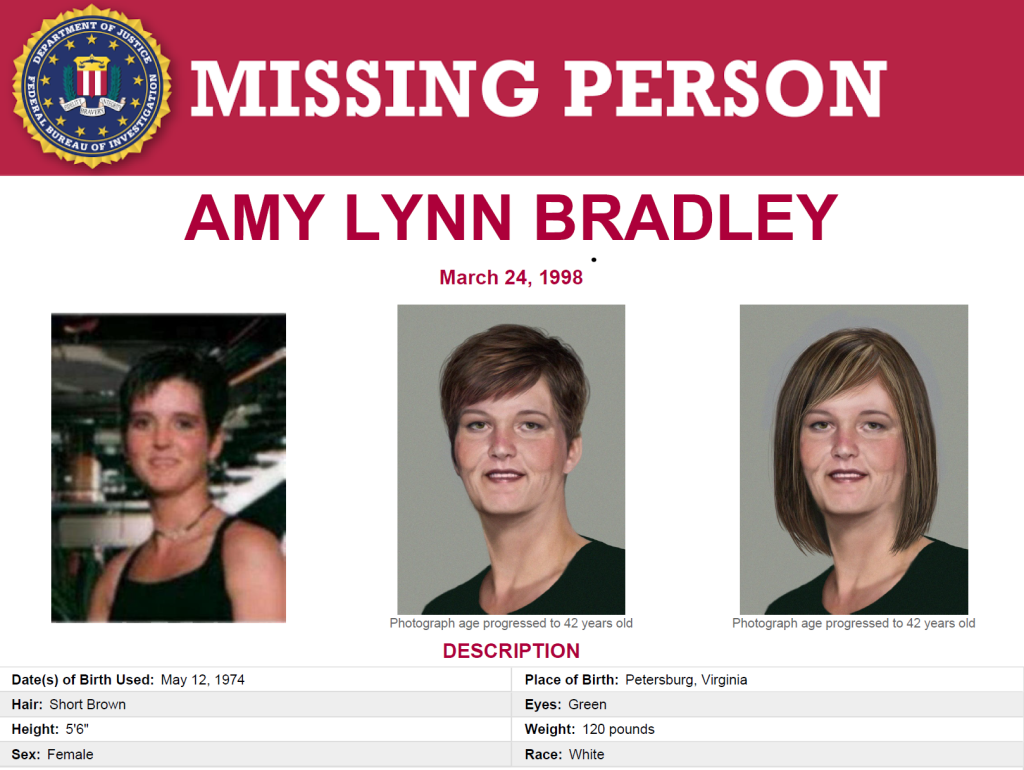
Age-progressed images released by federal investigators keep the search active — even decades later.
The case remains officially open. But open cases often sit in a quiet limbo unless:
a trafficker or associate talks,
someone recognises her from age-progressed images,
DNA intersects with a new database,
or Amy herself accesses a monitored digital space.
The “website activity” angle — where visits spike around family dates — is promising in theory, but difficult in practice. IP addresses traced to Caribbean waters could mean anything: tourists, criminals, traffickers, victims, or random coincidence. Modern OSINT firms could do more, but only with legal backing.
The FBI is still limited by jurisdiction. Private investigators are limited by access. And the Bradleys are limited by time and hope.
The question remains painfully open.
Did investigators ever prove that Amy Bradley was trafficked?
No. Trafficking remains a possible explanation, but no agency — including the FBI — has ever confirmed it. The theory gained traction because of unverified sightings, the Caribbean brothel claim, the staged Navy SEAL scam, and the shipboard witness who said she heard “Señorita kidnapped.” None of this proves trafficking occurred. It simply shows how quickly speculation can fill the gaps left by weak early evidence and unclear jurisdiction.
Why didn’t Amy Bradley try to escape if she was being held?
Survivors of long-term captivity consistently describe a mix of fear, psychological control, shame, and dependency that can feel stronger than physical barriers. Adults like Colleen Stan, Michelle Knight, and Amanda Berry had moments where escape looked possible — yet trauma and coercion made action nearly impossible. If Amy were alive in a controlled environment, the same psychological dynamics could suppress escape far longer than many assume.
If Amy accessed her family’s website, why couldn’t investigators trace the IP address?
They did trace certain hits — including one to a vessel near Barbados — but identifying a specific person behind an IP is rarely straightforward. Boats move between jurisdictions, onboard devices may use shared networks, and VPNs or satellite relays complicate geolocation. Even today, tracing a single website visitor doesn’t automatically reveal identity, motive, or proximity to a missing person.
Why didn’t the FBI or the Bradleys stay in Curaçao longer?
The family had no legal authority to search private property, interrogate suspects, or enter brothels. The FBI’s reach was also limited because the ship flew a foreign flag and the disappearance occurred in international waters. Remaining indefinitely on the island would have created emotional presence, but not investigative power. Without jurisdiction, resources, or institutional backing, staying permanently was not a realistic or effective strategy.
Could Amy have disappeared voluntarily?
It’s possible, and the psychological context matters. College friends have noted she was exploring her identity, navigating a same-sex relationship, and feeling the pressure of major life changes. Some adults do choose to disappear when faced with emotional turmoil, family expectations, or identity conflict. That doesn’t make it the most likely theory — only one that cannot be dismissed simply because it feels uncomfortable.
Why did so many people report seeing her if none were confirmed?
Eyewitness testimony in missing-person cases is notoriously unreliable, especially across languages and cultures. People often genuinely believe they’ve seen someone familiar, even when they haven’t. Confirmation bias, hope, guilt, and media exposure amplify this effect. In Amy’s case, the Navy officer, the brothel photo, and various island sightings all fueled speculation — but none reached evidentiary thresholds that investigators rely on.
Is there any realistic chance Amy Bradley is alive today?
There is no confirmed evidence either way. Historically, some adults have resurfaced after a decade or more. Others remain missing forever. The lack of remains, the unverified sightings, the psychological factors, the maritime failures, and the unique vulnerabilities of cruise-ship disappearances all keep multiple theories open. The most honest answer is that several scenarios remain plausible — and none can be ruled out with certainty.
For readers seeking verified information or wishing to view the Bradley family’s official updates, you can visit Amy’s dedicated missing-person website at: 👉 https://amybradleyismissing.com/
(This site is maintained by her family and provides official case details, images, and contact information.)