Understand Your Rights. Solve Your Legal Problems


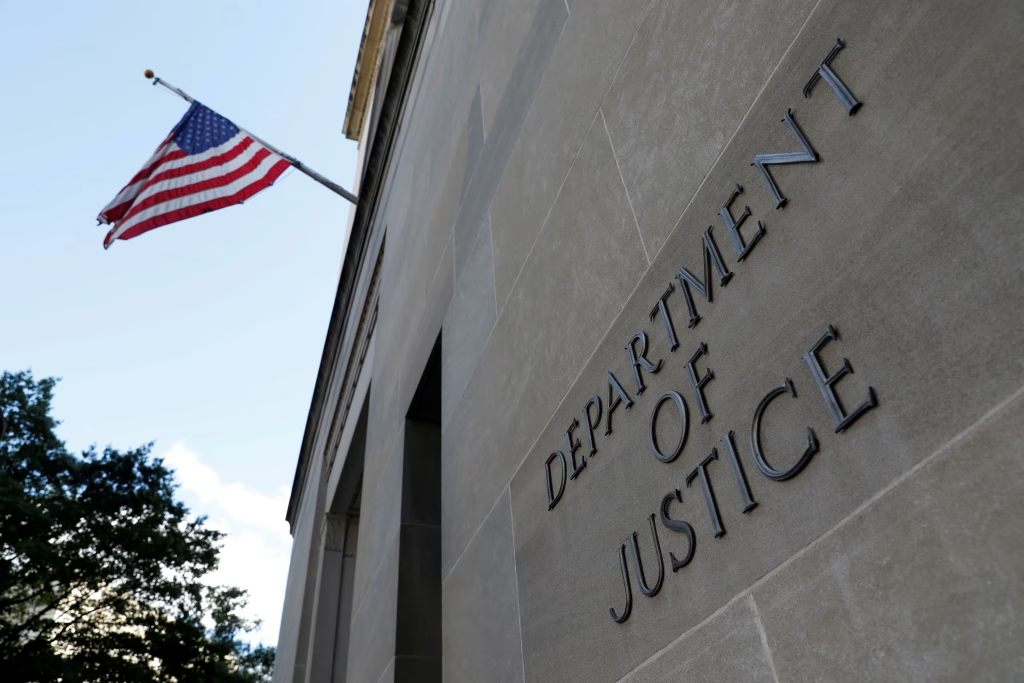
Federal prosecutors say a Fort Worth man who arrived under an Afghan resettlement program is charged after an online video described a bomb and suicide attack plan in Texas.
Federal prosecutors have charged 30-year-old Afghan citizen Mohammad Dawood Alokozay, who lives in Fort Worth, with transmitting a threatening communication after an online video showed him describing plans to build a bomb and carry out a suicide attack.
The video was recorded during a livestream in late November and later circulated on TikTok, X and Facebook.
Texas Department of Public Safety officials alerted the FBI on Nov. 25, and agents used facial recognition to identify Alokozay and arrest him the same day, according to court documents and Justice Department statements.
Authorities say the complaint alleges that Alokozay praised the Taliban, discussed building an explosive device in his car using a yellow cooking-oil container and said he was not afraid of deportation or death.
He entered the United States under Operation Allies Welcome, a federal program that has brought tens of thousands of Afghans to the country since the 2021 withdrawal from Afghanistan.
Prosecutors say the video was captured during a Nov. 23 video call in which Alokozay claimed he would construct “a bomb to explode in the Fort Worth area” and kill those on the call as well as other Americans.
The FBI says at least two other male voices can be heard speaking in Dari, a language widely spoken in Afghanistan, while Alokozay appears seated in a vehicle.
Court filings state that Texas DPS forwarded the video to federal agents on Nov. 25, who then used facial recognition to match the images with Alokozay’s Texas driver’s license, contact his employer in Haslet and arrest him at a gas station that morning.
He is charged in federal court with transmitting a threatening communication in interstate commerce and is also being held on a state terrorism charge in Tarrant County Jail, with a maximum federal penalty of five years in prison if convicted.
The Justice Department said in a public release that the threats described in the complaint required a rapid response from federal and local partners in North Texas.
Attorney General Pamela Bondi criticised the Biden administration’s vetting of Afghan arrivals, saying Alokozay came to the United States under that administration and “explicitly stated that he came here in order to kill American citizens.”
U.S. Attorney Ryan Raybould for the Northern District of Texas praised the work of the FBI, DHS, Texas DPS and Fort Worth police, saying there is “zero tolerance” for threats to kill Americans or others in the region.
FBI Dallas Special Agent in Charge R. Joseph Rothrock said public tips about the video helped the Joint Terrorism Task Force intervene “before he could commit an act of violence,” echoing long-running appeals for the public to report suspicious online content.
For residents in the Dallas–Fort Worth area, the case illustrates how a single livestream can rapidly become a law-enforcement matter when it appears to describe a bomb and suicide attack in a named city.
The investigation shows how threats that cross social platforms are handled: state authorities first flagged the video, and federal agents then pursued both criminal charges and immigration consequences, including an ICE detainer.
Similar online-threat cases in recent years have led to federal prosecutions where no device was actually found, reflecting a policy that focuses on the content of the threat and its potential impact rather than whether a plot was operational.
Texas consistently ranks among the U.S. states with the highest volumes of internet crime complaints reported to the FBI’s Internet Crime Complaint Center, underscoring how digital threats and scams are now a routine part of law-enforcement work in the state.
The FBI’s Internet Crime Complaint Center recorded more than 880,000 internet crime complaints in 2023, including a category for “threats of violence,” which captures online posts that threaten harm or death.
Federal analysts say these cases remain a small share of total reports but have increased alongside wider growth in digital crime, driving more attention to how livestreams and social-media tools are used to issue threats.
DHS’s nationwide “If You See Something, Say Something” campaign, launched in 2010, was created to support this kind of public reporting and has been credited by officials as a contributing factor in the Fort Worth investigation.
Federal court records in United States v. Mohammad Dawood Alokozay are available through PACER, and the Justice Department and FBI have posted official updates online.
Local outlets in North Texas, including KERA, NBC 5 and Fox 4, continue to follow the case and report on hearings, detention decisions and new filings.
Alokozay remains in custody as he awaits his first appearance in federal court in the Northern District of Texas, where a magistrate judge will outline the charges and his rights.
The court will then decide whether he should remain detained pending trial and set a schedule for the next steps, including indictment and arraignment.
State charges in Tarrant County and any immigration actions, including a federal detainer, will continue separately under their own procedures.
Federal investigators say the case began with a viral livestream and a public tip, underscoring how online speech, social platforms and law-enforcement tools intersect when violent threats are alleged.
The case also contributes to ongoing debate over refugee vetting and the balance between resettlement and public safety.
For audiences, the developments to follow include the court’s handling of the federal threat charge, any disclosures about the investigation and how oversight of online platforms or resettlement programs may evolve in response.
👉 How the U.S. immigration freeze could reshape the system 👈