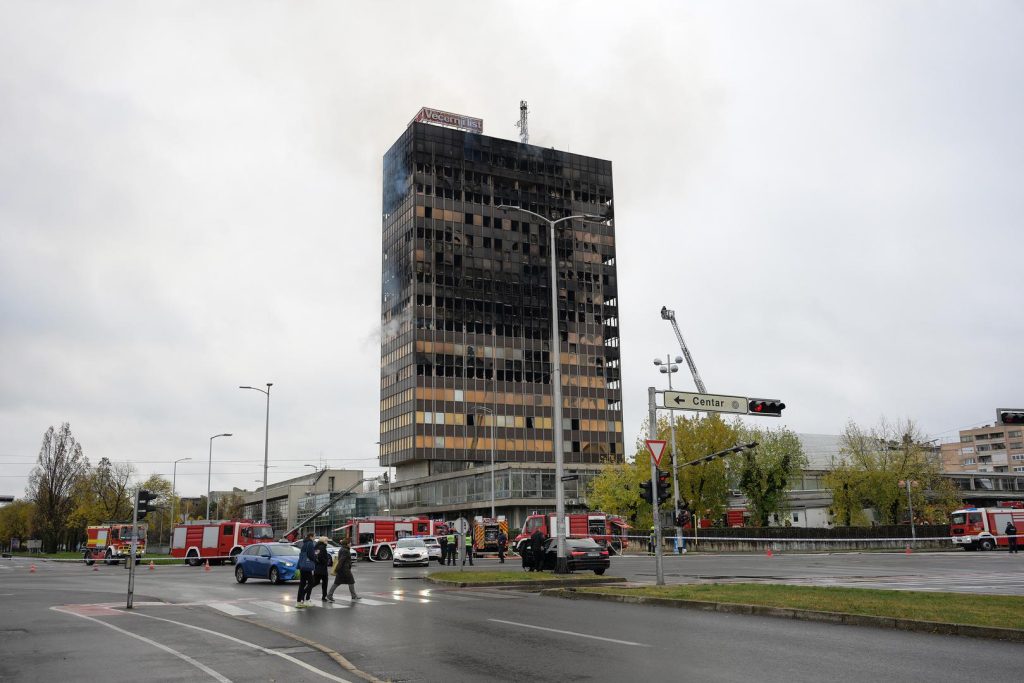
A large fire ripped through the Vjesnik skyscraper on Slavonska Avenue in Zagreb late on 17 November, burning vertically across several floors and reaching the roof of the well-known high-rise.
Although dozens of fire engines and nearly 80 firefighters managed to contain the blaze without casualties, Croatian media confirmed that the affected floors were being used to store parts of the government’s state archive.
Early assessments point to a possible fault in the building’s installations, and while engineers say the structure is not at risk of collapse, major reconstruction—or even demolition—remains on the table.
But beyond the visible damage sits a more complicated question: what happens legally when government archives are threatened, damaged, or destroyed?
Government Archive Storage and Public-Sector Liability
The fire has intensified scrutiny around how public bodies store sensitive or irreplaceable state records.
Government archives—physical or digital—sit at the intersection of administrative law, data protection rules, public-sector safety obligations, and, in some cases, criminal law.
A building fire doesn’t automatically imply negligence, yet it does activate a long list of statutory duties relating to record preservation.
Across most EU jurisdictions, archival law requires public institutions to:
• preserve official records for legally defined periods
• store them in facilities meeting safety, fire-protection, and structural standards
• maintain chain-of-custody documentation
• report any loss or destruction of documents
When those conditions are tested—whether by fire, flood, or building failure—the legal focus shifts to compliance.
Investigators examine not only what was damaged but why the records were stored in that particular facility, what risk assessments were in place, whether installations were maintained, and whether authorities met their statutory archiving duties.
Common Public Misconceptions About Government Archive Loss
Events involving state records tend to generate intense speculation. But several of the most common assumptions don’t align with how archival law actually works:
“All destroyed documents are irreplaceable.”
Most governments rely on dual-retention systems, including digital backups, offsite storage, or microfilm replication.
“Lost archives automatically invalidate criminal or civil cases.”
Courts routinely accept reconstructed files, certified copies, and secondary evidence when originals are lost through no fault of the parties.
“A fire means the government is liable.”
Liability turns on whether the state breached a specific statutory duty—fires from unforeseeable electrical failures, for example, rarely meet that threshold.
“Destroyed archives imply criminal wrongdoing.”
Criminal negligence requires proof of reckless disregard for safety standards. Administrative negligence, while serious, rarely crosses into the criminal sphere.
These misconceptions highlight why legal investigators approach archive damage from a standpoint of compliance and risk management rather than assumption of fault.
How Evidence Preservation Rules Apply Even Without Casualties
The absence of injuries does not lessen the legal complexity when archives are involved. Many state records carry legal weight in ongoing investigations, regulatory actions, or rights-based administrative proceedings.
Records tied to open cases
Investigators must quickly assess whether any criminal, civil, or regulatory matters relied on documents stored in the affected facility. Courts can authorise substitutions or certified reconstructions.
Records relating to administrative rights
Land registries, pension documents, business filings, immigration case files, and social-welfare records often have statutory protections requiring re-issuance or formal certification when originals are lost.
Records with historical or cultural value
Archival law typically obliges governments to attempt maximum reconstruction, using backups, partner institutions, or surviving fragments.
For this reason, the legal consequences of archive damage often extend long beyond the cleanup of the physical site.
Two Parallel Investigations: Technical and Administrative
In incidents involving government archives, authorities usually conduct a dual-track response:
• A technical fire investigation examines the cause, structural damage, and safety risks.
• An administrative review assesses whether archival storage complied with legal standards, safety requirements, and chain-of-custody rules.
If shortcomings are identified, the outcome is more often procedural reform than prosecution.
Criminal liability only arises when investigators find clear evidence of gross negligence or statutory breaches so severe that they meet the threshold for reckless disregard.
The central legal question, now, is whether the state met its obligations to protect the documents entrusted to it—and how the damaged records will be reconstructed or certified to maintain continuity in public administration.
Public Records and Archive Damage FAQ
Are governments legally required to keep backups of archives?
In most European jurisdictions, yes. The form varies—digital replicas, offsite storage, parallel systems—but redundancy is typically mandatory under national archival laws.
Can destroyed documents derail a major court case?
It’s rare. Courts allow certified copies, secondary evidence, and reconstruction procedures when originals were lost through no wrongdoing.
Can a government official face criminal charges over archive loss?
Only if investigators uncover clear evidence of gross negligence or deliberate violation of statutory duties. Most cases result in administrative findings, not criminal prosecutions.
What happens if personal documents were stored in the affected archive?
Citizens can usually request reconstruction or certification of lost records. Administrative law requires processes to restore legal continuity even after major archive damage.