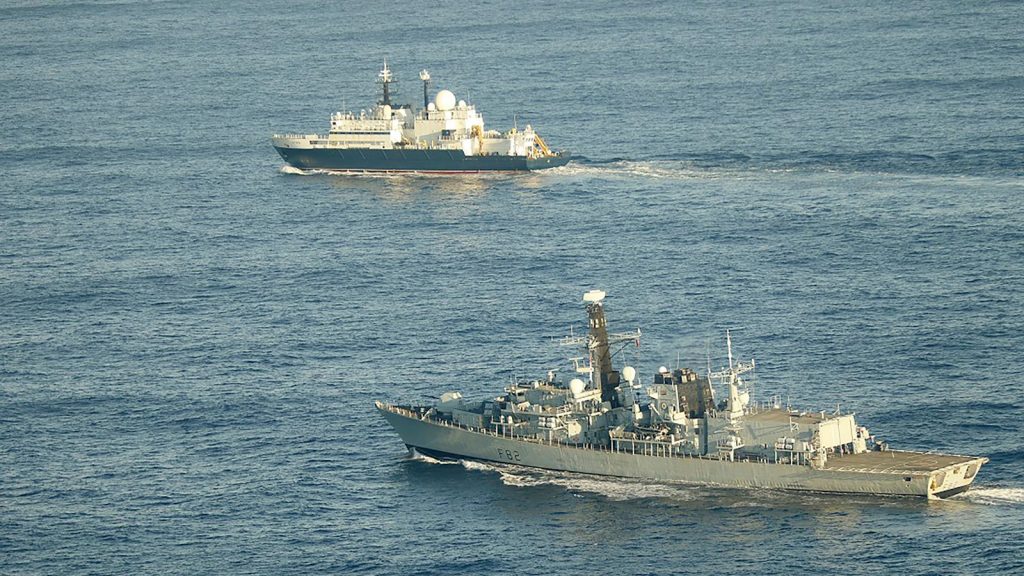
The standoff involving the Russian vessel Yantar—and Britain’s claim that RAF pilots tracking it were hit by lasers—has already made headlines. But the real story isn’t happening in the sky above the ship. It’s happening on the seafloor below it, where the backbone of Britain’s digital, financial and political life quietly rests.
This analysis steps away from the breaking-news flashpoints and examines the deeper question now troubling policymakers across Europe: if a hostile state truly wanted to disrupt Britain’s undersea cables, how vulnerable is the UK—and what would the consequences be?
Why the Real Danger Lies Beneath the Surface — Not in the Lasers
Most readers saw the laser allegation as reckless Russian behaviour. But anyone familiar with the Yantar’s capabilities knows that its presence near Britain is concerning for an entirely different reason. The ship is linked to Russia’s deep-sea intelligence operations, specialising in surveying, mapping, and potentially interacting with submarine infrastructure.
This matters because the UK relies on undersea cables to an extent few people realise. More than 95 percent of all global digital traffic travels through these systems, including financial transactions, cloud data, government communications, and everyday internet use. The UK, sitting at the crossroads of transatlantic communication, depends on a handful of key landing stations and seabed corridors that are far more fragile than the public imagines.
So the real question is not what the crew of the Yantar might be pointing at RAF aircraft—but what they might be doing on the seafloor.
What the Headlines Missed — and Why It Matters
The immediate news reporting skimmed over several deeper issues. It did not explain what would actually happen if several of Britain’s key cables were severed. It didn’t clarify how limited Britain’s rights are in its Exclusive Economic Zone, where foreign vessels can legally operate despite raising serious security concerns. And it didn’t place this incident in the wider European landscape, where the Nord Stream pipeline explosions and a series of unexplained cable failures have already demonstrated how easily seabed infrastructure can be compromised.
In short, the coverage showed the spark, not the powder keg beneath it.
The Hidden Architecture of Risk: Law, Strategy and the Seabed Battlefield
Submarine cables are simultaneously robust and fragile. Globally, the system is resilient: hundreds of cable routes connect continents. But locally, especially around Britain, the picture is different. Many routes converge on a few key landing points, often concentrated on small stretches of coastline. Parliamentary committees have warned for years that a well-planned attack on just a handful of these points could have “catastrophic” consequences for the financial sector.
Complicating matters further is the legal environment. The UN Convention on the Law of the Sea gives Britain full sovereignty only within 12 nautical miles. Beyond that, in the 200-nautical-mile Exclusive Economic Zone, foreign vessels—research ships included—have broad freedoms. Intentionally damaging cables is illegal, but merely surveying them exists in an ambiguous legal grey zone.
Strategically, Europe has already seen what seabed sabotage looks like. The Nord Stream explosions in 2022 proved it could be done without warning and without immediate attribution. Since then, suspicious damage to communication cables in the Baltic Sea and the Red Sea, alongside increased activity by Russian “research” vessels, has pushed seabed security to the top of NATO’s agenda. This led to the creation of a new critical infrastructure coordination centre at Northwood in the UK—an acknowledgement that the seabed has become a contested domain.
What Analysts and Security Specialists Are Really Worried About
Although they rarely agree on every detail, analysts consistently highlight several realities about the threat to submarine cables.
• The system is globally resilient but locally fragile.
Hundreds of cables exist worldwide, but the UK depends heavily on a few physical chokepoints. A determined attacker wouldn’t need to cut many links to cause serious disruption.
• Most cable damage is accidental—making deliberate attacks harder to detect.
Fishing gear and anchors still cause the majority of breakages. A hostile state could exploit this background noise to hide a targeted operation.
• Attribution is the real battlefield.
Even if a cable fails suspiciously, proving that a state actor caused it can take weeks. This delay undermines any immediate political or military response and encourages grey-zone operations.
• Current law is poorly suited to modern deep-sea threats.
Existing treaties were drafted for telegraph cables, not fibre-optic systems crucial to the global economy. Scholars have been pushing for clearer norms and thresholds around cable sabotage.
• Private companies own most of the infrastructure.
Defending it requires cooperation between navies, regulators, telecom operators and major tech firms—an uncomfortable but unavoidable reality for modern states.
Where This Goes From Here — And What Britain Must Prepare For
In the short term, Britain will continue to shadow the Yantar closely. The point is not simply to deter the vessel but to document its behaviour. Public warnings from Downing Street serve as a reminder that London is building a record, establishing patterns, and signalling to both allies and adversaries that it is watching.
But the real shift will be quieter. Cable operators will increase real-time monitoring. The UK will face mounting pressure to invest in its own cable-repair capacity, an area where it still relies heavily on commercial and allied ships. NATO will continue developing joint surveillance and response strategies, especially across the North Atlantic and the Arctic routes that Russia increasingly uses.
The Yantar incident is not an isolated provocation; it’s another sign that Europe’s seabed infrastructure is becoming a strategic fault line. Whether Britain is ready for that reality is still an open question.
What is clear is that the cables beneath the North Atlantic carry far more than data. They carry the economic and political stability of the UK itself. Any actor capable of accessing or sabotaging them holds a kind of leverage that few citizens have ever been encouraged to think about. The danger now exposed is not the ship Britain can see, but the hidden world it is capable of reaching.
Key Questions About the Undersea Cable Threat
1. Could Russia actually knock Britain offline by cutting a few cables?
Not instantly. The UK has redundancy and multiple routes. But targeted attacks on several key cables or landing stations at once could severely disrupt financial markets, slow or degrade internet traffic, and pressure critical services.
2. Would cutting undersea cables count as an act of war?
It depends on scale and intent. Deliberate, strategically significant sabotage could be treated as an armed attack under international law—but only if attribution is clear and the impact is substantial.
3. Who owns the undersea cables around the UK?
Primarily private companies—telecom operators, cloud providers, and consortium partners. Governments rely on these private networks for national and economic security.
4. Can satellites replace cables if they’re cut?
No. Satellites provide only a tiny fraction of international capacity. They can support essential services, but cannot replace the speed and volume required for normal economic and digital activity.
5. What is NATO doing to protect undersea cables?
NATO has enhanced patrols, launched a Critical Undersea Infrastructure initiative, and created a dedicated coordination centre in Northwood. The alliance is also working more closely with private operators to detect and respond to suspicious activity.
6. How does the Yantar incident change UK defence policy?
It accelerates trends already underway: expanded monitoring, strengthened rules of engagement, and political pressure to harden Britain’s undersea infrastructure. The dramatic laser allegation may fade, but the push to secure the seabed will not.