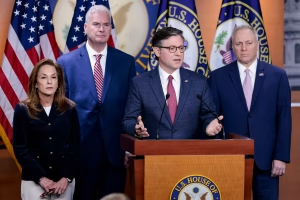
Wisconsin Assembly Speaker Robin Vos has blocked a bill that would extend Medicaid coverage for new mothers to 12 months after childbirth. The move underscores how legislative leadership can determine whether a widely supported health-care expansion ever reaches a vote, highlighting a part of lawmaking that the public rarely sees.
What the Proposed Coverage Extension Actually Does
Extending postpartum Medicaid from 60 days to 12 months is more than a policy preference—it engages a specific federal mechanism. States that choose the longer period do so through either a state plan amendment or another federally approved pathway that creates a continuous 12-month eligibility window after birth.
A continuous period means coverage cannot be cut off mid-year due to minor income fluctuations. This structure is the same across the states that have already adopted the change, and it is rooted in federal requirements designed to avoid abrupt loss of medical access during a medically vulnerable period.
How Legislative Gatekeeping Shapes Outcomes
Even in chambers with bipartisan majorities ready to vote, internal rules often give the Speaker significant control over what reaches the floor. Routing a bill to a slow-moving committee or declining to schedule it is a lawful use of procedural authority, even if the bill has enough support to pass.
This is why similar states can end up with contrasting health-care policies: the mechanics of agenda-setting frequently matter more than ideological divisions. Most residents assume broad backing ensures a vote; the procedural reality is far more dependent on leadership discretion.
The Legal Rights and Obligations Triggered by Postpartum Medicaid
If a state adopts the 12-month period, two legal consequences follow:
Continuous Eligibility
Federal law requires that the full 12 months be treated as uninterrupted coverage once a beneficiary qualifies. The purpose is to stabilize access to treatment for postpartum conditions, many of which appear well after the initial 60-day window.
Full-Scope Benefits
Federal Medicaid rules do not allow pregnancy-specific limits during the extended period. Individuals who qualify receive the same comprehensive benefits package provided to other eligible adults in the state’s Medicaid program. This can include medical, behavioral-health, and chronic-care services when medically necessary under the state plan.
Common Misunderstandings About Postpartum Medicaid
Several persistent public misconceptions cloud discussions surrounding postpartum expansion.
Not an ACA Expansion
The 12-month postpartum option is not tied to Medicaid expansion under the Affordable Care Act. It arises from separate federal authority that lets states treat postpartum beneficiaries as their own eligibility category.
Not Condition-Limited
Postpartum Medicaid is full-scope by federal rule. It does not limit coverage to “pregnancy-related” care during the extension, which is why debates in some states have centered on how broad federal requirements are, not on discretionary state-level choices.
Not a Mid-Year Reapply System
Once qualified at childbirth, an individual is not required to re-prove eligibility throughout the year, which prevents abrupt loss of care during a medically sensitive period.
How States Implement These Extensions
States that choose the full-year period follow a predictable administrative process:
-
Passage of enabling legislation to authorize the extended postpartum category.
-
Submission of a state plan amendment or related document to the Centers for Medicare & Medicaid Services (CMS).
-
CMS review and approval, which typically occurs within standard federal timelines.
-
System adjustments and beneficiary notifications by the state Medicaid agency.
This procedural rhythm is consistent across nearly all states that have implemented the extension.
How Fraud Enforcement Works When Medicaid Expands
Concerns about improper billing sometimes appear in policy discussions, so understanding the enforcement landscape is helpful. Medicaid fraud is governed by federal statutes requiring intentional deception. Investigations focus on provider conduct, billing schemes, or deliberate misrepresentation—not on patients receiving medically necessary services.
Penalties in confirmed cases are determined through statutory frameworks and federal sentencing guidelines, which consider the nature of the conduct and the financial impact. This enforcement structure exists regardless of whether a state adopts postpartum extensions, meaning expansion does not diminish oversight.
What Happens Next
If leadership continues to decline scheduling the bill, it remains inactive under existing chamber rules. Should the bill be placed on the calendar, the process moves quickly: a floor vote, administrative preparation by the Medicaid agency, and standard federal approval. The key legal variable is whether the measure is allowed to proceed to a vote.
Postpartum Medicaid: Key Questions Answered
Is postpartum expansion the same as Medicaid expansion under the ACA?
No. It relies on a different legal framework specific to postpartum eligibility.
Can states limit the extended coverage only to pregnancy-related conditions?
No. Federal rules require full-scope Medicaid benefits during the 12-month postpartum period.
Does income change affect eligibility during the year?
No. The year is a continuous eligibility period once qualified at childbirth.
Who approves the extension at the federal level?
The Centers for Medicare & Medicaid Services (CMS) reviews and approves state plan amendments for postpartum extensions.