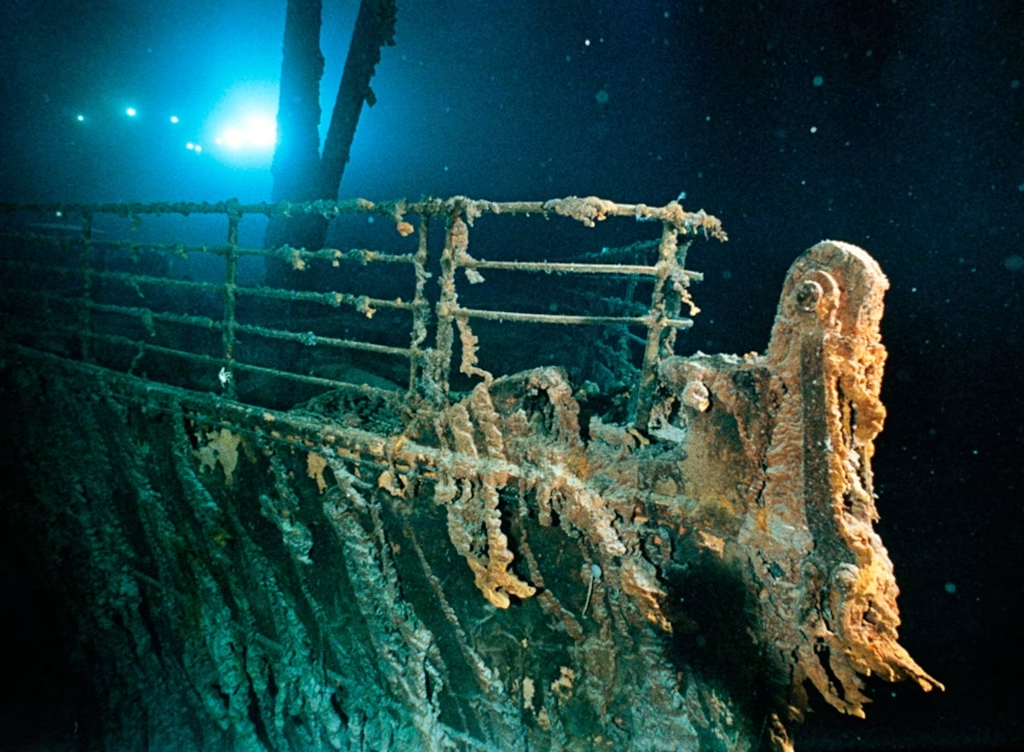
Who Owns the Titanic? The Hidden Legal Rules That Decide Who Can Claim Its Lost Treasures
More than a hundred years after the Titanic vanished into the dark Atlantic, certain objects still have the power to pull the past into the present.
A watch once owned by Isidor Straus recently resurfaced in public memory, its story inevitably bringing to mind his wife Ida and her refusal to abandon him in the ship’s final moments.
Their lives belong to history, yet their possessions sit in a peculiar legal space today—protected, regulated, and sometimes sold. And that raises a question almost everyone asks at some point: who actually owns the Titanic and everything left inside it?
It’s a surprisingly intricate story, built on layers of maritime law, international agreements, court decisions, and long-standing principles about personal property.
Most people imagine shipwrecks as lost places frozen in time. But legally, they remain very much alive. Ownership doesn’t vanish with the vessel. Rights don’t dissolve just because the ocean closes over a hull. And the law treats some items as part of human heritage while treating others exactly the way it treats everyday heirlooms.
Understanding how the Titanic fits into this landscape reveals something far bigger than one ship: it shows how we decide who gets to hold history in their hands.
Why Shipwrecks Don’t Become “Free for All” Finds
When a ship sinks in international waters, it doesn’t automatically become abandoned. The law works the opposite way: ownership stays with the original owner or any corporate successor unless explicitly renounced. That alone surprises many people.
Add a second layer—salvage rights—and the picture becomes even more distinctive. Salvage law is one of the oldest branches of maritime tradition and still guides courts today.
It rewards people who recover property at their own risk, but only with court approval. Salvors don’t instantly own what they recover; instead, they’re granted a narrowly defined right to bring items to the surface and receive compensation or limited ownership based on judicial oversight.
The Titanic brings all of this into sharper focus because:
-
The wreck is in international waters, beyond national jurisdiction.
-
It has historical and cultural significance, which invites global scrutiny.
-
It has been declared an international maritime memorial, adding ethical weight to legal processes.
This combination creates a legal environment unlike almost any other wreck.
The Court Battles That Defined Titanic Salvage Law
The modern legal framework around the Titanic comes largely from cases heard in the U.S. District Court for the Eastern District of Virginia. Beginning in the 1990s, the court evaluated claims from RMS Titanic, Inc., the company that conducted many of the deep-sea recovery missions.
Through long, highly technical proceedings, the court crafted a precedent with three main pillars:
1. Exclusive salvage rights
The court ruled that RMS Titanic, Inc. had demonstrated sufficient skill, expense, and intention to preserve the wreck to earn exclusive salvage rights. That meant no other company could legally remove items without violating those rights.
2. No transfer of ownership of the ship itself
The company had permission to recover artifacts, but the Titanic as a whole remained owned by the successor to the White Star Line. This separation between “salvage rights” and “ownership rights” became one of the signature features of the case.
3. Strict conservation responsibilities
The court required:
-
meticulous documentation
-
professional conservation
-
long-term preservation
-
no breaking up of collections without permission
These were not suggestions—they were binding conditions written into court orders. The goal was to balance scientific exploration with ethical stewardship.
Through these decisions, the Titanic became one of the most legally supervised wrecks in history.
Why UNESCO Doesn’t Fully Control the Titanic
Many assume that the Titanic now falls under UNESCO’s underwater heritage protections. The reality is complicated.
UNESCO’s 2001 Convention on the Protection of Underwater Cultural Heritage only applies when:
-
the wreck is at least 100 years old
-
it lies in international waters
-
and the involved nations are signatories
The Titanic became eligible in 2012. But at that point, major stakeholders—including the United States—had not ratified the Convention. Years later, cooperative agreements between the U.S. and U.K. added layers of protection, but they didn’t retroactively rewrite ownership or salvage rights already recognized by the courts.
That means artifacts recovered years earlier aren’t suddenly governed by modern UNESCO standards.
This legal timeline explains why certain items can appear in private collections: the rules at the time of recovery matter just as much as the rules in place now.
When a Titanic Artifact Becomes Personal Property
Not all items recovered from the Titanic follow the same legal route. The law treats some items—especially personal belongings of passengers—differently from structural pieces of the ship.
An artifact can become personal property when:
-
a court confirms the salvor has lawful possession
-
the item is returned to a victim’s family as part of an estate
-
legal ownership is documented through probate or transfer
-
the object is not subject to a court order requiring museum retention
This is how certain heirlooms, including items once belonging to families like the Strauses, became private property long before auction houses ever entered the picture.
Once an item becomes part of a family’s estate, it’s governed by ordinary legal rules—inheritance, taxation, and eventual sale—just like any other personal asset.
The Ethics Debate: Who Should Safeguard History?
Legally, the framework is clear. Ethically, it’s anything but.
Many view the Titanic as a gravesite. Others see it as an archaeological site. Some believe it should be left untouched forever. And others argue that carefully recovering objects prevents them from decaying beyond repair.
Courts rarely address these emotional questions directly. They focus on rights, responsibilities, and practical considerations like conservation standards. Yet the ethical debate shapes public opinion, influences policymakers, and sometimes reshapes how courts view future cases.
A few of the questions that often surface:
-
Should any items linked to human loss ever be sold?
-
Is private stewardship acceptable when museums cannot preserve everything?
-
Does recovering objects dishonor the dead, or keep their stories alive?
These aren’t questions the law answers easily. They’re questions society continues to wrestle with.
Why the Titanic’s Legal Story Affects Many Other Shipwrecks
Although the Titanic is uniquely famous, the principles that govern it apply to countless other wrecks:
-
sunken wartime vessels
-
lost merchant ships
-
ancient trading boats
-
passenger liners lost in storms or fires
Each case forces courts to consider ownership, abandonment, inheritance, cultural value, and the obligations of salvors. The Titanic simply makes these legal mechanisms visible to the general public, partly because its story blends tragedy, history, and romance in a way few other disasters do.
And that visibility leads to recurring search questions such as:
“Is it legal to own something from the Titanic?”
or
“How do courts decide who can recover items from a shipwreck?”
The answers lie in the same legal principles that have guided maritime law for centuries.
Frequently Asked Questions About Titanic Ownership and Shipwreck Law
1. Is it legal to own an item recovered from the Titanic?
Yes—if the item was lawfully recovered and transferred under court-approved conditions. Personal belongings returned to families decades ago, for example, can legally be inherited or sold.
2. Who owns the Titanic wreck itself?
The Titanic remains owned by the successor to the original White Star Line. No country owns the wreck because it lies in international waters, though the U.S. and U.K. now enforce protective agreements.
3. Can anyone dive to the Titanic?
Physical access is heavily regulated. Modern dives require compliance with international agreements and may require permits or cooperation with agencies overseeing the site’s protection.
4. Why aren’t all Titanic artifacts placed in museums?
Some items became private property long before heritage protections existed. Museums often lack the funding to acquire or conserve every artifact, which allows private collectors to participate in preservation.
5. Do families still have rights over items recovered from victims?
If an object was returned to a family and became part of their estate, it is treated like any inherited possession. Descendants may keep it, loan it, or sell it according to ordinary property law.