Understand Your Rights. Solve Your Legal Problems


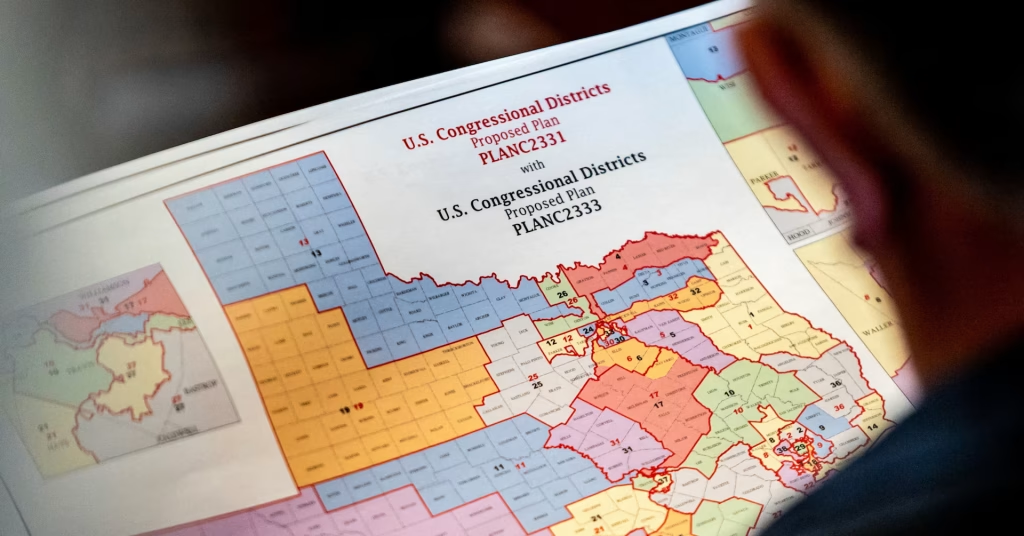
Texas’ mid-decade redistricting plan—pushed aggressively by Republicans and backed by former President Donald Trump—has been thrown into chaos after a panel of federal judges ruled the new congressional maps cannot be used. The decision forces Texas back to its previous district lines and leaves millions of voters wondering what map will govern the high-stakes 2026 elections.
The ruling is one of the most consequential legal setbacks Texas Republicans have faced in years. Judges concluded that lawmakers attempted an extraordinary and unconstitutional power play by redrawing maps mid-decade to secure up to five additional GOP-held U.S. House seats. Now the state is scrambling to determine whether it can salvage the plan before ballots are printed.
The outcome? Millions of Texans may have to vote in the same districts they used in 2022—even though the Legislature already passed and the governor already signed a map designed to transform the political landscape.
The federal panel’s ruling centers on two core findings: (1) Texas attempted an unlawful mid-decade redistricting, and (2) the new maps likely violated the Voting Rights Act by diluting the political power of Black and Latino voters.
Under federal law, states may not redraw congressional districts mid-decade solely for partisan advantage. Courts found Texas’ plan—engineered to secure up to five additional GOP seats—was an unconstitutional attempt to “entrench political power.”
Civil rights groups also argued the maps fractured minority communities in fast-growing regions, weakening their ability to elect candidates of choice. The judges agreed there were substantial signs of racial vote dilution, a violation of Section 2 of the Voting Rights Act.
Because the 2026 election calendar is already underway, the panel issued a preliminary injunction preventing Texas from using the new maps. Until an appeal is resolved, the state must revert to its previously approved district lines.
Bottom line: the court ruled that Texas’ new maps cannot be used because the Legislature’s mid-decade redraw was both procedurally improper and potentially discriminatory under federal law.
This fall, Texas lawmakers executed a rare mid-decade redrawing of congressional districts. It was a fast-moving political maneuver encouraged by Trump and embraced by state Republican leadership, including Gov. Greg Abbott and Attorney General Ken Paxton.
But in November, a three-judge federal panel halted the map, ruling that Texas could not enforce it in the 2026 elections.
The court’s order immediately reshaped the political calculus for both parties — and thrust Texas into yet another redistricting battle with national implications.
Attorney General Ken Paxton has vowed to appeal, but it remains unclear if the state realistically has time to rescue the rejected maps before candidate filing deadlines.
Multiple lawsuits were filed by groups representing Black and Latino voters who argued the redrawn districts diluted minority voting power and violated the Voting Rights Act.
Plaintiffs pointed to districts where fast-growing minority communities were carved apart, merged with distant suburbs, or shifted into majority-white districts in ways that dramatically changed their political influence.
The courts appeared to agree, issuing a ruling that blocked the maps before they could take effect.
If the ruling stands, the “new” mid-decade districts will not be used. Instead:
Voters will revert to the previously existing congressional maps
Candidates may have to adjust campaign plans abruptly
Some communities will escape dramatic changes that would have reshaped who represents them
The Texas Secretary of State has not yet provided updated district lookup tools, leaving many voters unsure which district they fall into for now.
Republican strategists who had counted on five new safe seats are now recalculating their 2026 roadmap. Losing those seats drastically alters GOP expectations for their national majority.
Democrats, meanwhile, see the ruling as a vindication of long-standing claims that Texas lawmakers repeatedly used the redistricting process to disadvantage communities of color. One senior Democratic strategist, reacting to the ruling publicly, called it “the most significant redistricting decision in Texas in nearly a decade.”
Local campaigns across the state are now in limbo. Several GOP challengers had launched campaigns specifically designed for the redrawn districts—districts that may no longer exist by the time the primaries begin.
Political consultants on both sides say the uncertainty could reshape fundraising, endorsements, and turnout operations.
One strategist summed it up bluntly:
“This ruling blew up everyone’s 2026 map overnight.”
The state has vowed to challenge the ruling, but mid-decade redistricting challenges often stall in the courts long enough to push disputed maps into the next decade.
If Paxton cannot win a fast-track appeal, voters will remain under the court-approved preexisting lines through at least the 2026 cycle.
The next major update will likely come when the court releases its full legal reasoning and timeline for potential appeals.
For now, every Texan’s question is the same: What map will I be voting in next year?