Understand Your Rights. Solve Your Legal Problems



The cause of death for Akira Stein, 19, has been officially confirmed by the U.S. Drug Enforcement Administration (DEA). According to authorities, she died from a fentanyl-laced pill overdose at her family’s Manhattan apartment in May 2023.
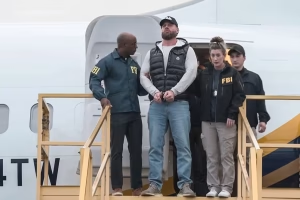
Her father, Chris Stein, the co-founder and guitarist of the iconic band Blondie, broke his silence after five people were arrested and charged with distributing the counterfeit pills that led to her death. The arrests, announced on October 30, 2025, were part of a broader DEA investigation into a New York drug network responsible for three teen fatalities — including Akira and Leandro De Niro Rodriguez, the grandson of actor Robert De Niro.

That same day, Stein, 75, posted a photo of his daughter to Instagram and thanked the DEA, NYPD, and U.S. Attorney’s Office for their work, calling their efforts “very sympathetic and respectful.”
“Arrests have been made and announced today in Akira’s case,” Stein wrote. “The DEA, U.S. Attorney folks from the NYC Southern District, and NYPD have been very sympathetic and respectful through this process. I can’t thank them enough for this hope of some justice for her. Please be careful.”
Akira, the younger daughter of Stein and actress Barbara Sicuranza, had long been described as creative and warm-hearted. Her older sister Vali, now 20, continues to live in New York. In a July 2023 Facebook post, Stein revealed that Akira had “been struggling for a few years and addiction took her.”
“She was wonderful and a bright place in the world,” he wrote. “Barbara, Vali and I are moving ahead but there’s a huge piece missing from our lives. Just remember her and be kind to each other — and you young people please avoid this trap.”
According to the federal indictment unsealed in Manhattan, the defendants allegedly ran a fentanyl pill distribution network that used social media and encrypted messaging apps to sell to teenagers across New York City.
Authorities said Akira purchased pills from two of the defendants during the six months before her death and suffered multiple non-fatal overdoses before the final, fatal incident. Despite those warning signs, the same dealers allegedly continued supplying her counterfeit pills disguised as legitimate painkillers.
This detail has sparked a haunting question among families and readers alike:
How could someone who had already overdosed multiple times still get pills from the same dealers?
Investigators say the men relied on online anonymity — ephemeral messages, emoji-coded offers, and slang for pills — to target vulnerable teens. Many believed they were buying Percocet (M30) or Oxycodone, unaware that the pills were fake and laced with potent fentanyl.
“Every pill, every dose, represents a calculated act of devastation,” said HSI New York Special Agent Ricky Patel. “These defendants left behind shattered lives and the destruction of dreams.”
Blondie frontwoman Debbie Harry, Akira’s godmother, shared her own grief shortly after Stein’s announcement.
“While on stage sometimes I felt she was there watching — just like when she was a little girl,” Harry wrote. “I will grieve for the rest of my life at our terrible loss.”
Harry also urged fans to recognize the growing threat of synthetic opioids, calling fentanyl “too dangerous yet seductive and too easy to get.”
For Blondie’s tight-knit circle — a group that once symbolized downtown New York’s energy and rebellion — the tragedy has added a new layer of purpose: a warning against the illusion of safety around counterfeit prescription drugs.
Under the Controlled Substances Act (21 U.S.C. § 841), it is illegal to manufacture, distribute, or possess with intent to distribute a controlled substance — including fentanyl. When distribution results in death or serious injury, the penalty can include up to life imprisonment.
In Akira’s case, prosecutors say the defendants knowingly distributed counterfeit oxycodone pills that led to her overdose. They have been charged with conspiracy to distribute and possess with intent to distribute fentanyl, a violation that carries mandatory minimum sentences if proven.
But this tragedy also exposes a new dimension of drug law — one that stretches beyond the physical street corner and into the digital ecosystem.
“Drug traffickers are targeting our teens and young adults where they spend time — on social media — and they’re selling fake pills made of fentanyl,” said DEA Administrator Anne Milgram in a prior 2024 statement.
For everyday readers, the takeaway is clear: these laws don’t just target cartel-level traffickers. They can apply to anyone knowingly distributing a controlled substance — including individuals reselling counterfeit pills on Snapchat, Telegram, or Instagram.
Actionable takeaway: Parents and guardians should be alert not only to physical drug use but to digital behavior — slang terms like “percs,” “M30s,” or “blues” — which can signal high-risk interactions online.
If a young person experiences a non-fatal overdose, it must be treated as an emergency intervention point, not just a scare. Dealers who continue to sell after such incidents may face federal homicide-level penalties.
Data from the Centers for Disease Control and Prevention (CDC) shows that more than 100,000 Americans died of overdoses in 2023, with synthetic opioids like fentanyl responsible for nearly 70% of those deaths.
In New York City alone, health officials reported over 2,400 fentanyl-linked fatalities in 2024 — and nearly 75 involved teens and young adults aged 15–24.
These numbers show the same chilling pattern: counterfeit pills bought online, delivered through encrypted messaging apps, consumed by unsuspecting teens — sometimes after surviving prior overdoses.
Public health experts say repeated non-fatal overdoses are one of the strongest predictors of eventual death. Yet few legal or medical systems have real-time tracking to flag and intervene when those events occur.
In May 2025, two years after his daughter’s death, Stein posted a short video on Facebook titled simply “Akira.” The caption read:
“Two years. I carry your heart with me (I carry it in my heart). I am never without it.”
In his memoir Under a Rock, Stein described Akira’s death as “the hardest thing I’ve ever dealt with.” He reflected on his own past drug experiences and the guilt he carries.
“I thought that I presented my own drug experiences in a negative light to our kids,” he wrote. “But I’m racked with guilt that any discussions might have been misconstrued.”
Now, his grief has become advocacy — a call for awareness, accountability, and compassion in a crisis claiming thousands of young lives each year.
The case against the five defendants will proceed in federal court in Manhattan. Prosecutors say their arrests mark a significant step toward dismantling the social-media-based supply chain that has claimed multiple teen lives.
Meanwhile, the DEA continues to warn that fake prescription pills remain the deadliest form of fentanyl exposure — responsible for the majority of new overdose deaths nationwide.
For Chris Stein and his family, justice may still be far off, but the message is already echoing: even one counterfeit pill can kill.