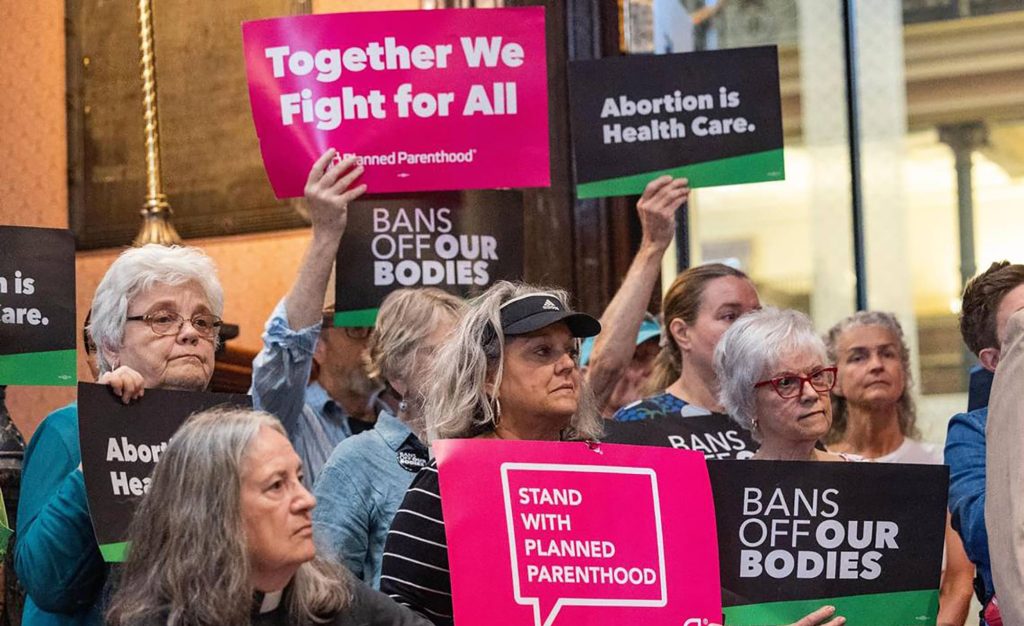
South Carolina lawmakers ignited a fierce statewide backlash Tuesday after advancing a proposal that could reshape the state’s criminal laws and expose patients, along with anyone who helps them to prison sentences of up to 30 years for terminating a pregnancy.
The bill, known as S.323, attempts to eliminate every exception currently allowed under South Carolina’s existing six-week ban and would classify abortion as a felony comparable to homicide.
The measure goes further than any policy the state has debated in decades, sweeping in patients, doctors, support networks, and even people who share abortion information online.
The hearing that pushed the proposal forward took place behind closed doors, adding urgency and frustration among residents and advocacy groups who say the legislation’s reach is unlike anything the state has considered before.
Because of how far the bill extends criminal liability, legal analysts warn it may trigger the most consequential reproductive-rights debate in South Carolina since Roe v. Wade fell.
The Major Changes Inside S.323
The bill introduces a series of significant legal shifts, including:
-
No exceptions for rape, incest, fatal fetal conditions, or serious medical emergencies.
-
Felony charges for patients, providers, and anyone who “aids or abets” an abortion, with penalties reaching 30 years.
-
Criminalization of abortion medication possession and the sharing of abortion-related information.
-
Reclassification of embryos as full legal persons, raising concerns from medical groups about potential implications for IVF.
-
Criminal exposure for transporting a minor out of state for abortion-related care.
If passed, these provisions would position South Carolina among the most restrictive states in the country, with some of the most severe criminal consequences tied to abortion.
What’s Driving the Push for S.323
South Carolina’s push behind S.323 comes during a political shift inside the state’s Republican majority, where several lawmakers have embraced policies that treat “personhood” as beginning at fertilization.
Supporters inside the Capitol have framed the proposal as a new phase in the state’s approach to reproductive policy, moving beyond limitations on abortion access toward fully redefining how the law treats embryos and pregnancy.
Opponents see a very different trend. They note that the bill arrives at a moment when multiple states are testing how far criminal penalties can reach in the post-Roe era.
For critics, S.323 is part of a larger national pattern in which lawmakers are exploring the outer limits of criminal enforcement tied to reproductive health.
Even within anti-abortion circles, the proposal has caused noticeable tension: some groups support the bill’s uncompromising criminal provisions, while others argue that targeting patients themselves departs from decades of messaging and risks long-term political fallout.
Those tensions became even sharper during Tuesday’s closed-door hearing, where lawmakers advanced the bill without allowing public comment.
The decision frustrated residents who had filled hours of testimony during an earlier October hearing and expected to be heard again.
With that option removed, advocacy organizations mobilized supporters to contact legislators directly, sharing medical experiences, policy concerns, and legal reasoning about the bill’s reach.
For groups tracking the legislation, the quiet, rapid movement of the proposal is telling. South Carolina has often influenced regional policymaking on reproductive issues, and the speed of this hearing indicates how quickly the bill could progress once the full session begins.
National reproductive-rights organizations are watching closely, not because they predict specific outcomes, but because the state’s legislative actions have historically shaped similar debates across neighboring states.
How Criminal Charges Work Under S.323
If S.323 becomes law, prosecutors would handle abortion-related cases using the same basic structure applied in other felony investigations.
That means the state would need to prove intent, showing that a person knowingly ended a pregnancy or knowingly helped someone else do it.
Prosecutors would also need to establish action, such as providing abortion medication, performing the procedure, or offering direct assistance that contributed to the termination.
From there, investigators could rely on the types of evidence commonly used in felony cases, medical files, messages, location data, financial records, transportation details, or witness statements, depending on the specifics of each case.
Because the bill aligns abortion with homicide-level categories, the potential penalties mirror existing statutes that allow sentences of up to 30 years.
These are established legal mechanisms, not forecasts or legal advice, but they illustrate how the bill would slot into South Carolina’s existing criminal framework.
With Tuesday’s closed-door hearing, S.323 has cleared only one early step. Multiple committee reviews still lie ahead, and lawmakers have already signaled that amendments could surface once the full legislative session opens.
Even so, the bill’s rapid early movement has intensified attention from legal observers, medical groups, and national advocacy organizations who view South Carolina as a bellwether in the post-Roe landscape.
The next phase will decide whether the proposal continues gaining traction or whether pressure from constituents and internal divisions slows its progress.
For now, S.323 stands as one of the most sweeping criminal abortion proposals a U.S. state has considered — and the coming months will determine if it becomes law or meets resistance before reaching the Senate floor.