SAS Betrayal: 'Murderers as Martyrs'—Veterans Say Labour Is Rewriting History to Hunt
Heroes of Loughgall The Double-Blow: The Return to the Courtroom
The men who faced down the IRA at Loughgall are now facing a new enemy: their own government.
Forty years after the most decisive SAS victory of the Troubles—an ambush that wiped out an IRA bomb squad—veterans say they have been betrayed by the UK's new legacy reforms. The Labour government’s move, announced by Northern Ireland Secretary Hilary Benn this week, marks a direct reversal of the Conservatives’ 2023 Northern Ireland Troubles (Legacy and Reconciliation) Act, which had promised veterans closure by halting such inquests.
For many of the 300,000 veterans who served under Operation Banner, this feels like a double-blow: they were promised that years of investigations were over, only to face new scrutiny and potential prosecution nearly four decades later. As the disgusted veterans point out, this decision flies in the face of recent assurances from Defence Minister Al Carns that no such inquest would take place.
It is clear that the Northern Ireland Office is calling the shots, leaving the Ministry of Defence—which purports to look after our veterans—powerless or simply uncaring.
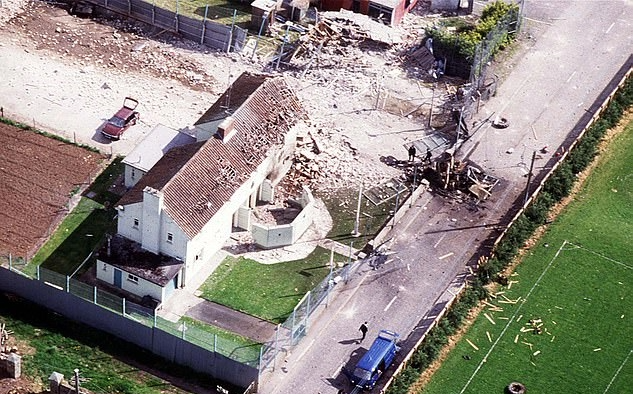
A devastating scene unfolded outside the Loughgall police station in 1987 — the aftermath of what became the IRA’s most crushing defeat of The Troubles, brought about by the swift and decisive action of the Special Air Service.
Scene Setter: Rorke’s Drift with Diggers
The Loughgall attack remains one of the most dramatic and significant episodes of the Troubles. The plan was one of audacious, murderous intent, hatched by Jim ‘The Executioner’ Lynagh and Padraig McKearney, two of the most psychotic figures within the IRA of the late 80s.
Their orders were clear: the three duty policemen inside the tiny country police station in Loughgall were to be blown to pieces at their desks by a digger carrying a 400lb bomb—a mix of fertiliser and diesel with a high explosive booster. Any officer attempting to escape was to be shot dead.
But the police had received intelligence, and the men of the Special Air Service (SAS) were waiting.
The SAS had secreted 24 men in and around the station, including five in plain clothes hidden inside an upstairs room. When the van carrying the gunmen screeched to a halt and the digger crashed through the gates on the evening of May 8, 1987, the IRA unit, expecting a massacre, instead met a heavily armed force.
One of those SAS men—speaking for the first time, exclusively to the Daily Mail—recalls crawling out of the wreckage alive while still under fire: “It was like Rorke’s Drift with diggers.”
When the noise subsided, the bodies strewn around the wreckage were not the police officers earmarked for slaughter, but eight terrorists, including the two maniacs in charge. The IRA certainly did not win that day; they suffered their gravest defeat in the history of The Troubles.
Forensic tests on the captured weapons showed they had been used to murder more than 50 people. Lynagh, alone, had been linked to more than 30 deaths. The SAS saved many more lives than just the three policemen who survived that evening.

The Human Cost: John X's Testimony
For the soldiers involved, the legal reopening is not about evidence—it's about endurance.
John X, a long-serving SAS veteran in the thick of the action, has never breathed a word to anyone outside ‘the Regiment’ about the events of that evening. Now in his mid-70s, Mr Benn’s decision has goaded this brave old soldier beyond endurance.
He recounts the terror when five IRA guys deployed from the van and opened fire: “There was no chance of saying ‘hands up’... It was heavy fire raking the whole station.” He recalls his comrade, ‘Barry,’ falling back, his face covered in blood after a bullet fragment hit the steel window frames. Then, they were just “blown back against the back wall” when the 400lb bomb detonated, obliterating one half of the building.
After running through the wreckage and neutralizing the remaining gunmen, John and his team returned to barracks for the mandatory debrief. His only reward? Being snubbed by the general commanding British Land Forces, who mistook him for a cleaner.
Back then, John and his mates received free beer in the mess for six months for ridding Northern Ireland of two homicidal monsters. All soldiers complied with a full investigation, and in 1988, the Director of Public Prosecutions ruled there was no evidence to warrant a prosecution. Now, he faces being charged if the coroner decides the deaths were unlawful.
“I’ve lived that night a thousand times,” he reportedly told colleagues. “Now they want to make me relive it in court.”
A History of Inequality: Terrorists' Immunity vs. Veterans' Exposure
The decision to hound veterans is made all the more outrageous by the existence of ‘comfort’ letters—secret get-out-of-jail cards issued by the Blair government during the Northern Ireland peace talks to protect around 200 terror suspects from prosecution.
For the veterans, there is still only one set of combatants from The Troubles who can wave these letters: the terrorists.
In a profound ethical failing, the UK government is proceeding with an inquest that threatens soldiers who stopped a massacre, while the Labour government’s new 'Legacy Framework' is being jointly consulted with the Irish government. It did not go unnoticed that while Hilary Benn pledged vague ‘new protections for veterans,’ the Irish deputy PM assured Irish voters there would be ‘no new protections for veterans.’ The old soldiers smell betrayal because the scales of justice are not merely imbalanced; they are broken.
The New Enemy: Lawfare and the ECHR
The current fight is not military, but legal. The reopening of the inquest is driven by human-rights law, specifically Article 2 of the European Convention on Human Rights (ECHR), which demands an "effective investigation" into state-involved deaths.
The problem for veterans is that the judge in the inquest will apply human rights law that did not exist at the time of the shooting to an event more than 30 years before.
This creates what critics call the “cosy legal La-La Land” of judges. John X emits an exasperated guffaw when asked why British troops didn't just ask the terrorists to put their hands up: “They’d already opened up first. If I’d tried to say, ‘You’re under arrest’, I’d be dead.”
Precedent of Persecution: Lessons from Coagh and Clonoe
We know how these new inquests will operate thanks to the recent inquiries into the deaths of IRA terrorists caught red-handed at Coagh in 1991 and Clonoe in 1992.
In both cases, High Court judge Michael Humphreys applied the retrospective law and criticised the SAS operations because they did not “minimise to the greatest extent possible” the need for “lethal force.” He even referred the Clonoe case to prosecutors.
The message is clear: according to this legal standard, the only correct response on being confronted with a man in a balaclava blasting a machine gun in a public place is to risk your life by saying, ‘Halt. You are under arrest.’ This is the impossible standard Loughgall veterans will now face.
Propaganda and the 'Martyrs': Why the IRA Demands a Rewrite
For the IRA and their sympathizers, Loughgall remains a stinging humiliation that simply has to be recast as a moral victory. Hence, the endless songs and murals about the ‘Loughgall Martyrs.’
The IRA’s lawyers kept pushing every new interpretation of the Human Rights Act until, in 2015, an Advocate General caved in to demands for a fresh inquest. Even though the European Court of Human Rights ruled in 2001 that the killings were not unlawful (despite procedural flaws in the original investigation), the campaign never stopped.
The current inquest is not about evidence—the soldiers complied with a full investigation in 1987 and there is nothing new. It is about politics and propaganda: repainting the IRA's murderous incompetence as some sort of martyrdom while demonizing the SAS as the bad guys.
The Final Reckoning
On previous form, we can be reasonably sure of a few predictions:
- The new inquest will cost many millions of taxpayer pounds.
- The soldiers will have nothing to add to their signed statements from 1987.
- The debate will boil down to the absurd question: could the SAS have stopped the attack before it started? The simple answer is yes—by standing outside with blue flashing lights, allowing the IRA to slip away quietly, only to come back another day when no one was looking. And no one, 38 years later, would be demanding an inquest into why those policemen were slaughtered at their desks.
As the Belfast courtroom prepares to hear the echoes of 1987, the question remains: Can a nation truly honor both truth and those who once fought in its name, or will it allow its heroes to be hunted while their enemy walks free with a 'comfort' letter?