Understand Your Rights. Solve Your Legal Problems



A major safeguarding review released today has detailed a series of missed opportunities by multiple agencies in the years before the death of 10-year-old Sara Sharif, who was found dead at her home in Woking, Surrey, in August 2023. Her father, Urfan Sharif, was jailed for life in December 2024 for her murder, along with her stepmother Beinash Batool. Her uncle, Faisal Malik, was convicted of causing or allowing her death.
The independent review, commissioned by the Surrey Safeguarding Children Partnership, found that professionals in education, health, policing and social care each held information indicating potential risk, but key details were not shared, escalated or connected in time to prevent the fatal outcome.

Urfan Sharif was jailed for life for murder
According to the report, professionals observed changes in Sara’s presentation after she was placed in the care of her father in 2019. School staff documented unexplained injuries, periods of absence and sudden behavioural changes. She also began wearing a hijab, a garment she had not previously worn. The review states that although staff noted concerns, some were not escalated due to uncertainty about procedures and information-sharing rules.
Health professionals raised similar observations, but these were not linked to concerns already held by other agencies. Police records showed a history of domestic abuse involving Sharif, but this information was not consistently shared with social care or family court professionals later responsible for decisions about Sara’s welfare.
Social workers managing Sara’s case were dealing with significant workloads, and several early contacts were closed without comprehensive follow-up. One key family court assessment was produced under tight deadlines by an inexperienced practitioner, and crucial historical information about Sharif’s violent behaviour did not reach the judge overseeing the private law proceedings.
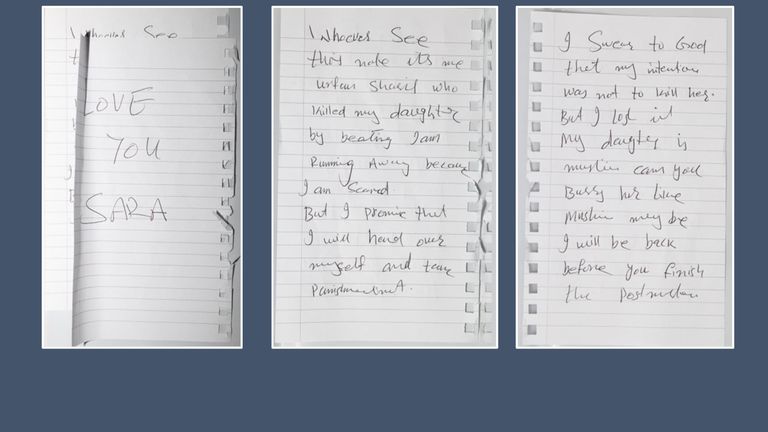
A handwritten note left by Sara’s father before he fled the UK. Image: Surrey Police
In early 2023, Sharif withdrew Sara from school, stating that she was being bullied. Under current UK legislation, home-educated children do not automatically need to be seen by local authorities unless an active safeguarding concern is open. A scheduled home-education visit — the primary opportunity to verify Sara’s wellbeing — was delayed and then sent to an incorrect address. Two days later, Sara was found dead.
A post-mortem examination recorded more than 100 injuries, including fractures, burns and signs consistent with prolonged assault. Sharif and Batool left the UK shortly before the discovery and were later extradited from Pakistan to stand trial.

Urfan Sharif and Beinash Batool were both convicted of murdering Sara, and her uncle, Faisal Malik, was convicted of causing or allowing her death.
The review highlights several systemic gaps in child-protection law and inter-agency communication:
The report recommends:
a mandatory national register for home-educated children
a statutory requirement for authorities to see a child within a set timeframe
clearer guidance on information sharing between schools and local authorities
Earlier admissions by Sharif during a domestic abuse intervention programme did not reach the Family Court during later private law proceedings. Reviewers recommend automatic disclosure of domestic abuse histories in all relevant cases.
Sara’s mother, who speaks limited English, did not receive full interpreter support during key court hearings. The review states that language needs must be clearly identified and consistently met to ensure full participation in future cases.
Sir Peter Wanless, chief executive of the NSPCC, previously stated that the case demonstrates the importance of clear communication and coordinated action when professionals encounter evidence of potential domestic violence or risk to a child.
Surrey County Council chief executive Terence Herbert issued an apology following today’s publication, confirming that the council would implement all recommendations in full. The Surrey Safeguarding Children Partnership said the findings would inform national discussions on strengthening safeguarding practice across health, education, policing and family justice.

Sara Sharif died in August 2023 with over 100 injuries — a horrifying catalogue of the abuse she had suffered.
The review concludes that Sara’s death was the result of criminal actions by her father and stepmother, but identifies significant areas where earlier intervention may have been possible. National policymakers are expected to examine the report’s recommendations in ongoing work to improve safeguarding processes, information sharing and oversight of home-educated children.
The Surrey Safeguarding Children Partnership will oversee the implementation of reforms locally and will publish progress updates over the coming year.
👉 UNSAFE BRITAIN: The Failures That FREED a Killer. Why Officials Get PROMOTED When Innocents Die 👈