Understand Your Rights. Solve Your Legal Problems


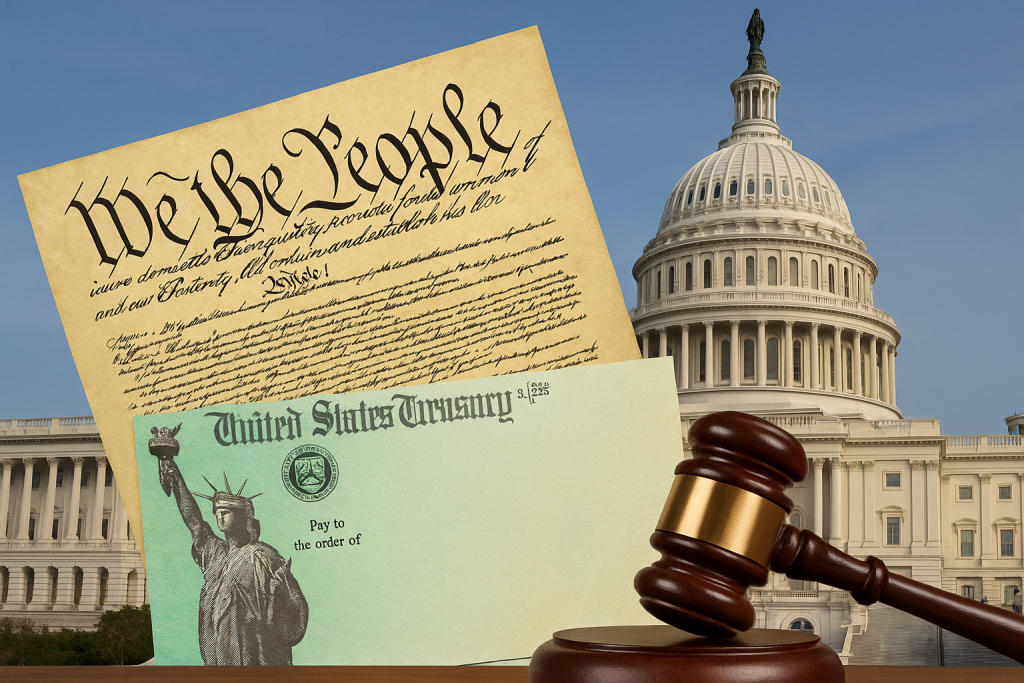
Trump’s rebate idea has revived a widespread misconception: that the White House controls federal payments. Here’s what the Constitution, Congress, and emergency powers actually allow.
When Donald Trump suggested the idea of $2,000 tariff-funded rebate checks, the reaction was immediate: Could a president really do that? It’s a question that resurfaces whenever the economy tightens or a crisis hits—usually followed by a wave of confusion.
At the heart of it lies one of the biggest misconceptions in American public life: the belief that presidents can simply “send out money” when they decide relief is needed. The truth is far less dramatic and far more legally structured. And understanding that structure helps explain why big promises often turn into long political battles before they ever become a payment in someone’s bank account.
In reality, the president’s power to distribute money directly to the public is far more limited than most people assume, and the legal guardrails that govern federal spending have been in place since the founding era.
Article I, Section 9 of the U.S. Constitution contains a short sentence with massive implications:
“No money shall be drawn from the Treasury, but in consequence of appropriations made by law.”
This is what constitutional scholars call the power of the purse. And it means:
Only Congress can authorise federal spending.
Presidents cannot create new programs that hand out money.
Even existing government revenue—such as tariffs—cannot be spent without a specific law.
This principle has been reaffirmed repeatedly. Government Accountability Office (GAO) decisions, for instance, regularly underscore that federal agencies may not spend funds “in the absence of statutory authority.” The Supreme Court has referenced the same concept in cases dealing with separation of powers and executive overreach.
So when Americans wonder, “Can the president send stimulus checks without Congress?” the legal answer is consistent: no.
The pandemic-era stimulus payments—including the CARES Act and the American Rescue Plan—only became possible because Congress passed them. Presidents sign relief legislation, but they do not generate the spending authority behind it.
Whenever a president proposes a bold spending idea, people naturally ask whether emergency powers could act as a shortcut. After all, modern presidents frequently declare national emergencies. The United States currently has dozens of ongoing emergency declarations.
But emergency power is not a financial cheat code.
Key statutes—including the National Emergencies Act, the International Emergency Economic Powers Act (IEEPA), and the Stafford Act—allow the president to regulate trade, freeze foreign assets, speed up disaster relief, and direct certain agency resources.
What they do not do is permit the federal government to issue new cash payments to households. Courts have consistently held that emergency declarations cannot override the Appropriations Clause or create new spending streams on their own.
A commonly cited example is Trump v. Sierra Club (2020), in which the Supreme Court examined the administration’s attempt to redirect funds under emergency authority. While the case focused on border-wall construction, it highlighted a broader principle: emergency authority cannot replace Congressional appropriations.
So even in moments of crisis, the president still cannot legally send checks without legislation.
If the president can’t simply decide to send money, how does federal financial relief actually work?
There are only a few legally recognised pathways:
These require a full act of Congress that defines eligibility, funding, and method of distribution. The Treasury Department and IRS then administer the payments.
Congress can approve credits that function like cash, processed through the IRS. This is how several pandemic-era benefits were delivered.
Some agencies have ongoing authority to issue grants or benefits, but only within tightly defined statutory limits—such as FEMA disaster aid or USDA nutrition programs.
Across every category, the pattern is clear: Congress authorises, and the executive branch implements.
The confusion is understandable. Presidents deliver State of the Union speeches, take credit for legislation, and often use phrases like “my plan” or “my administration will send relief.”
Politically, it sounds straightforward. Legally, it’s not.
Behind the scenes, every relief proposal triggers a chain of events involving:
Congressional budget committees
The Congressional Budget Office (CBO) for cost estimates
Appropriations subcommittees
Treasury systems
IRS infrastructure
Federal oversight bodies, including the GAO and Inspectors General
These processes are largely invisible to the public. So it’s no surprise many people think the president is pulling the financial levers directly.
But understanding the gap between political messaging and legal reality is essential—especially when the public hears promises of “immediate relief,” “rebate checks,” or “direct payments.”
If any administration—Republican or Democratic—wanted to pursue something like a nationwide rebate, the practical steps would look like this:
Draft a bill outlining who receives what and where the money comes from.
Submit it to Congress, where committees review, alter, or replace the plan.
Pass identical versions of the bill through both the House and Senate.
Presidential signature, turning the bill into law.
Implementation by the Treasury and IRS, sometimes involving new systems or updated processes.
Even “fast” stimulus efforts, such as those in early 2020, required extensive bipartisan negotiation and multiple rounds of amendments.
This slow structure is intentional: the founders designed it to prevent any single branch from spending public funds without oversight.
As economic conditions shift, so will political promises—and direct payments will likely be part of campaign conversations for years to come. But the legal framework remains stable: the president cannot authorize nationwide payments without Congress.
Whether the topic is tariff-funded rebates, expanded tax credits, student loan forgiveness, or future stimulus proposals, the same constitutional guardrails apply.
The upside? Understanding how federal spending actually works gives voters a clearer picture of what’s legally possible—and what’s simply political messaging.
No. Federal payments must be approved through Congressional appropriations.
No. Federal revenue cannot be spent without a law specifying how it may be used.
Existing emergency statutes do not authorise nationwide direct cash payments.
The U.S. Treasury and IRS manage distribution under Congressional authorization.