Understand Your Rights. Solve Your Legal Problems


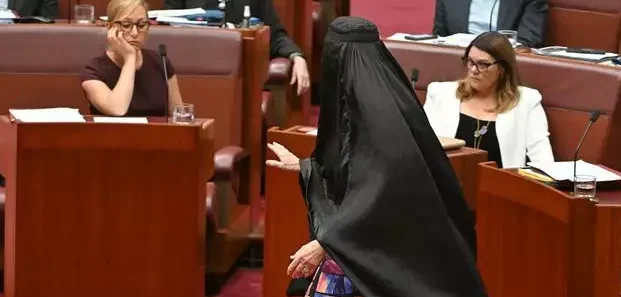
Australia’s Senate was thrown into turmoil on Monday morning when Pauline Hanson entered the chamber wearing a full black burka, igniting anger, walkouts, and accusations of racism in one of Parliament’s most chaotic scenes of 2025.
The One Nation leader staged the dramatic protest moments after being blocked from introducing a bill that would outlaw full-face coverings in public.
The clash erupted at roughly 11 a.m. in Canberra, with senators shouting across the chamber as proceedings were suspended.
Hanson refused to remove the garment, triggering immediate condemnation from political leaders and Muslim senators, who said she had crossed a line “every Australian should be ashamed of.”
The stunt has rapidly spiraled into a national flashpoint, sparking fierce debate online and inside Parliament about religious freedom, racial discrimination, and the limits of political theatre.
Witnesses described a stunned silence turning into a roar of anger as Hanson walked into the chamber fully veiled. Security did not intervene, but senators demanded proceedings stop until she removed the covering.
It was her second time attempting the same demonstration her first in 2017, yet today’s version occurred in a far more heated and politically divided environment.
Several senators accused her of using Muslim communities as a political prop. Others called it a deliberate attempt to stir public fear after her failed bill was rejected minutes earlier.
Hanson later posted on social media that she intended to “show the reality” of what Parliament refused to ban, claiming full-face coverings compromise public safety and represent the mistreatment of women.
She insisted she was not targeting people of faith, saying she “respects all religions,” and framed the protest as a message to Australians about national security. Her critics dismissed that explanation as disingenuous.
Condemnation came swiftly from across the political spectrum.
Leaders from both major parties - Labor and the Coalition said the stunt disrespected Parliament and inflamed racial tensions at a time when multicultural communities already feel targeted.
A motion was introduced to suspend Hanson for refusing to comply with chamber rules, marking one of the most severe responses to a protest by a sitting senator in recent years.
Muslim senators, including those from New South Wales and Western Australia, said the incident left them “deeply unsettled” and accused Hanson of endangering community safety by legitimizing anti-Muslim hostility.
The uproar inside Parliament has sparked a wave of questions from everyday Australians: Can the government actually ban full-face coverings nationwide? The short answer is complicated, and the real rules are far more limited than many people assume.
There is no national law prohibiting burkas, niqabs, or any other religious garment. Clothing restrictions in Australia only exist in specific, practical situations, usually when a person must be identifiable such as in airports, banks, secure buildings, or when dealing with police officers. Outside those narrow settings, people are free to dress according to their beliefs.
Even if lawmakers attempted a federal ban, they would need to clear a high constitutional bar. Parliament must show strong evidence that a full-face covering creates a real and measurable threat to public safety.
Political arguments or symbolic gestures are not enough. The High Court traditionally expects clear justification when a law affects religious expression.
One point that often gets lost in the political debate is that law enforcement already has the tools they need. Police and security officers may legally ask someone to briefly uncover their face for identification, and people must comply.
These existing powers cover most of the scenarios used to argue for a broader ban.
If Parliament attempted to outlaw specific religious garments, the law could face High Court challenges under discrimination principles. Courts would likely examine whether the law unfairly targets a particular community or restricts religious practice without solid evidence of public harm.
Clothing bans in Australia are tightly limited for a reason: they must balance public safety with personal freedom and religious expression. Despite the heated debate around Hanson’s protest, the legal framework remains unchanged and any attempt to rewrite it would face a long, difficult road.
Pauline Hanson’s protest has reignited one of Australia’s most sensitive national debates, and the fallout is unlikely to fade quickly.
The Senate now faces renewed pressure from both sides of the political divide those calling for stronger protections for religious communities and those demanding tougher rules around face coverings in public spaces.
With party leaders condemning the disruption and legal experts stressing the limits of what Parliament can actually ban, the next steps will hinge on whether lawmakers want to cool tensions or continue pushing the issue into the spotlight.
For now, the only certainty is that Hanson’s burka protest has left the country divided, energised, and bracing for the political battles still to come.