Understand Your Rights. Solve Your Legal Problems


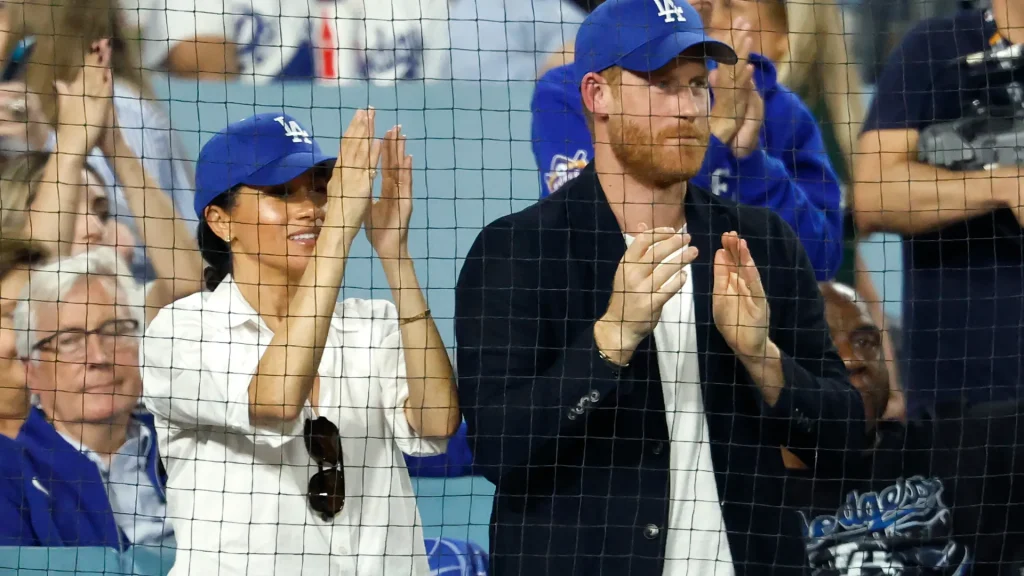
Prince Harry and Meghan Markle made a surprise appearance at Game 4 of the World Series between the Los Angeles Dodgers and Toronto Blue Jays on October 28, 2025, arriving in matching blue caps and coordinated navy-and-white outfits. Harry, 41, wore a white tee and blazer, while Meghan, 44, paired a knit sweater with a white button-down and gold accessories.
Days earlier, Meghan shared photos from a pumpkin patch outing with their children, Archie, 6, and Lilibet, 4. What seemed like a casual date night quickly sparked debate over celebrity privacy and media law — raising the question of how much control public figures truly have over their image at high-profile events.
:max_bytes(150000):strip_icc():focal(734x287:736x289)/Prince-Harry-Meghan-Markle-4-102825-2f25f868fd0d48928c3f9a5b830d1796.jpg)
Prince Harry and Meghan Markle attend Game 4 of the World Series at Dodger Stadium on October 28
For the Sussexes, stepping into the front row behind home plate — ahead of legendary stars like Sandy Koufax and alongside NBA hall-of-famers — isn’t just a night out. As reported, their seats drew commentary: broadcaster Howie Rose asked, “How does Sandy end up in the second row?” when Koufax was seated behind them. In an era where every public outing by high-profile figures is parsed for meaning and media reaction, this event carries three intertwined threads: fandom, branding and optics.
From a public interest standpoint, people are asking:
Why did the couple choose this outing now?
How does this shift public perception of their roles — as former royals turned Hollywood-adjacent celebrities?
What does this say about the balance between personal life and public life for figures under constant scrutiny?
Social media lit up within minutes — not over the game, but the performance. Some praised the couple’s relaxed look and family vibe, while others called the moment staged, citing carefully angled clips on Instagram.
For Meghan, an L.A. native and longtime Dodgers fan, the outing felt authentic. For Harry, it sparked debate over allegiance and optics. Brand-wise, it fit neatly into the Sussexes’ image as global yet relatable figures — family-first, media-savvy, and always camera-ready. Still, one question lingers: how much of it was genuine, and how much was crafted?
When high-visibility personalities like the Sussexes appear in public events, they operate at the intersection of visibility rights and personal privacy. Under UK and U.S. law, there are distinct concepts:
Origin & scope
In the UK, under the Human Rights Act 1998, Article 8 of the European Convention on Human Rights protects “the right to respect for private and family life”, while Article 10 protects freedom of expression. Courts balance these when deciding privacy cases involving public figures.
In the United States, the law tends to allow a reduced expectation of privacy for public figures. The “public figure” doctrine — stemming from landmark decisions like New York Times v. Sullivan (1964) — limits the ability of public persons to claim defamation unless actual malice is shown. Privacy torts (e.g., intrusion upon seclusion, public disclosure of private facts) remain available depending on jurisdiction.
Why it matters
For individuals such as the Sussexes, attending a high-profile sports event invites media attention, but it doesn’t automatically relinquish all privacy rights. A photo of them in the stands is likely “newsworthy” and allowed under freedom-of-expression principles. But if they were to attend with a heightened expectation of privacy (for example via invite-only hospitality box off-camera), a disclosure of private behaviour might trigger a successful claim — particularly in UK courts.
Precedent & example
For instance, the UK press-regulation body and courts have recognised that even royals are entitled to some privacy protection. In 2023, the UK courts ruled against certain media outlets for photographing and publishing images of their private activities when the individuals were acting in a purely private capacity. Meanwhile, in the U.S., public figure plaintiffs face stronger barriers: they must demonstrate that the publication was made with actual knowledge of falsity or reckless disregard for the truth.
Expert insight
Legal experts have noted that public figures should expect to be photographed in open venues, but context determines whether privacy expectations still apply. Analysts told Reuters that even a former working royal “cannot expect complete immunity from press coverage when attending a high-profile sporting event” (Reuters, 2024).
Reader takeaway
If you’re a public figure attending an open stadium event, you should assume your image may be published and your conduct may be commented on. While you retain rights against intrusions or unauthorised commercial uses of your likeness, you will have a significantly reduced claim if your presence is public, at a ticketed event, and the images are used for journalistic reporting.
In recent days, the Sussexes’ appearance at the World Series ties into larger threads — their ex-royal status, their American re-location, and their navigation of contemporary celebrity culture. Unlike their earlier high-profile interviews or royal tours, this outing is softer, more domestic: a date night, a family moment, a fandom flash. Yet it still carries spectacle.
For Meghan, this moment re-centres her Los Angeles roots and her fan identity as a Dodgers supporter. For Harry, it demonstrates his adaptability: shifting from royal duties to public appearances in wholly new contexts. Together, they appear less as aloof archetypes and more as a modern celebrity couple. That pivot resonates in search patterns: terms like “Meghan Markle Dodgers fan”, “Prince Harry Los Angeles date night public outing”, and “royal couple celebrity sports event 2025” are likely trending upward.
But the optics also invite scrutiny: critics on social platforms flagged elements of performance — the perfect hat angle, the camera-ready moment, the front-row seats. One X user wrote:
“LOOKS SO FAKE… the camera was perfectly positioned to capture everyone”
And another:
“So scripted… of course it was NOT staged because you know, the camera…”
Whether orchestrated or not, these critiques matter: in the court of public opinion, authenticity is currency. The couple’s future engagements will likely be measured not just for content, but for tone.
This World Series outing may seem like light-entertainment, but for the Sussexes it ticks numerous boxes: family time, brand reinforcement, media moment, story arc. For us as observers and publishers, it underscores how even seemingly casual appearances by prominent figures carry multiple layers — personal, legal, reputational.
And if you’re thinking of headlining your next piece with “Meghan and Harry at Dodgers” — you’re already speaking into the wave of search interest, public curiosity and legal nuance that this event embodies.
1. What rights do public figures have when it comes to privacy?
Public figures — including celebrities, politicians, and royals — have a limited expectation of privacy, especially when appearing in public spaces. Courts often balance privacy against the public’s right to know. In the U.K., Article 8 of the Human Rights Act protects private life, but it’s weighed against Article 10 (freedom of expression). In the U.S., public figures face even higher hurdles and must show “actual malice” in defamation or privacy claims.
2. Can media outlets publish photos taken in public without consent?
Generally, yes — if the photo is taken in a public setting and used for news reporting rather than commercial purposes. However, publishing images taken in private spaces, or using them to promote products without permission, may violate privacy or publicity rights. Exceptions exist if the subject has a reasonable expectation of privacy, such as in a private residence or restricted area.
3. What can individuals do if their privacy is violated by the media?
They can file a legal claim depending on the jurisdiction — for instance, for intrusion upon seclusion, public disclosure of private facts, or misappropriation of likeness. In the U.K., victims may pursue claims under the Data Protection Act 2018 or privacy torts recognised by courts. Remedies often include damages, takedown orders, and, in serious cases, injunctions preventing further publication.