The BBC's 'Pregnant People' Scandal: Why It's a Fear of Being Human, Not Just a Fight Over Words
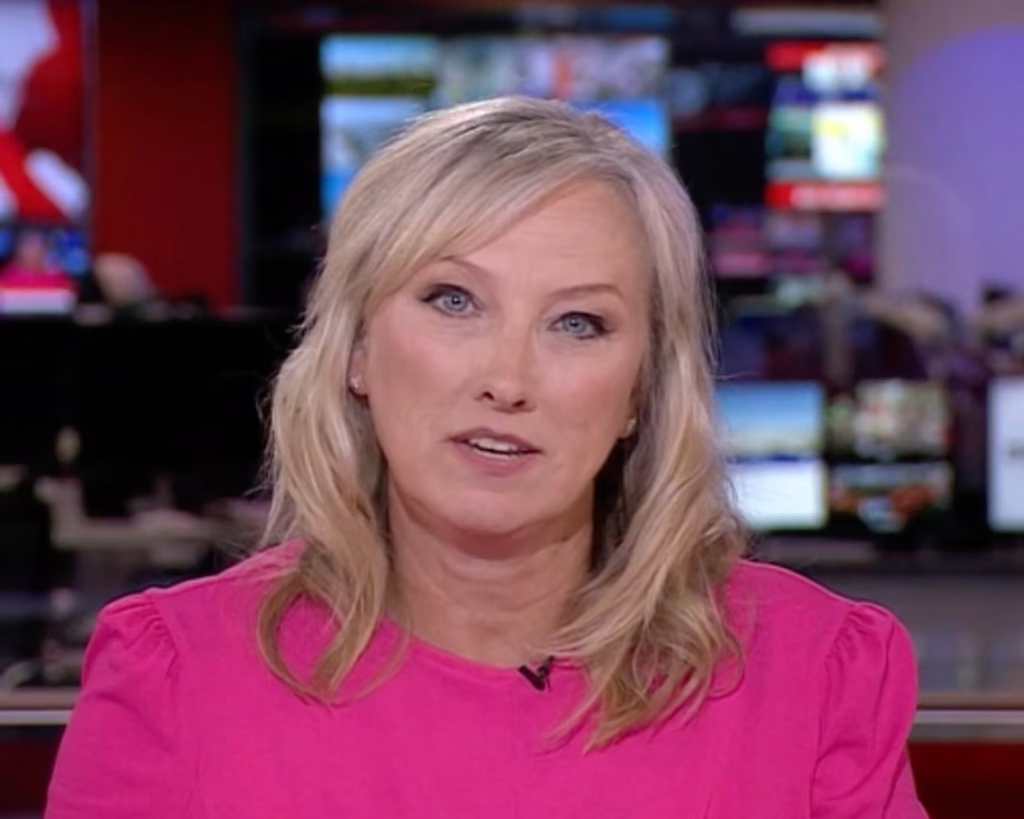
When BBC newsreader Martine Croxall corrected the phrase “pregnant people” to “women” during a live broadcast, it lasted barely a second. But that second — and one raised eyebrow — has turned into a national storm.
The BBC has since upheld complaints against Croxall, saying her subtle facial expression “laid it open to the interpretation” that she expressed a personal view on trans identity. To the corporation, that fleeting look was a breach of impartiality. To millions online, it was a sign of quiet rebellion.
But this was never really about gendered language. It was about how fear has crept into the heart of public broadcasting — fear of interpretation, fear of emotion, fear of being seen as human.
RELATED: Did the BBC Mislead Viewers? The Trump Speech Editing Scandal
What Happened on Air
The moment came during a summer news segment about heatwave risks. Reading from a script based on a university press release, Croxall said:
“The aged, pregnant people… women… and those with pre-existing health conditions need to take precautions.”
Her correction was immediate — a natural shift that most viewers might have missed. But the camera caught a brief flash of frustration. Online, it was clipped, shared, and dissected in slow motion.
Within hours, the clip went viral. JK Rowling praised her as a “new favourite BBC presenter.” Critics accused her of bias. The BBC launched a review.
The Eyebrow as a Rorschach Test
Watch the clip again — not for the correction, but for the half-second after it.
In that moment, Croxall’s eyebrow became a mirror. Some viewers saw courage. Others saw contempt. Most just saw a flicker of human irritation at awkward phrasing. But the fact that one microexpression could trigger headlines across every major outlet says more about us than about her.
We now live in a culture where microexpressions are weaponized — a raised brow becomes ideology, a smile becomes allegiance. It’s exhausting, and yet it’s shaping how journalists, politicians, and even teachers speak in public.
Hey @BBCNews if you don't want your newsreaders to correct your propaganda, don't put propaganda in the autocue for them to read out. https://t.co/BUU8zMDHSZ pic.twitter.com/0PSCJS9Ika
— Anya Palmer (@anyabike) November 6, 2025
When Neutrality Becomes Performance
The BBC’s complaints unit later ruled that the presenter’s “exasperation” could be seen as partial. Even if unintentional, her reaction “laid it open to interpretation” — a phrase that might as well describe the entire modern media landscape.
In 2025, neutrality is no longer about what you say, but how you look while saying it.
A pause, a sigh, an eyebrow — each one can now be interpreted as political commentary.
It’s a fragile new reality for broadcasters. Once, “impartiality” meant avoiding overt opinion. Now, it means suppressing emotion itself. And that’s a far more dangerous kind of silence.
The BBC’s Language Tightrope
To its credit, the BBC didn’t invent this linguistic minefield — it inherited it. Scientific and government institutions increasingly use inclusive terms like “pregnant people” to reflect medical diversity. But on live TV, such phrasing can feel awkward, even alien, to audiences who still expect plain English.
Croxall’s correction, the BBC said, came from “reacting to clumsy scripting.” But in today’s climate, intent doesn’t matter. Perception is everything.
That’s the paradox of modern broadcasting: the push to speak inclusively collides with the fear of sounding ideological. Presenters are left stranded — not knowing whether to prioritize clarity, compassion, or compliance.
The Human Cost of Over-Policing Emotion
At the core of this controversy isn’t language. It’s the idea that a journalist’s humanity has become a liability.
Every broadcaster knows the tension of live television — words stumble, tone shifts, instinct kicks in. But where previous generations saw that as proof of authenticity, institutions now treat it as risk.
It’s why the BBC’s ruling feels larger than one presenter. It’s a signal to everyone in media: feel less, react less, be less.
The result? Newsrooms that sound robotic, presenters who fear spontaneity, and audiences who no longer trust that anyone means what they say.
Fear Has Replaced Authority
For decades, the BBC’s authority came from its calm neutrality — a sense that its journalists could navigate complexity without panic. But that confidence has given way to anxiety.
The corporation is now trapped between critics who call it “woke” and campaigners who accuse it of exclusion. In trying to please both, it pleases neither.
Croxall’s case is a symptom of that paralysis. A single moment of humanity became evidence in a bureaucratic trial of tone. And that’s the tragedy — not for her alone, but for an entire institution trying to survive the attention economy.
This Wasn’t About ‘Pregnant People’ or ‘Women’
What happened to Martine Croxall isn’t just about gender. It’s about what happens when institutions mistake humanity for bias.
The BBC may have upheld its rulebook, but it lost something subtler — the trust that its presenters are allowed to be real. In chasing purity of language, it risks erasing the very people who bring the news to life.
Because in the end, the eyebrow didn’t break impartiality. The overreaction did.
What the Law Says About Impartiality
Under the Ofcom Broadcasting Code, every UK broadcaster must maintain “due impartiality and due accuracy” on politically or socially contentious issues. The BBC’s Royal Charter mirrors that duty, requiring its journalists to avoid language or conduct—verbal, visual, or tonal—that could be seen as expressing a personal view.
If Ofcom finds a breach, it can issue public findings, fines, or require on-air corrections. For individual presenters, the legal exposure lies less in courtrooms and more in employment law, where failing to follow editorial policy can justify reprimand or disciplinary action. Impartiality, in this sense, is both a regulatory and contractual requirement.
A 2022 Ofcom ruling against Emily Maitlis established a key precedent: even the tone of a line that “suggests a personal opinion” can violate impartiality. The Martine Croxall case extends that reasoning to facial expression—testing whether a non-verbal cue can trigger the same legal scrutiny.
Media lawyer Mark Stephens CBE, partner at Howard Kennedy LLP, has argued in BBC and Law Society Gazette interviews that impartiality should be viewed as a statutory safeguard rather than a gag order, noting that regulators increasingly assess perception as much as intent when reviewing potential breaches.
For journalists, the lesson is simple: intent matters less than perception. Under Article 10 of the European Convention on Human Rights, free expression can be limited to maintain broadcasting neutrality. In the BBC’s case, that means even a fleeting expression—meant as fatigue or irony—can fall within the law’s gaze.
Martine Croxall Complaint FAQ's
Why was Martine Croxall reprimanded by the BBC?
Because she changed the phrase “pregnant people” to “women” during a broadcast and made an expression that the BBC said could be interpreted as showing bias.
What did she actually say?
While introducing a heatwave study, she read “pregnant people,” corrected it to “women,” and briefly raised her eyebrows — prompting online debate and viewer complaints.
What does this controversy say about the BBC?
It highlights the corporation’s growing struggle to balance inclusivity with impartiality — and how even small gestures are now scrutinized as political acts.
Is impartiality still possible in live news?
Many journalists say the current climate makes true neutrality impossible. Every word, pause, or facial expression can be taken out of context online within seconds.