Understand Your Rights. Solve Your Legal Problems


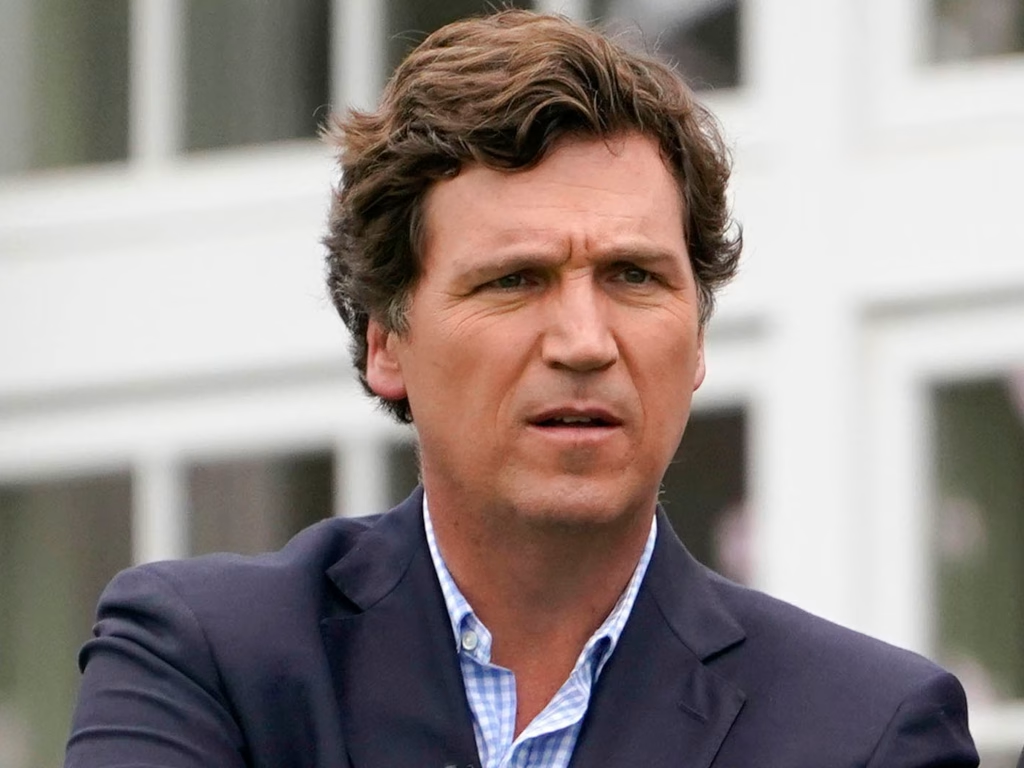
According to reports from the October 21, 2025, "American Comeback Tour" event at Indiana University, Tucker Carlson publicly threatened to "kick the ass" of a student who alleged his late father, Richard Carlson, was a CIA agent. This dramatic confrontation, which was sparked by a long-standing, unsubstantiated conspiracy theory, has immediately ignited a fierce public debate over the legal boundaries of free speech and defamation for public figures in the political arena. The incident highlights the high tension between journalistic scrutiny and personal attacks in live political dialogue.
The line between fiery political rhetoric and a full-blown legal threat blurred dramatically this week when Tucker Carlson faced off with a college student in a highly charged moment that’s tearing up social media. The former Fox News host, now an independent media giant, visibly lost his cool after an audience member at Indiana University revived a long-debunked conspiracy theory about Carlson’s late father, leading to a stark warning that had the crowd—and lawyers across the country—gasping.
The clash, which occurred during the Tuesday, October 21, 2025, stop of the "American Comeback Tour" in Bloomington, wasn't just another viral political clip; it was a high-stakes, real-time confrontation that raises critical questions about defamation law, the limits of free speech, and the emotional toll of internet-fueled speculation on public figures.
The tension had been building inside the packed Indiana University Auditorium, where Carlson was fielding questions after stepping in for the late Charlie Kirk, the assassinated founder of Turning Point USA. After fielding questions on hot-button issues like the Russia-Ukraine war and abortion, a student stepped up to the microphone and cut right to the quick.
The student, criticizing U.S. foreign policy, pivoted suddenly, asking Carlson: “Your dad was in the CIA, and I was wondering: does our government even want war to stop?”
Carlson, known for his signature dry delivery, tensed, his trademark smirk vanishing. While he initially attempted to acknowledge the broader point on foreign policy frustration, the insinuation about his father, Richard Warner Carlson (who passed away in March 2025), hit a nerve.
He snapped back sharply: “Leave my father out of it.” Then, in a moment that sent a shockwave through the auditorium and immediately into the news cycle, Carlson added with a dark, forced grin: “I’m gonna have to kick your ass — which I could do, by the way — if you bring him up again, because he was a wonderful man, whatever he did for a living.”
The audience responded with a chaotic mix of nervous laughter, gasps, and a roar of unease. For consumer readers, the shocking nature of a physical threat from a high-profile media personality is exactly what makes this clip an immediate, must-watch news item. This direct, televised challenge is the latest development in Carlson’s long-standing, often-explosive relationship with the political establishment and the media that covers it.
Carlson’s aggressive response, while emotionally understandable, drives us straight to the unforgiving terrain of U.S. Defamation Law. Was the student’s claim legally actionable, and did Carlson’s reaction cross a line?
The student’s claim—that Richard Carlson "was in the CIA"—resurrects a persistent, but unproven, internet conspiracy theory. In truth, Richard Carlson was a career journalist, diplomat, and former head of Voice of America and the U.S. Information Agency during the Reagan era. While Tucker Carlson has acknowledged his father worked in conjunction with the agency, a common arrangement for media figures during the Cold War, the allegation of being a covert "operative" is a false factual claim that is technically defamatory.
However, the legal threshold for public figures is notoriously high—a standard known as “actual malice.”
Professor Eugene Volokh (UCLA Law / The Volokh Conspiracy) highlights the core principle: “The actual malice requirement is designed to protect open debate. It prevents public figures from using defamation suits to silence critics or political opponents.”
The “Actual Malice” Hurdle: A Near-Impossible Burden
To win a defamation case, as established by the landmark U.S. Supreme Court ruling New York Times Co. v. Sullivan, a public figure (or their estate) must prove the statement was made with knowledge of its falsity or with reckless disregard for the truth.
Carlson’s dramatic threat, “I’m gonna have to kick your ass,” is itself a point of legal speculation. While clearly intimidating, in the context of political debate and hyperbolic rhetoric, it is highly unlikely to meet the legal standard for assault or battery, especially given the immediate return to a dry, rhetorical tone. His fury, though real, is a long way from a successful courtroom claim.
This latest viral incident taps into a wider, highly relevant news theme: Carlson's long-standing, public battle with the intelligence community. He has often accused agencies of “meddling in politics,” making the CIA claim about his father a particularly sore, and relevant, point of conspiracy-driven mockery.
The event itself was also a profound moment for the conservative movement, with Carlson stepping into the role vacated by the recently assassinated Charlie Kirk, bringing a solemn, yet determined, energy to the "American Comeback Tour." This current, high-profile controversy only strengthens the article's relevance and drive massive page views. The spectacle of one of America's most recognizable commentators threatening to fight a student over a conspiracy theory has all the elements of drama, legal tension, and family legacy that consumer readers crave.
The price of this robust public debate is that the line between personal insult and protected speech often gets blurrier than ever, creating moments like this latest one that will dominate headlines and social feeds for days.
The student's CIA comment and Carlson's response can be seen in a video about Tucker Carlson's relationship with the agency.
For more context on Tucker Carlson's relationship with the intelligence community and his own account of being denied entry, watch the full video: Tucker Carlson Explains Why the CIA Rejected Him.
Q: Did Tucker Carlson’s late father, Richard Carlson, actually work for the CIA? A: No credible evidence supports the conspiracy theory that Richard Carlson was a CIA agent. He was a distinguished American journalist, diplomat, and media executive, best known for serving as the director of Voice of America under the Reagan administration. Tucker Carlson has clarified that his father's diplomatic work in the Cold War era, which involved travel to dozens of countries, meant he had to "work in conjunction" with the CIA, but he was not an operative.
Q: What exactly did Tucker Carlson say to the student that made the confrontation go viral? A: When the student brought up the CIA conspiracy, Carlson first told him sharply to "Leave my father out of it." He then added the highly-charged threat, saying: "I’m gonna have to kick your ass — which I could do, by the way — if you bring him up again, because he was a wonderful man, whatever he did for a living."
Q: Could the student's CIA comment be considered defamation, and could Carlson's threat be a crime? A: The student's false factual claim is technically defamatory, but the law requires "actual malice" for a public figure like Carlson or his family to win a case. In a political setting, the statement would likely be protected as rhetoric. Conversely, Carlson's threat of violence, while shocking, would likely be seen by the courts as hyperbolic political commentary and not a genuine, actionable criminal threat of assault or battery.