Trump Loses Nobel Peace Prize to Venezuela’s María Corina Machado
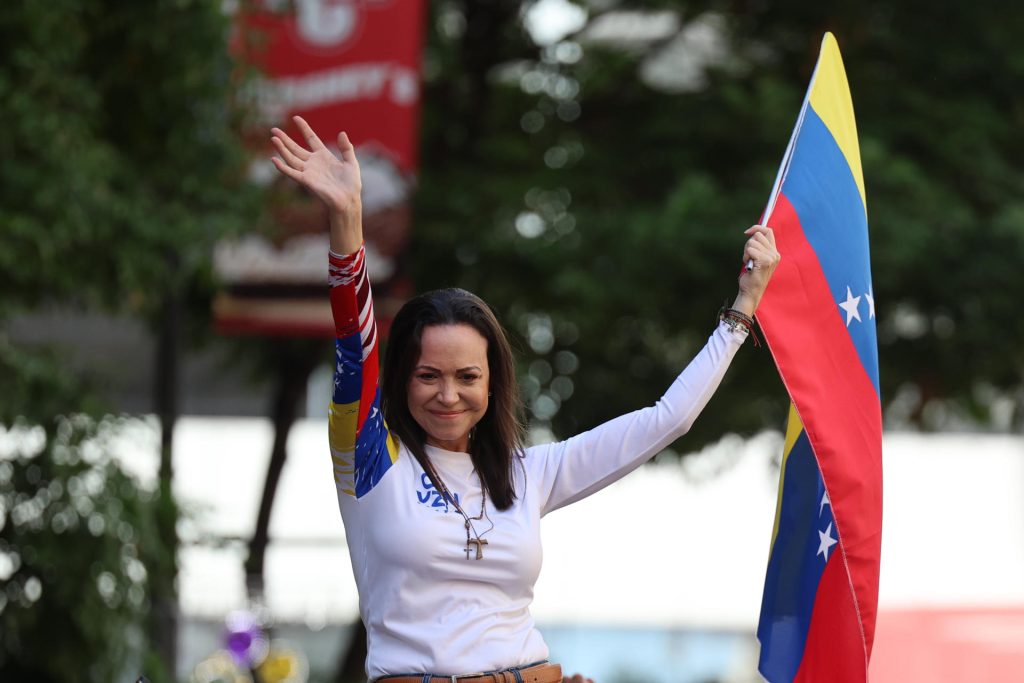
Norwegian Nobel Committee awarded the 2025 Nobel Peace Prize to Venezuelan opposition leader María Corina Machado for her “tireless work toward a peaceful transition to democracy.”
The recognition of Machado, long seen as a symbol of resistance to authoritarianism came as a disappointment to former U.S. President Donald Trump, who had openly campaigned for the honor while claiming credit for resolving what he called “seven unendable wars.”
A Prize for Principle, Not Publicity
At 58, Machado’s life has been defined by risk. She has endured travel bans, arrests, and public vilification while trying to unite Venezuela’s fragmented opposition.
The committee’s chair, Jørgen Watne Frydnes, told reporters that decisions “are based only on the will of Alfred Nobel,” adding that the panel “does not respond to campaigns or media pressure.”
Meanwhile, Trump’s aides had been privately hopeful. Since returning to office in January, he has boasted about brokering ceasefires from the Middle East to Southeast Asia, and aides reportedly prepared a statement anticipating victory.
Yet the committee had already chosen its laureate days before his latest ceasefire announcement making the result a foregone conclusion.
In Norway, lawmakers braced for Trump’s reaction. “When a president behaves this unpredictably, we prepare for anything,” said Kirsti Bergstø, leader of Norway’s Socialist Left Party.
“The Nobel Committee is independent, but I’m not sure Trump knows that.”
Who Can Win and Who Decides?
Nobel Peace Prize is governed by strict legal and procedural rules established in Alfred Nobel’s 1895 will.
Under Article 6 of the Nobel Foundation Statutes, the Peace Prize must be awarded by a five-member committee appointed by the Norwegian Parliament (Stortinget).
That committee operates independently of any government, and its deliberations are confidential for 50 years under Norwegian law.
No individual, not even a head of state, can campaign or apply for the prize.
Nominations must be submitted by approved nominators such as professors of history or political science, past laureates, and members of national assemblies.
Lobbying or public campaigning such as Trump’s, carries no formal weight and, according to the Foundation’s Code of Conduct § 3, can actually disqualify consideration if seen as manipulative or self-serving.
This legal independence is central to the committee’s legitimacy. As the Nobel Foundation itself states, “neither the Norwegian government nor any foreign authority may influence the decision.” (nobelprize.org)
The Symbolism Behind the Decision
For observers, the choice between Machado and Trump reads like a referendum on two kinds of power: moral versus performative. Machado’s victory highlights how peace work is often slow, local, and dangerous, while Trump’s diplomacy has relied heavily on televised summits and campaign rhetoric.
Analysts say the decision also fits a recent pattern. In the past decade, the Nobel Committee has favored activists journalists in Belarus, climate campaigners, and women’s rights defenders in Iran over global leaders.
The reasoning, according to Oslo political scientist Åse Gilje Østensen, is simple: “The committee has grown wary of rewarding political deals that may unravel. It prefers individuals whose work endures beyond election cycles.”
What It Means for Venezuela
Inside Venezuela, Machado’s Nobel Peace Prize has become more than a symbolic victory it represents a rare moment of international validation for a society that has endured decades of corruption, authoritarian governance, and systemic human-rights violations.
Her recognition arrives at a delicate legal and political juncture, where Venezuela’s fragile institutions remain caught between constitutional reform and continued executive dominance.
For many Venezuelans, the award signals renewed hope that the rule of law can one day be restored.
Supporters filled social media with calls for “Peace through courage” and “Freedom for Venezuela,” but the deeper resonance lies in how the prize may bolster domestic reform movements seeking to revive democratic processes within the framework of the 1999 Venezuelan Constitution.
That charter amended repeatedly under former President Hugo Chávez and later interpreted expansively by Nicolás Maduro’s administration, has long been criticized for weakening the independence of the judiciary and the National Assembly.
Internationally, Machado’s Nobel recognition could strengthen the legal standing of Venezuela’s pro-democracy campaigners.
By affirming her commitment to peaceful advocacy, the award may lend additional legitimacy to ongoing Organization of American States (OAS) proceedings and International Criminal Court (ICC) investigations into alleged crimes against humanity committed by state forces.
Under Article 7 of the Rome Statute, such investigations depend in part on credible civil leadership demonstrating a non-violent path toward justice — a standard Machado’s activism exemplifies.
Economically, the impact could also be profound. Global donors and democratic allies, particularly within the European Union and the Inter-American Development Bank, are expected to revisit humanitarian aid and rule-of-law funding previously suspended due to political instability.
Should Venezuela approach credible elections in 2026, Machado’s elevated international profile might pressure the Maduro government to permit broader electoral monitoring under Article 3 of the Inter-American Democratic Charter, which enshrines citizens’ right to participate in free and fair elections.
Ultimately, her Nobel win reframes Venezuela’s struggle in legal rather than purely political terms.
It positions democracy, human rights, and international law not as abstract ideals but as tools for rebuilding national legitimacy reminding the world that peace, in its truest legal sense, depends on accountability and the restoration of lawful governance.
Trump’s Continuing Quest for Recognition
For Donald Trump, who once dismissed the Nobel process as “rigged,” the loss is both personal and political.
Since returning to office, he has repeatedly cited his diplomatic “wins” including ceasefire talks in Israel–Gaza and Ukraine–Russia — as proof of his credentials as a peacemaker.
Yet his transactional approach to diplomacy, emphasizing leverage and strength over long-term institutional reform, contrasts sharply with the Nobel Committee’s criteria of sustained humanitarian and legal impact.
Analysts note that Trump’s pursuit of recognition highlights a broader tension between political image and international legitimacy.
While his efforts may yield temporary calm, they often lack the legal frameworks and accountability mechanisms that define lasting peace.
Whether his record ultimately earns historical validation remains uncertain, but for now, his campaign for the Nobel underscores the enduring divide between power politics and principled diplomacy.
People Also Ask (FAQ)
Who won the 2025 Nobel Peace Prize?
Venezuelan opposition leader María Corina Machado won the 2025 Nobel Peace Prize for her peaceful fight to restore democracy and human rights in Venezuela.
Why did Donald Trump want the Nobel Peace Prize?
Trump argued that his foreign policy achievements, including ceasefire efforts in the Middle East and Eastern Europe, made him deserving of the award. However, the Nobel Committee emphasized independence and humanitarian impact over political lobbying.
Is it legal for a U.S. president to accept the Nobel Peace Prize?
Yes. The U.S. Department of Justice’s Office of Legal Counsel confirmed in 2009 that the prize does not violate the Emoluments Clause, since it comes from a private foundation, not a foreign government.
How does the Nobel Committee decide who wins?
The Norwegian Nobel Committee, appointed by the Norwegian Parliament, evaluates nominations confidentially under the Nobel Foundation Statutes. It bases its decision solely on contributions to peace and humanitarian progress, not on political campaigns or public image.
What impact could Machado’s Nobel win have on Venezuela?
Her recognition is expected to strengthen Venezuela’s pro-democracy movement, increase global attention on human rights abuses, and pressure the Maduro government to allow freer elections and international legal oversight.