Understand Your Rights. Solve Your Legal Problems


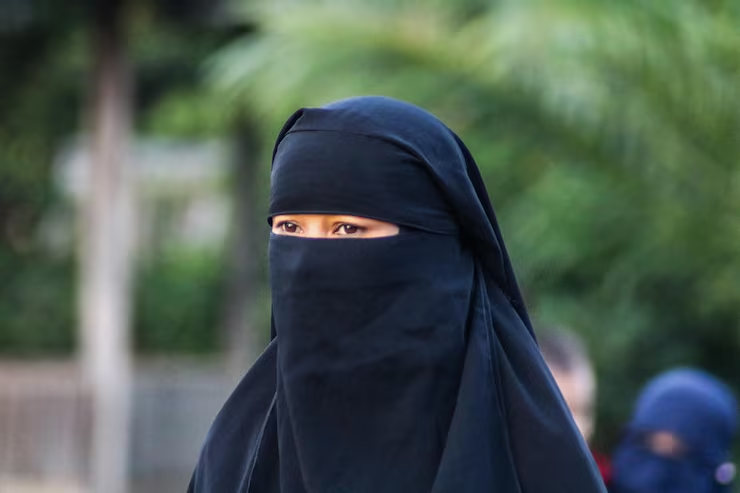
Portugal has moved a step closer to outlawing burqas and niqabs in public spaces, after lawmakers approved a far-right proposal that would criminalise full-face coverings “for gender or religious motives.”
If signed into law, the Portugal burqa ban bill 2025 would impose fines of €200 to €4,000 and potential prison terms for coercion, making Portugal the latest country in Europe to test the limits of religious freedom, gender equality, and constitutional law.
The measure, introduced by the Chega party, prohibits any clothing “intended to conceal or obstruct the display of the face” in public spaces, including streets, government offices, demonstrations, and sporting events.
Exceptions apply for health, professional, artistic, religious (within private religious institutions), or climatic reasons. The bill also makes it a criminal offence to force someone else to wear such coverings, carrying penalties of up to three years in prison.
As of now, wearing a burqa or niqab in Portugal remains legal. However, if this new legislation is enacted, covering one’s face for religious reasons in public would become a punishable offence.
As of now, wearing a burqa or niqab in Portugal remains legal.
However, if the new legislation is enacted, covering one’s face for religious reasons in public would become a punishable offence, with limited exemptions.
In plain English: it would no longer be legal to wear a burqa or niqab in public areas like streets or government buildings, although private spaces and religious institutions would remain exempt.
The bill passed with support from the Social Democratic Party (PSD), Liberal Initiative, and CDS–PP, while being opposed by the Socialist Party (PS), Bloco de Esquerda, Livre, and Portuguese Communist Party (PCP).
Chega’s leader André Ventura defended the proposal as “protecting Portuguese women from oppression,” while left-wing MPs accused him of “using gender equality as a weapon against religious minorities.”
The heated exchange turned Portugal’s normally measured parliament into a flashpoint for Europe’s wider debate on identity, secularism, and religious liberty.
Portugal’s Constitution (Articles 13 and 41) guarantees both equality before the law and freedom of conscience and religion. Legal experts say the burqa ban risks violating these rights unless the government can demonstrate a clear and proportionate public interest, such as security or anti-discrimination policy.
Under Article 18, any restriction of fundamental rights must be necessary and the least intrusive means available. Since face coverings are extremely rare in Portugal, constitutional lawyers believe the law could fail the proportionality test.
This debate reflects a deeper tension: Supporters claim the ban defends women’s dignity and aligns with Portugal’s equality principles, but opponents argue it undermines autonomy and criminalises choice.
As Andreia Neto of the PSD acknowledged, “No woman should be forced to veil her face, but no woman should be punished for choosing to,” highlighting the complex intersection between feminism and faith.
Portugal’s move echoes bans in France, Belgium, Austria, and the Netherlands, each of which faced legal challenges before the European Court of Human Rights (ECHR).
In S.A.S. v. France (2014), the ECHR upheld France’s ban, arguing that preserving “living together” was a legitimate goal under the European Convention on Human Rights. But critics now view that doctrine as outdated and overly broad.
If challenged, Portugal’s ban could trigger a new ECHR ruling, one that redefines how Europe balances religious expression with secular public policy.
Such a case would test the boundaries of Article 9 (Freedom of Thought, Conscience and Religion) and Article 14 (Prohibition of Discrimination) in the European Convention on Human Rights.
Supporters claim the ban defends women’s dignity and aligns with Portugal’s equality principles. Yet opponents argue it undermines autonomy and criminalises choice.
“No woman should be forced to veil her face, but no woman should be punished for choosing to,” said Andreia Neto of the PSD, acknowledging the complex intersection between feminism and faith.
The debate reflects a deeper European tension: whether feminism and religious liberty can coexist without one being used to justify the limitation of the other.
President Marcelo Rebelo de Sousa, a respected constitutional law scholar, faces a pivotal choice.
He can sign the bill, bringing the ban into effect; veto it, sending it back to Parliament; or refer it to the Constitutional Court, where judges would decide whether it aligns with Portugal’s Constitution.
Given the deep rights implications, most legal analysts expect a judicial review to be inevitable.
Beyond Lisbon, the measure could draw scrutiny from both the European Commission and the European Court of Human Rights (ECHR), particularly over Portugal’s compliance with the EU Charter of Fundamental Rights.
Human rights groups, including Amnesty International Portugal, warn the ban could stigmatize Muslim women and set a dangerous precedent for other forms of religious restriction across Europe.
For a nation long admired for its tolerance, the legislation risks turning Portugal into a test case for how secular Europe defines diversity and liberty in the 21st century.
The Committee on Constitutional Affairs will now review the bill before it returns to Parliament for a final vote.
If approved and signed, it could take effect by late 2025, but a Constitutional Court challenge appears all but certain.
The ruling that follows could reshape European religious rights law, redefining how courts interpret gender equality, secularism, and individual freedom for years to come.
Will Portugal ban the burqa in 2025?
Portugal’s parliament has approved a proposal to ban burqas and niqabs in public, but it has not yet become law. The bill still requires presidential approval and may be referred to the Constitutional Court for review before enforcement begins later in 2025.
What happens if you wear a burqa in Portugal under the new law?
If enacted, the Portugal burqa ban law would make it illegal to wear a burqa or niqab in most public areas, such as government offices, schools, and streets. Fines would range from €200 to €4,000, and anyone forcing another person to wear a veil could face up to three years in prison.
Why does Portugal want to ban face coverings?
Supporters say the law protects women’s rights and promotes social cohesion, while critics believe it targets Muslim women and restricts freedom of religion. The government argues it’s a measure of public order, but human rights lawyers say it’s a form of symbolic legislation with little real impact on equality.
What does the European Court of Human Rights say about face-veil bans?
In S.A.S. v. France (2014), the ECHR upheld France’s face-veil ban, accepting the argument that it supported “living together.” However, many legal scholars now consider that justification weak and outdated. A Portuguese case could reopen the issue and test whether such bans are still compatible with European human rights law.
Which European countries have banned the burqa?
Countries with full or partial burqa bans include France, Austria, Belgium, the Netherlands, and Denmark. Each ban differs slightly in scope—some target security risks, others claim to promote gender equality or secular values. Portugal would become the fifth Western European nation with a national veil ban if the law passes.
Could Portugal’s burqa ban be overturned in court?
Yes. If signed into law, opponents can appeal to the Portuguese Constitutional Court, arguing violations of Articles 13, 18, and 41 (equality, proportionality, and religious freedom). The Court could strike down or narrow the law. If not, the case could proceed to the European Court of Human Rights, creating a major precedent.