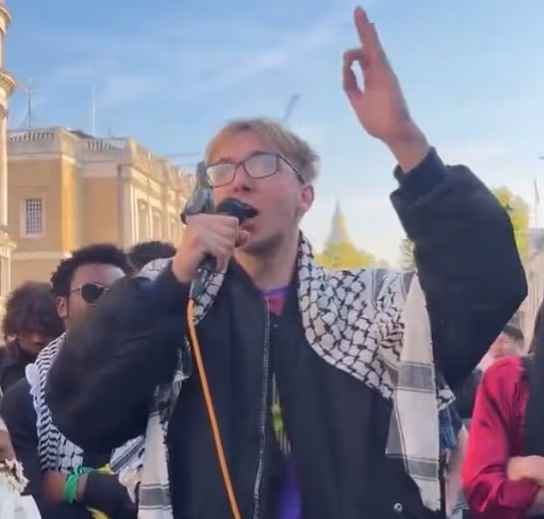
Free Speech or Criminal Incitement? The Legal Fallout from Oxford’s ‘Zios’ Chant Arrest
The arrest of an Oxford University student over an alleged hate-speech chant has reignited one of Britain’s most contested legal questions: where does freedom of expression end and criminal incitement begin?
Samuel Williams, a 20-year-old philosophy, politics, and economics student at Balliol College, was detained by Metropolitan Police officers in Oxfordshire on October 15 after footage emerged of him leading protesters in the chant “Put the Zios in the ground” during a pro-Palestine demonstration in London.
Oxford has since suspended Williams while launching its own disciplinary inquiry, as detectives investigate a potential offence of inciting racial hatred under the Public Order Act 1986.
What Does “Put the Zios in the Ground” Mean?
The phrase has been widely interpreted as an anti-Semitic call for violence.
In plain English, “Zio” is a derogatory shorthand for “Zionist”, often used online as a slur against Jewish or pro-Israel individuals. Because of its extremist origins and threatening context, police and Jewish groups treat its use as potential hate speech rather than political commentary.
For a broader perspective on how speech can blur into legal territory, see Steven Tyler Lawsuit: Free Speech or Legal Interference? — a feature exploring similar tensions between expression and liability.
The Legal Framework: Hate Speech vs Free Expression
Under Sections 17–29 of the Public Order Act 1986, it is an offence to use “threatening, abusive or insulting words or behaviour” intended or likely to stir up racial hatred.
The offence carries a maximum sentence of seven years’ imprisonment.
The Public Order Act 1986 is a key piece of UK legislation that defines crimes related to riots, violent disorder, harassment, and hate speech.
It gives police the authority to intervene when speech or conduct in public threatens public safety, stirs up racial hatred, or causes harassment or alarm.
Sections 17–29 of the Act make it a criminal offence to use threatening, abusive, or insulting words with the intent or likelihood of stirring up hatred against people based on race, religion, or sexual orientation.

A photo from Oxford student Samuel Williams’s Instagram shows him wearing a red and white keffiyeh associated with pro-Palestine activism.
In plain English, the law aims to balance freedom of expression with protection from harm, allowing citizens to protest or express opinions while making it illegal to encourage violence or hatred toward others.
At the same time, Article 10 of the Human Rights Act 1998 protects the right to free expression even speech that “offends, shocks or disturbs.”
But Article 10(2) allows restrictions in the interests of public safety and the rights of others.
For a broader look at how courts handle the boundaries of expression and liability, read Steven Tyler Lawsuit: Free Speech or Legal Interference?.
The Williams case will therefore turn on context and intent: whether the chant represented political protest or crossed into criminal incitement.
Legal experts say such cases are fact-sensitive and politically charged, requiring courts to strike a delicate balance between liberty and protection.
University Liability and Due Process
Oxford University faces its own legal and procedural challenges. Under the Higher Education (Freedom of Speech) Act 2023, universities must protect lawful speech, while the Equality Act 2010 requires them to safeguard students from harassment or discrimination.
Williams’s suspension raises questions about procedural fairness, academic freedom, and the extent of university responsibility when speech becomes a police matter.
A university spokesperson said Oxford “condemns, in the strongest possible terms, any language urging violence or racial hatred.”
Observers note that this incident may become an early test of how institutions reconcile free speech duties with equality compliance under UK law.
Similar tensions have surfaced elsewhere, notably in the University of Sussex Free Speech Violation Case, where administrators were fined £585,000 for breaching free expression protections on campus.
Political and Policy Repercussions
Education Secretary Bridget Phillipson has previously described antisemitism on campus as “unacceptable,” confirming additional funding to help universities address hate incidents.
Following the arrest, ministers reportedly contacted Oxford to reiterate expectations of “zero tolerance” for antisemitic behaviour.
The Union of Jewish Students welcomed the police response, calling for “an end to the culture of impunity around antisemitism.”
Civil-liberties campaigners, however, caution that aggressive hate-speech enforcement could chill legitimate protest and risk over-policing student activism.
Expert Perspective
A leading media-law specialist noted:
“This incident encapsulates the modern tension between expression and accountability. The legal test is not whether words are offensive, but whether they cross into threats or incitement, boundaries that courts continue to redefine in real time.”
For related analysis, read Legal Experts Say It’s Rare to Lose an Anti-SLAPP Victory on Appeal examining how courts protect speech from frivolous legal challenges while ensuring accountability.
How This Case Could Redefine Free Speech on Campus
Williams remains under investigation by Scotland Yard. If charged, the case could set a benchmark for how UK law distinguishes political protest from racial hatred in the post-2023 legislative landscape.
Regardless of outcome, it underscores a growing challenge for universities: maintaining vibrant spaces for activism while meeting their statutory obligations to combat hate.
People Also Ask (PAA)
Is hate speech illegal in the UK?
Yes. The Public Order Act 1986 makes it a criminal offence to use threatening, abusive or insulting words intended or likely to stir up hatred based on race, religion, or sexual orientation. In simple terms, hate speech becomes illegal when it encourages hostility or violence against a protected group.
What is the Public Order Act 1986?
It’s the main UK law governing public disorder and hate speech. The Act limits threatening language and behaviour at protests to prevent violence and racial hatred, giving police powers to intervene when speech risks public safety.
What does the Freedom of Speech Act 2023 mean for universities?
The Higher Education (Freedom of Speech) Act 2023 requires universities to defend lawful speech and academic debate, even if controversial. But they must also uphold the Equality Act 2010, which protects students from harassment. Universities therefore have to balance both obligations carefully.
Can universities discipline students while a police investigation is ongoing?
Yes, provided they follow due process. Universities may act under internal conduct codes if speech breaches policies or endangers others, even when police are still investigating.
Could the Oxford case set a legal precedent?
Potentially. If it proceeds to trial, it could clarify how courts interpret hate speech in political protests and influence how universities apply free speech and equality laws nationwide.