Understand Your Rights. Solve Your Legal Problems



Michigan Jet Crash: Pilot's Final Cry “Stall Recovery” Captured in Audio Published October 17, 2025
The chilling final moments of a jet crash that killed all three people on board have been revealed in air traffic control audio. Moments before the crash in Bath Township, Michigan, the pilot shouted a desperate, urgent warning: “Stall recovery! Stall recovery!”
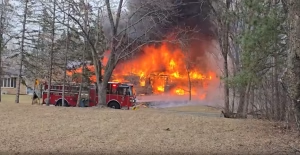
The Mexico-registered Hawker 800XP went down Thursday evening near Clark Road and Peacock Road while conducting a post-maintenance test flight—a fact now central to the National Transportation Safety Board's (NTSB) investigation. Authorities have confirmed three fatalities, with no names released as the recovery operation continues.
A Hawker 800XP, XA-JMR, stalled and impacted terrain near Bath, Michigan, USA. The three occupants perished.
The aircraft was on a post-maintenance test flight.pic.twitter.com/ujhLLDl4Ha— Aviation Safety Network (ASN) (@AviationSafety) October 17, 2025
Audio obtained from LiveATC.net, and reported by multiple outlets, captures the harrowing communication. The pilot was initially communicating calmly with Air Traffic Control (ATC) as part of a routine check. That routine ended suddenly.
The pilot’s final, shocking transmission was a shouted plea, “Stall recovery! Stall recovery!” before the signal cut out. Air traffic controllers immediately attempted to reestablish contact and directed nearby aircraft to scan the area for smoke or wreckage on the ground.
To the general public, the term "stall" suggests an engine quitting. In aviation, however, an aerodynamic stall occurs when the wings' angle relative to the oncoming air is too steep, causing the smooth flow of air over the wing to break down. This results in an immediate loss of lift, making the aircraft fall.
Investigations reveal the jet had undergone maintenance at Kellogg Field (Battle Creek), operated by Duncan Aviation. The aircraft was performing a test flight which, according to aviation director Phil Kroll, included "testing out some systems." These post-maintenance flights often involve intentional stall maneuvers at a safe altitude to verify the aircraft's handling after repairs.
Tracking and ADS-B data show the plane climbing to approximately 14,775 feet before it entered a rapid nosedive. The descent lasted only seconds before impact in a heavily wooded area, complicating rescue and recovery efforts.
The FAA and NTSB are leading the federal investigation. Their immediate priorities are clear:
While the NTSB focuses on the cause, the facts point to significant legal implications. For the family members of the deceased, the fact that the crash occurred during a post-maintenance test flight places immediate scrutiny on the company that performed the work.
A crash during a test of aircraft systems may indicate potential areas of liability, including:
Authorities anticipate a detailed report from the NTSB and FAA in the months ahead, but the immediate focus for the families will soon shift toward who holds the legal responsibility for the tragic loss of life.