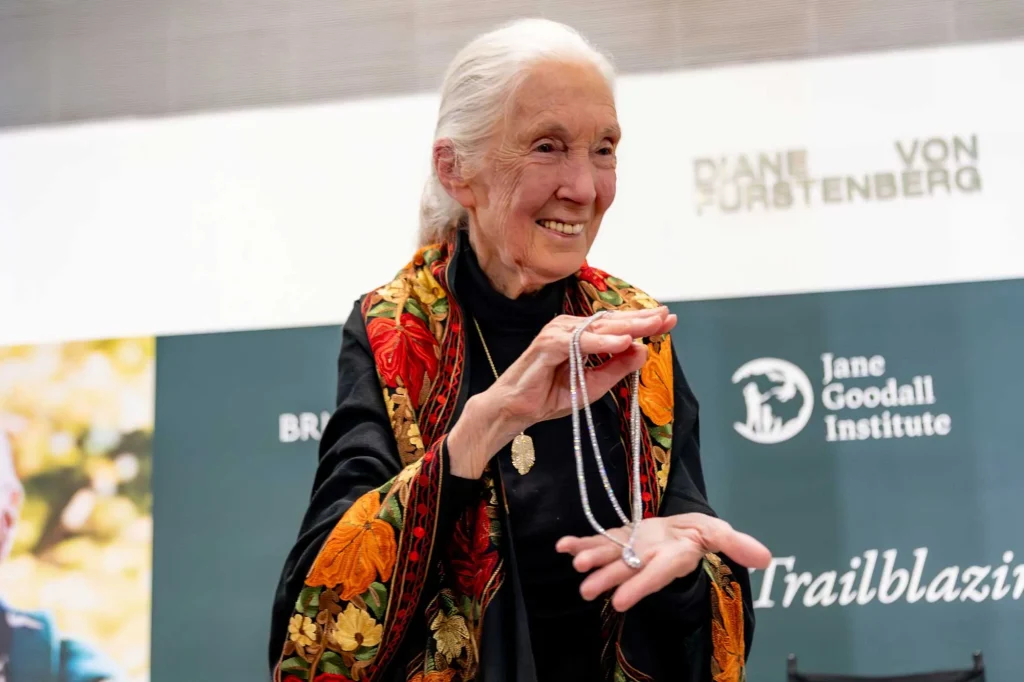
Jane Goodall’s Cause of Death Revealed as She Passed Away in Her Sleep During U.S. Speaking Tour
The legendary primatologist and conservationist was 91 years old
Jane Goodall’s cause of death has been confirmed several weeks after the world learned the beloved environmental pioneer had passed away peacefully in her sleep while on tour in Los Angeles.
According to a report from TMZ, which cited her official death certificate, Goodall died from cardiac arrest—also referred to as cardiopulmonary arrest—at the age of 91.
The Jane Goodall Institute had previously shared that she died “peacefully” on October 1 while visiting California as part of her latest public speaking engagements. The organization emphasized that she passed away of natural causes.
Goodall, widely regarded as the world’s leading expert on chimpanzees, dedicated her life to studying and protecting them, beginning with her groundbreaking field research in Tanzania’s Gombe Stream National Park.
She is survived by her son, Hugo, and three grandchildren.
“Dr. Goodall’s discoveries as an ethologist revolutionized science,” her institute said in a tribute. “She was a tireless advocate for the protection and restoration of our natural world.”
In its statement, the institute reflected on her life’s legacy: “Her work left an indelible mark not only on our understanding of chimpanzees and other species but also on humanity itself. She inspired hope, compassion, and curiosity across generations.”
A Life of Relentless Purpose
Despite her age, Goodall maintained an intense travel and work schedule, reportedly spending nearly 300 days a year on the road. She was preparing to speak at UCLA on October 3, just days after her passing.
Her longtime assistant, Mary Lewis, who worked with her for three decades, told People that Goodall had been working late into the night before she died — editing a document as late as 10:30 p.m. on September 30.
“She was always driven,” Lewis said. “Lately she seemed to recognize her own limits, but that never stopped her. Everyone says, ‘It’s the end of an era,’ but the era isn’t ending — her influence will carry on.”
Final Appearances and Powerful Words
Goodall made one of her last public appearances during New York Climate Week in late September, where she called climate change “the greatest challenge of our time.”
At Forbes’ Sustainability Leadership Summit, she urged global leaders and corporations to “have courage” and unite against environmental threats, reminding attendees that “climate change must be at the heart of everything — politics, business, and daily life.”
Just days before her passing, she appeared on Jimmy Kimmel Live! and The Wall Street Journal’s podcast, where she spoke about the importance of individual responsibility:
“Every day we live, we make an impact on the planet,” she said. “We can choose what kind of impact we make.”
Goodall was also scheduled to attend a tree planting ceremony in Pasadena on October 1, the same day her death was announced, according to NBC affiliate KNBC.
A Bittersweet Goodbye
Friend and fellow environmentalist Patrick McCollum told People that he had planned to meet Goodall in Los Angeles shortly before her passing.
“She said, ‘I’ll be in Los Angeles — we’ll have one
Legal Legacy and Environmental Protections (The Hook)
Jane Goodall’s impact wasn’t confined to the scientific community—it is a powerful, stealth legacy woven into the fabric of modern American conservation law and international policy.
For decades, the world focused on her groundbreaking work with chimpanzees, but behind the scenes, her research and passionate advocacy became the foundational evidence that strengthened global wildlife protection statutes, from the Convention on International Trade in Endangered Species (CITES) to local anti-poaching legislation across Africa. This influence is not just historical; it is the backbone of a legal revolution in the U.S. today.
Legal experts and ethicists routinely cite Goodall’s work as the galvanizing force behind new debates about the legal personhood of animals and the revolutionary Rights of Nature movement—a rapidly growing global effort that seeks to grant ecosystems and wildlife full legal standing in court. Specifically, her evidence is used by groups like the Nonhuman Rights Project (NhRP) in high-profile U.S. court cases seeking to change the legal status of animals like chimpanzees from mere "property" to "persons." As discussions around global climate law intensify, her legacy continues to shape the evolving legal frameworks of environmental justice.
The Revolutionary Concept of 'Legal Personhood'
To understand the seismic shift Jane Goodall helped trigger in the legal world, we must clarify one key term: Legal Personhood.
In simple U.S. law, a 'person' is an entity capable of holding legal rights and duties. A human being is a person. Crucially, a corporation is also considered a person under U.S. law, meaning it can own property, sign contracts, and sue in court.
The modern, Goodall-inspired debate asks: why are chimpanzees—creatures with documented self-awareness, emotions, and complex social bonds—still legally classified as mere 'things' or 'property'?
Goodall's decades of scientifically rigorous observation provided the critical evidence that non-human primates possess advanced cognitive abilities, effectively dismantling the old legal argument that animals are incapable of having legal interests.
Granting legal personhood would mean an animal, or a specific species, could not be treated as disposable property. They would have the fundamental right to bodily liberty or autonomy, allowing a lawyer to petition for their release via a writ of habeas corpus—a legal maneuver traditionally reserved only for humans. This shift, which is now being argued in courts across the U.S., is a direct application of the empathetic, science-backed view of nature that Jane Goodall pioneered.