Chaos at ICE Facilities: Clashes, Lasers, and a Nation on Edge
By George Daniel — U.S. National Affairs
Published: October 12, 2025 | Updated: October 12, 2025
America’s Immigration Battle Turns Violent
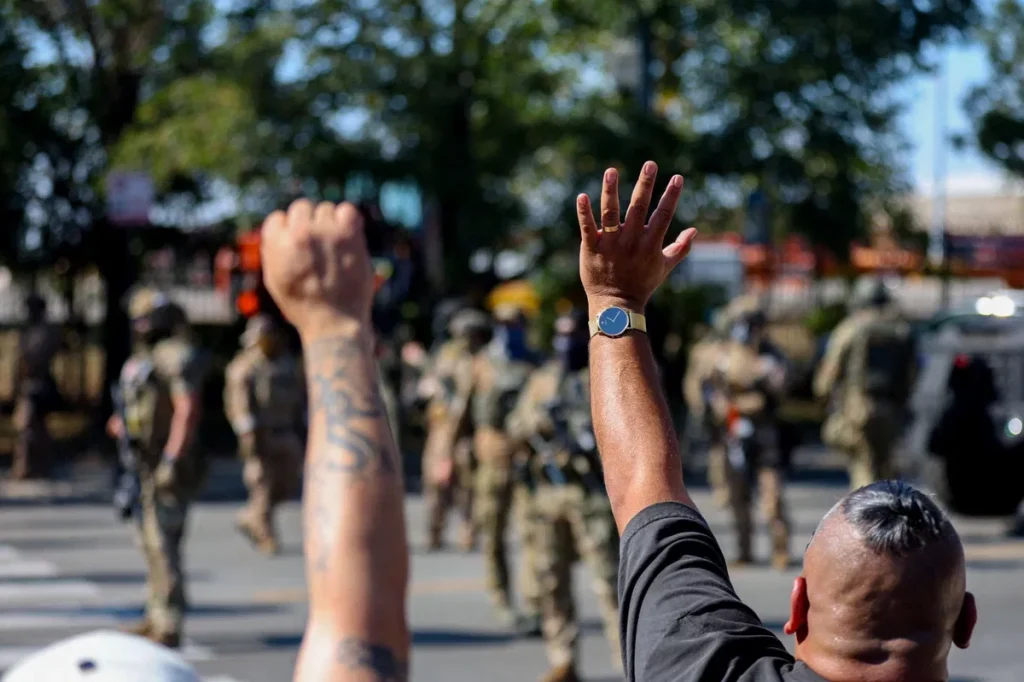
What began as a peaceful demonstration outside the Broadview ICE facility in Chicago quickly spiraled into chaos — with protesters breaching barricades, police responding with batons, and helicopters circling overhead. At the same moment in Oregon, activists staged a controversial “laser protest” aimed at federal helicopters — a move that’s ignited fierce debate across the country.
“This confrontation appears to be the most aggressive domestic standoff over immigration enforcement in decades,” said constitutional law attorney David Cole, commenting on the widening legal conflict between state governments and federal agencies.
Hundreds gathered in Broadview to demand an end to what they called “Trump’s militarized immigration crackdown.” Illinois State Police and Cook County Sheriffs formed defensive lines as demonstrators pushed forward, chanting for the abolition of ICE.
Meanwhile, in Portland, protesters calling themselves “The Light Brigade” organized what they dubbed a “laser party,” encouraging residents to beam green light into the night sky in defiance of what they described as “federal occupation.”
Videos of the Broadview clash and laser protests in Portland have exploded across platforms like X and TikTok, sparking fierce debate about free speech, federal power, and where the line between protest and crime truly lies.
The Chicago Clash: “A War Over Who Controls the Streets”
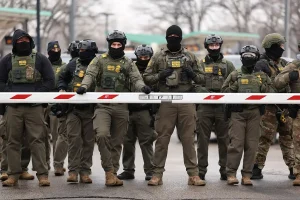
By mid-afternoon, the scene outside the Broadview ICE Detention Facility had turned violent. Barricades were overturned, police lines were breached, and officers in riot gear moved in to disperse the crowd.
“They hit us like we were insurgents, not citizens,” said protest organizer Ana Rojas, who livestreamed the confrontation to over two million viewers on X.
At least seven protesters were detained, with others treated for injuries. Law enforcement says demonstrators entered restricted areas. Activists claim police escalated without provocation.
Whatever the truth, the images have become symbols of a growing national divide.
Portland’s “Laser Party”: Protest or Federal Crime?
Two thousand miles away, the protests in Portland took on a more surreal — and dangerous — form.
Videos show protesters shining high-powered green lasers at helicopters above the Portland ICE facility, reportedly forcing one aircraft to alter its flight path.
The Portland Police Bureau confirmed that aiming lasers at aircraft violates both state and federal law, carrying penalties of up to five years in prison. The Department of Homeland Security called the stunt “reckless and potentially deadly.”
Still, organizers defended their actions as symbolic resistance.
“We’re not attacking — we’re resisting,” said one masked participant. “They occupy our sky every night. This is how we fight back.”
Despite the risks, the event — tagged #LaserRebellion and #AbolishICE — gained millions of views in hours, transforming a local protest into a viral act of defiance.
Legal Battles and the Question of Federal Power
Saturday’s unrest came just hours after a federal court ruling limited President Trump’s deployment of National Guard troops to Illinois and Texas.
Judge April Perry ruled there was “no evidence of rebellion” sufficient to justify activation under the Insurrection Act, temporarily halting military support for ICE operations.
Illinois Attorney General Kwame Raoul hailed the decision as “a victory for democracy and due process,” while Trump allies denounced the courts for “crippling federal law enforcement.”
“Donald Trump is not a king — and Illinois will not be occupied,” Raoul posted on X.
Even so, 500 federalized Guard members remain stationed near Elwood, Illinois, awaiting further orders as the Justice Department prepares an appeal.
The ruling could redefine the boundaries between federal authority and state sovereignty in so-called sanctuary jurisdictions.
The Legal Line: Civil Rights vs. Immigration Enforcement
The weekend’s unrest underscores a deeper legal collision between federal immigration enforcement and constitutional civil rights.
At the heart of it lies a question that courts have wrestled with for decades: How far can the government go to enforce immigration law before it violates the First and Fourteenth Amendments?
Under the Fourth Amendment, ICE agents must have warrants or “reasonable suspicion” to conduct searches or detain individuals. Yet, advocacy groups argue that many ICE operations — including workplace raids and “knock-and-talk” detentions — blur that standard. Civil rights attorneys say such tactics amount to unlawful search and seizure, especially when they occur in sanctuary jurisdictions that limit cooperation with federal agents.
The Tenth Amendment further complicates matters. States like Illinois and Oregon argue that the federal government cannot compel local police to enforce federal immigration laws — a principle upheld in several past Supreme Court cases, including Printz v. United States (1997).
When federal agents act unilaterally within those states, critics contend, they risk violating the doctrine of state sovereignty.
Constitutional scholars also point to First Amendment protections, warning that labeling demonstrations as “threats to federal security” could chill free speech. As law professor Erwin Chemerinsky recently noted, “The right to protest the government — even harshly — is foundational. Once that right erodes, accountability disappears.”
The result is a legal gray zone where immigration law, civil rights, and executive authority overlap — a space that courts, police, and protesters are all testing in real time.
Nationwide Protests Reflect Deep Divisions
The chaos in Chicago and Portland mirrors unrest spreading across the nation — from Los Angeles to Atlanta, where anti-ICE rallies have drawn thousands.
Activists accuse the agency of racial profiling, family separation, and deporting long-term residents without due process.
Conservative commentators, meanwhile, describe the movement as “anarchic lawlessness” that undermines immigration enforcement.
On social media, the conflict has evolved into a digital war of words, with hashtags like #ImmigrationProtests, #ResistTrump, and #SanctuaryNow dominating U.S. trending lists.
“This isn’t about one protest,” said civil rights lawyer Marissa Delgado. “It’s about whether Americans can challenge their government without being treated like enemies.”
Analysis: The Line Between Dissent and Disorder
The laser beams in Portland and the clashes in Chicago reveal more than outrage — they expose a nation at odds with itself.
Every act of protest now doubles as a test of constitutional endurance:
Who decides when dissent becomes danger? When law enforcement becomes suppression?
For some, these are the growing pains of democracy.
For others, they are signs that law and order is giving way to chaos.
Either way, America has reached a turning point — one where freedom and fear are locked in the same struggle, and where every flash of light in the sky seems to signal something deeper stirring on the ground.
People Also Ask (SEO / Google AI Overview Section)
Why are people protesting ICE in 2025?
Protesters are rallying against what they describe as the Trump administration’s “militarized immigration crackdown,” increased deportations, and alleged civil rights violations by Immigration and Customs Enforcement.
What happened at the ICE facility in Chicago?
On October 11, 2025, hundreds of protesters clashed with Illinois State Police outside the Broadview ICE Detention Center, resulting in multiple arrests and widespread calls for accountability.
What is the ‘laser protest’ in Portland?
Activists in Portland hosted a “laser party” protest, shining high-powered lasers at federal helicopters to disrupt surveillance. Federal authorities have called the act dangerous and illegal.
Can protesters legally block ICE operations?
Peaceful protest is protected under the First Amendment, but obstructing or interfering with federal enforcement operations can lead to serious criminal charges.
What’s next for ICE protests nationwide?
Courts are reviewing the legality of Trump’s National Guard deployments, while civil rights lawyers prepare lawsuits alleging excessive force. More demonstrations are expected in the coming weeks.