Understand Your Rights. Solve Your Legal Problems


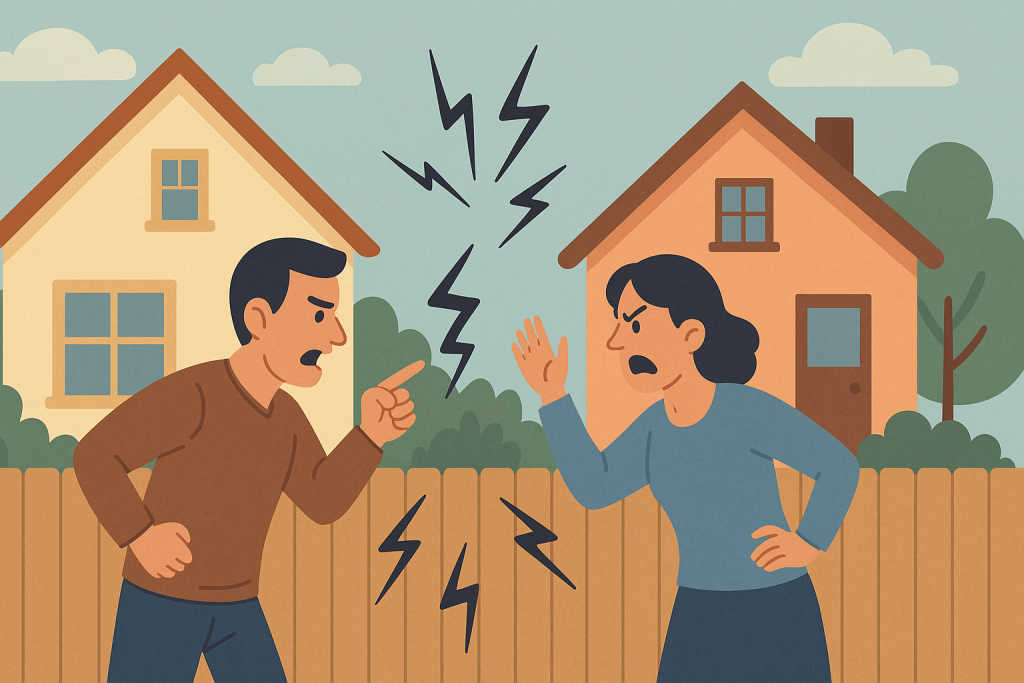
Across Britain’s quiet villages and exclusive postcodes, the battle lines of property law are being redrawn — not by lawmakers in Westminster, but by celebrities waging million-pound wars with their neighbours. Behind manicured hedges and high brick walls, disputes over basements, privacy, and planning permissions have turned into headline-grabbing court cases with real consequences for every homeowner in the country.
A Lawyer Monthly review reveals how these showbiz feuds have evolved from petty quarrels into landmark judgments that are shaping the nation’s understanding of private nuisance, planning control, and property rights.
While celebrity disputes dominate the tabloids, the same tensions unfold daily on ordinary streets across the UK. According to composite data from local authorities and home-insurance surveys, these are the most common causes of neighbour disputes:
| Rank | Dispute Type | Key Contributing Factor | % of All Disputes (Approx.) |
|---|---|---|---|
| 1 | Noise | Loud music, barking dogs, TV volume, construction noise | 35–40% |
| 2 | Boundaries | Fence, wall, or hedge placement disagreements | 30–35% |
| 3 | Trees & Hedges | Overhanging branches, root damage, blocked light | 10–15% |
| 4 | Access / Parking | Driveway obstruction or misuse of private spaces | 5–10% |
| 5 | Planning / Building | Loss of light, privacy, or disruption from construction | 5–8% |
These numbers reveal the wider pattern: fame only magnifies what homeowners already face — the collision between personal ambition and shared environment.
The trend of “iceberg homes” — lavish properties with multi-storey basements — has unleashed a new breed of neighbour dispute, blending structural risk with lifestyle excess.
Case Study: Robbie Williams vs Jimmy Page
Few feuds have become as notorious as the one between pop star Robbie Williams and rock legend Jimmy Page. Williams’s plan to dig an enormous underground extension beneath his West London mansion drew fierce resistance from Page, who feared vibrations from the excavation would endanger his adjoining Grade I-listed gothic home, Tower House.
After years of legal sparring, Williams secured planning approval in 2019 — but under an extraordinary Section 106 legal agreement giving Page the right to monitor seismic activity and halt work if damage was detected. The clause effectively froze construction, proving that not even a pop superstar can bulldoze heritage protections.
In 2023, Britain’s highest court made history by recognising visual intrusion as a form of private nuisance — a precedent that could transform urban privacy law.
Case Study: The Tate Modern Residents
Residents of the luxury Neo Bankside flats opposite London’s Tate Modern sued over the gallery’s popular viewing platform, claiming constant observation from visitors left them “living in a zoo.” In a groundbreaking Supreme Court ruling (Fearn v Tate Modern, 2023), the justices agreed: persistent overlooking could violate the right to private enjoyment of one’s home.
The court ordered the Tate to install privacy screens, ending a five-year legal saga and creating a new benchmark for city dwellers seeking protection from prying eyes.
In rural Britain, the problem is subtler — not one grand development, but a slow accumulation of small planning applications that gradually transform farmland into private fortresses.
Case Study: David & Victoria Beckham in the Cotswolds
At their sprawling Great Tew estate, the Beckhams have faced repeated clashes with neighbours over their serial building projects — from a lake and barn to a glasshouse. Their latest proposal, to pave a new private access road bypassing traffic to the nearby Soho Farmhouse, has sparked outrage among locals.
One objector told the West Oxfordshire District Council: “Ramblers use the lane and they should be left undisturbed by giant SUVs lumbering up and down.”
The council’s pending decision will determine how far celebrity homeowners can push incremental expansion before it crosses the line into overdevelopment.
Sometimes, the law’s flexibility becomes the battleground itself — when planning permission is granted for one purpose but used for another.
Case Study: Ed Sheeran’s ‘Wildlife Pond’
On his Suffolk estate nicknamed Sheeranville, pop megastar Ed Sheeran built a picturesque pond after convincing planners it was a “wildlife habitat.” Neighbours quickly accused him of creating a disguised swimming pool, pointing to the jetty and steps.
The council imposed a restriction banning recreational use — only for Sheeran to appeal successfully, arguing the condition was “unnecessary and unreasonable.” His victory overturned the ban and exposed how ambiguous planning conditions can be leveraged by persistent applicants, leaving councils struggling to enforce intent once consent is granted.
Disputes over boundary trees often pit environmental conservation against structural safety — a fine legal balance determined by expert evidence.
Case Study: Daniel Craig & Rachel Weisz
A neighbour of the acting couple claimed a large London Plane tree in their garden was causing subsidence and property cracking. Seeking removal, the complainant faced opposition from Camden Council, which instead issued a Tree Preservation Order (TPO) safeguarding the tree.
The compromise: the tree stays, but with strict pruning and monitoring — preserving both property safety and ecological value.
From subterranean cinemas to wildlife ponds, these celebrity feuds are more than tabloid entertainment — they are shaping the evolving relationship between property rights and public interest.
As housing density grows and personal wealth concentrates, planning authorities are being asked to draw new boundaries between ambition and intrusion. The principle of “quiet enjoyment,” once a simple phrase in English land law, is now a high-stakes battleground defining modern living.
For every headline-grabbing mansion case, there are thousands of ordinary homeowners watching closely — because what starts in Kensington or the Cotswolds often filters down to the cul-de-sac next door.
What is a Section 106 agreement in UK planning law?
It’s a legally binding agreement between a developer and the local authority, often used to mitigate the impact of large projects — such as requiring structural monitoring or community contributions.
Can overlooking windows really be considered a nuisance?
Yes. The 2023 Supreme Court ruling in Fearn v Tate Modern confirmed that excessive, continuous visual intrusion can amount to an actionable private nuisance.
What rights do neighbours have over basement excavations?
Neighbours can object under planning law and the Party Wall etc. Act 1996, which requires notice and structural safeguards for adjacent properties.
How can I resolve a property dispute without going to court?
Mediation or specialist property-law solicitors can often resolve issues faster and cheaper than litigation. Many councils and insurers now fund early-stage mediation.
Reviewed and verified by Lawyer Monthly’s property-law contributors. Sources include UK Local Authority Surveys 2023–24, Supreme Court Judgments Archive, and regional planning authority decisions.