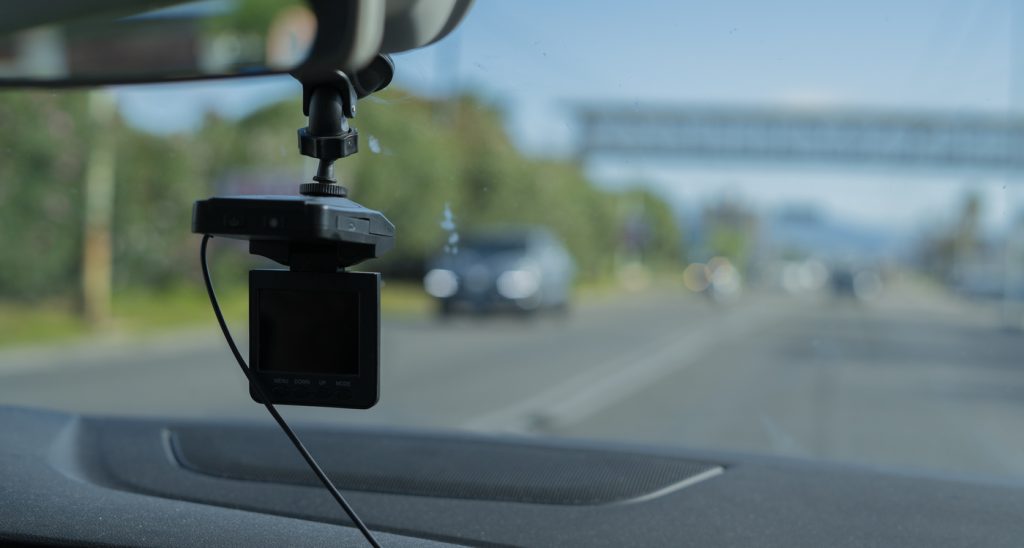
Dashcams are small devices that continuously record while a vehicle is running. Originally popular among truck drivers and law enforcement, dashcams are becoming increasingly common as a mainstream solution for everyday drivers.
A large part of dashcams’ expanded acceptance is that their footage, following a car accident, can serve as powerful, impartial evidence. However, just as it has the potential to help one’s claim, it can also diminish one’s ability to obtain compensation, as you’ll discover below.
What Is Dashcam Footage?
Dashcam footage is video recorded by a camera installed within your vehicle. Some models only capture a front-facing view, while others are capable of rear, side, and cabin views as well. Some higher-end options even record audio and GPS data, including your speed and location.
How Dashcam Footage Can Help Your Case
Since dashcam footage captures real-time events as they happen, it can act as an invaluable tool in the aftermath of a motor vehicle accident, primarily acting as one of the most objective sources of evidence.
You and your attorney can use dashcam footage to accomplish many tasks, such as:
- Proving fault
- Clarifying disputed facts, such as who had a green light
- Supporting injury claims
- Undermining false statements
In many cases, the facts of a traffic crash can get somewhat blurry, especially if you suffer serious injuries. If there are no third-party witnesses, it will be your word against that of the other driver.
Dashcams help eliminate that gray area by providing an indisputable and unbiased account of what really happened. In fact, dashcam video has already been used to support countless cases and has helped injured parties receive fair compensation.
Real Cases Where Dashcam Footage Helped the Client
A pedestrian in Chicago was struck by a vehicle and injured while walking in a marked crosswalk. Their attorney obtained dashcam footage from the at-fault driver, which, in turn, helped the client recover $395,000 for their injuries.
In another case in Colorado, personal injury attorneys used dashcam footage to demonstrate that their client proceeded into an intersection when their light turned green. Moments later, the camera captured a distracted driver running through a red light and hitting the victim’s car, proving the client’s case.
When Dashcam Footage Can Hurt Your Case
While dashcams can offer valuable evidence, they can also backfire if the footage they capture reveals facts that end up working against you. Here are a few ways in which video from a dashcam can hurt your car accident claim:
- The video reveals that you were speeding, distracted, or failed to signal
- The footage contradicts part or all of your retelling of events
There are several instances where plaintiffs have had their claims diminished or dismissed entirely because of dashcam video evidence. Let’s look at a few examples.
Real Cases Where Dashcam Footage Hurt the Client
Plenty of real-world examples should serve as a reminder to practice safe driving habits, as well as the fact that dashcam video, like any kind of recorded evidence, can cut both ways.
One of these involved dashcam footage being used as key evidence in a DeKalb County personal injury case in 2023. The camera showed that the plaintiff was going 12 MPH over the speed limit before the incident occurred, which, due to the state’s comparative fault rules, meant their settlement value was reduced by 30%.
In another case, this time in Texas, a plaintiff sued a trucking company for damages following a motor vehicle crash, alleging that the truck driver swerved out of their lane and struck their car. However, the trucking company had recently equipped its vehicles with dashcams, whose footage revealed that the plaintiff changed lanes into the front corner of the truck. The case was dismissed shortly after.
How to Include Dashcam Footage in Your Claim
If you believe your dashcam footage supports your case, it’s important to preserve it as soon as possible by saving a copy of the footage file to a secure location. It will usually contain metadata like time, date, and GPS details that can help authenticate the video.
A dashcam’s recordings are stored on a memory card, and since the device itself typically records in a loop, old footage will eventually be automatically overwritten unless you save or lock it. You don’t want valuable evidence to be lost simply because you forgot to save it.
With the footage backed up, find an experienced personal injury attorney to assist with your case. You should never submit dashcam footage to an insurer or court without reviewing it with a legal professional, as the latter can help you identify which parts of the footage are relevant. Often, the moments just before and immediately after a crash are just as important as the impact itself, as they provide crucial context to the event as a whole.
Does Georgia State Law Allow You to Submit Dashcam Footage in Court?
In Georgia, dashcam footage is generally admissible as evidence in both civil and criminal cases, so long as it is legally obtained. In other words, your footage can be used to prove fault, support damages, or refute false claims.
If the other party has dashcam footage, your attorney can help you obtain the video during the discovery process. However, it’s important to act fast, especially if you are concerned that the at-fault driver may destroy or alter the video. An attorney can send a preservation of evidence notice while you await a formal order from the judge for the video.
A Personal Injury Lawyer Can Help You Secure Dashcam Footage
If you have been involved in a car accident and need help submitting dashcam footage from your vehicle (or obtaining video from the other driver’s in-car camera), a personal injury lawyer can help. Furthermore, they can assist in preserving evidence, submitting your claim, and representing you during the negotiation process. The right legal strategy can make all the difference in the aftermath of a car accident, especially when video evidence is involved.