
Understand Your Rights. Solve Your Legal Problems


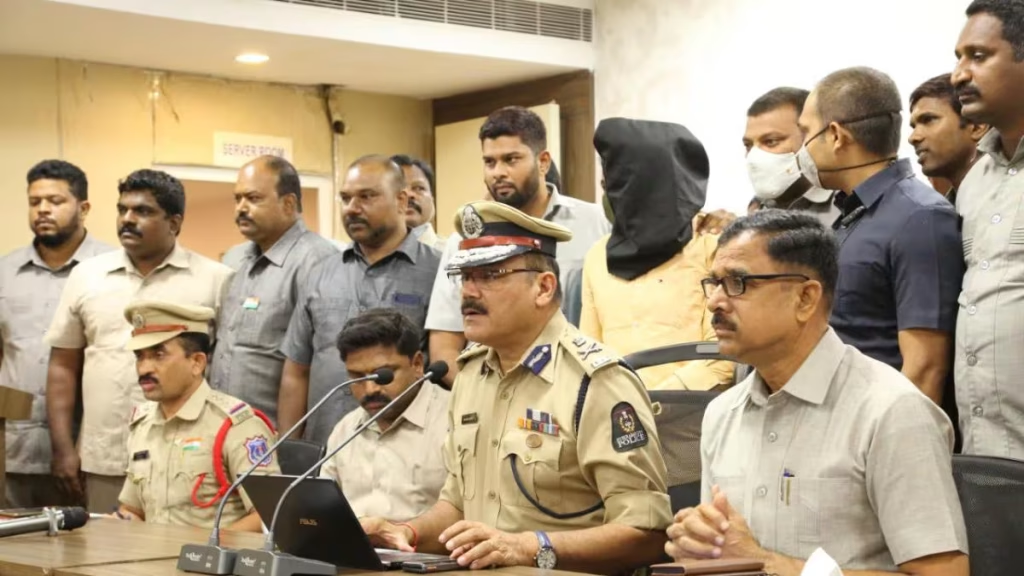
As of 2025, Maina Ramulu remains India's notorious serial killer, convicted of murdering up to 18 women in the Telangana region. His violent, decades-long crime spree, which began as early as 2003, was driven by intense misogyny following the abandonment by his wife. The article details Ramulu’s psychological descent, his repeated escapes from custody, and his current status on death row after his 2023 conviction.
The name Maina Ramulu once faded into the background of a quiet, working-class life, but today, it is etched in the dark history of India as a chilling symbol of unchecked rage. The man accused of murdering up to 18 women across Telangana state stands as one of the nation’s most prolific and terrifying serial killers, a stone-cutter who turned his failed marriage into a toxic, violent obsession. His story isn't just a record of horrific crimes; it’s a shocking psychological descent from personal trauma into a five-year reign of terror.
The arrest in January 2021 brought a wave of horrified relief, but it only opened the door to the truly disturbing question: how does an ordinary, unexceptional man morph into a monster driven by a desire to kill?
Born in Arutla village, Telangana, Ramulu was, by all accounts, an introverted and unmemorable child, blending seamlessly into his modest, working-class background. His early life held no obvious warning signs, save for perhaps a simmering frustration common in those leading a life of low-paying manual labor. However, the true psychological fracture occurred at the age of 21.
Ramulu’s arranged marriage ended abruptly when his wife eloped with another man just days after the wedding ceremony. This crushing abandonment was an emotional catastrophe that shattered his fragile sense of self-worth. He was unable to process the grief and rejection, allowing it to curdle into a profound and dangerous misogyny. This rejection wasn't just a personal slight; in Ramulu’s warped mind, it became a justification for a deadly vendetta against an entire gender.
This extreme emotional trauma triggered what authorities would later describe as a deep psychological breakdown. Hyderabad’s Commissioner of Police, Anjani Kumar, commented on the motive upon Ramulu's arrest, stating, “He was married at an early age after which his wife escaped. It created some mental impact [on the accused]... all his victims were women.” This single, personal tragedy was the unmaking of Ramulu, fueling a terrifying need for power and revenge.
Ramulu’s spree wasn't a single, continuous event, but a series of calculated attacks spread across multiple years and murder sprees, beginning as far back as 2003. His method was insidious and cold. He reportedly targeted single, vulnerable women in toddy shops (local taverns), befriending them, offering them liquor, and then luring them to secluded areas. His primary modus operandi involved strangulation, often using their own saris, after which he would steal their valuables. The combination of intimate, rage-filled murder and the theft of property suggests a motive driven by both emotional satisfaction and a need for gain.
What truly highlights the failure of the system to contain this threat is Ramulu’s repeated ability to evade justice and continue killing:
According to analysis reviewed by Lawyer Monthly, this pattern of repeated judicial release despite a history of heinous crimes and escapes raises serious questions about the safeguards in place for high-risk offenders in India's legal system.
The final, high-profile manhunt led to Ramulu’s arrest in January 2021. A task force, piecing together crucial CCTV footage and forensic evidence, finally connected the dots, revealing a decades-long pattern of calculated violence. In his confession, Ramulu admitted to killing the women as part of his delusional revenge fantasy, confirming the police's theory that his crimes were rooted in a deep, poisonous hatred for women following his wife's abandonment.
The ensuing legal proceedings were harrowing, forcing the families of his 18 victims to confront the chilling details of their loss.
In 2023, the Hyderabad Sessions Court delivered the maximum penalty, sentencing Maina Ramulu to death for his heinous crimes. The court deemed his acts to be premeditated and cruel, rejecting the defence's arguments of mental health issues as a basis for a lesser sentence.
As of late 2025, Ramulu remains incarcerated in a high-security prison in Hyderabad, awaiting the final resolution of his sentence. The death penalty in India is subject to a long and complex appeals process that can include appeals to the High Court, the Supreme Court, and a mercy petition to the President of India. The families of the victims face a continuous, agonizing wait as the legal system grinds slowly towards a final verdict.
The story of Maina Ramulu is a tragic and terrifying narrative that continues to haunt Hyderabad, a stark reminder of the unimaginable horrors that can erupt when deep-seated emotional distress and misogynistic rage are allowed to spiral unchecked. The legacy of his violence remains, measured in the 18 lives senselessly extinguished by a man who sought to avenge his broken heart.
The most crucial legal question consumers ask when they read the story of Maina Ramulu is: How was a convicted serial killer allowed to walk free—not once, but multiple times—only to kill again?
The case of Maina Ramulu throws a harsh spotlight on the legal doctrine of Sovereign Immunity and the doctrine of State Liability concerning judicial and executive negligence in India. Ramulu’s deadly freedom was not the result of a single error, but a recurring pattern: he was convicted, escaped from a psychiatric facility, was rearrested, and then released twice by the Telangana High Court after filing appeals against his life sentences in 2018 and 2020. These judicial decisions allowed a proven, high-risk offender back onto the streets, leading directly to more murders.
In India, the principle of Sovereign Immunity—the idea that the government cannot be sued for its actions—has traditionally provided a shield to police, prison, and judicial authorities. However, this shield is not absolute, particularly when fundamental rights are violated. When a court's decision or the state's failure to adequately supervise a known threat leads to the loss of life, the families of the victims can, and often do, pursue claims against the State for Negligence.
State liability for a crime often rests on proving gross negligence—that the authorities failed to exercise the degree of care and caution a reasonable person would under the circumstances, and that this failure was the direct cause of the subsequent harm. In cases like Ramulu's, where a convict already serving a life sentence for multiple murders is released based on a successful legal appeal, any subsequent crime by that individual raises profound questions of judicial oversight and due diligence.
For the average consumer, this legal angle is critical because it defines the extent of State accountability for public safety failures. While it is extremely difficult to prove judicial negligence, successful cases could compel the government to pay monetary compensation to the families of victims under the principle of Constitutional Tort for the violation of the victims' fundamental Right to Life (Article 21 of the Constitution). This compensation, though incapable of replacing a loved one, provides a measure of justice and financial security.
The key takeaway for any citizen who feels public authorities have failed in their duty is to be meticulous in documenting the negligence.
Practical Advice: If you or someone you know is the victim of a crime that could have been prevented by proper judicial or police action (e.g., ignoring a threat, improper release of an accused, refusal to file a First Information Report or FIR), you must:
Related: Unmasked: The 21 Most Famous Cold Cases of All Time—New DNA Leads, Shocking Arrests, and the Latest Twists You Need to Know Now!














