
Understand Your Rights. Solve Your Legal Problems
Historically, the concept of cohabitation has been frowned upon, especially in religious societies where marriage is expected before sharing the same roof. But times have changed - living together out of wedlock has, in most cultures, become a social norm.
There are, as you would expect, still conflicting beliefs and opinions on the matter, between different parts of the world. Stronger religious outlooks, for example, tend to be connected to a more negative view of cohabitation, and even where it is legal on paper, it can still be taboo within a society. That being said, modern culture is ever changing, and overall cohabitation is becoming more and more popular worldwide. Let’s take a look at the current state of affairs for 2020.
In the United Kingdom, cohabitation is perfectly acceptable. Data released in 2019 shows that the proportion of cohabiting couples was up to 3.4 million - totalling at 17.9% of couples living together. This is up from 15% just a few years prior.
This growth in popularity is echoed across western culture, but the UK is one of the most popular places for unmarried couples to settle down together and share a home. In the same report, cohabiting was highlighted as the “fastest growing family type” in the UK.
As with most places, cohabiting couples in the UK have no legal obligation to support one another financially, and there are not anywhere near the same rights as a marriage when it comes to separation. It’s no surprise then that the UK has seen a rise in cohabitation dispute solicitors.
Cohabiting was highlighted as the “fastest growing family type” in the UK.
The USA is quite a bit more complicated than the UK - not least because there is a federal government which oversees different laws state by state. As mentioned above, where strong religious beliefs are held, there is more likely to be either legislation or social expectations of marriage.
Two states, Mississippi and Michigan, have had laws on their books against cohabitation, though they are rarely enforced. It is generally accepted now to live together without being married so long as they have a proper cohabitation agreement.
By contrast, places like California recognise cohabitation and call those couples “domestic partners”. Again, these couples have no legal rights and have simply entered a cohabitation agreement, and they are not protected by any laws in the event of separation.
The law of living together in Canada is very much like the UK - it’s perfectly acceptable to live with your partner and cohabit with or without an agreement. It wasn't always this way of course - common law marriage was once a major part of society. As of 2016, cohabiting couples in Canada were around 21%. This is a huge increase from 16.4% in 2001.
South America is no exception to the vast majority of the world in that cohabitation is on the rise. It was reported that there was a boom between 1970 and 2007. In Peru, Colombia and Venezuela there has all been a rise, though it has been reported that cohabitation levels follow other negative aspects such as lower education levels. However, like the rest of the world, non-married couples are living together in harmony without walking down the aisle.
[ymal]
China is big on cohabitation, with more couples opting for it than in previous generations. Though this is very much in line with patterns around the world. Older mentalities are fixed on the idea that cohabitation without getting married is immoral and unstable, though it’s said that more and more young people are influenced by western culture. A survey from 2015 shows that this rise has been quite consistent - with a huge 59.6% of couples living together before marriage who were born in the 1980s.
Travel to the other side of the continent and it’s a different story. Muslim cultures do not permit cohabitation, largely owing to strongly held beliefs against pre-marital sex. Cohabitation is against the law in places such as Saudi Arabia and Pakistan.
Islam has a large presence in much of Africa, especially in the north and the west. As mentioned, cohabitation is frowned upon if not illegal in Muslim countries. Regardless of religion, African culture is said to have seen cohabitation as socially unacceptable and not tolerated by many societies living there. Couples are said to be living together without marriage in some areas, though cohabitation is not recognised as any form of legal relationship.
In Australia, couples who choose to live together without getting married are considered to be in a “de facto” relationship. This can not be considered by people living together who are not in a romantic relationship - so essentially it is a cohabiting couple much like in the UK. De facto relationships are governed by the Family Law Act of 1975, meaning there are some rights under this law, but again, nothing like those of a legal marriage.
Legal practice management company Clio announced on Monday that it will set up a $1 million disaster relief fund to help the legal community overcome the financial challenges posed by the ongoing coronavirus crisis.
In an interview with LawSites, Clio CEO and cofounder Jack Newton said that the company intends “to ensure lawyers are set up to succeed as well as ensuring their clients can continue to get the legal help they need.”
Newton also remarked that the legal industry is “in a moment when change that the legal profession might have expected to see over the next 10-20 years will now happen in the next 10-20 days,” citing the decentralisation of work environments and the transition from on-premises technology to cloud technology as two of the most significant developments that will be seen.
Clio’s disaster relief fund, or “COVID-19 Legal Relief Initiative”, rests on four “pillars”, representing areas where Clio’s financial aid will be deployed and criteria under which people can apply for funding:
Clio has created a dedicated page on its website to explain the initiative, with an appeal to law community “leaders” to help ensure its effectiveness.
“If you are a community leader, let us know what is needed most right now and help us share this message broadly,” the statement reads.
The Serious Fraud Office (SFO) has the task of investigating and prosecuting serious or complex fraud, bribery and corruption. Aziz Rahman of law firm Rahman Ravelli outlines how the SFO works and how best to respond to it during an investigation.
Since Lisa Osofsky became Director of the SFO in 2018 she has made a number of changes. She brought a number of new senior figures into the agency, has talked of the need for greater speed and efficiency and has dropped certain long-running investigations. Osofsky also wants greater co-operation with other national and international enforcement agencies and with the business community.
Yet the SFO has made it clear that any co-operation with it must be more than going through the motions in an attempt to gain lenient treatment. This is why those who have dealings with the SFO need to know how to proceed.
Any company or individual that is investigated by the SFO – or has reason to believe it is about to be investigated by the agency – has to know exactly how to respond. This can only be done effectively if those under investigation know how the SFO functions and are able to use this to help construct the strongest defence possible.
The SFO has teams of skilled experts and unique powers. Section 2 of the Criminal Justice Act 1987 – the Act that created the SFO – gives it the power to compel any individual or organisation to provide it with information or documents that it believes are relevant to an investigation.
The SFO is also able to offer an organisation that is the subject of an investigation a deferred prosecution agreement (DPA), which is an alternative to a prosecution. A DPA involves a prosecution being suspended if the accused admits the wrongdoing and agrees to meet certain conditions. In the most recent DPA, in January 2020, aircraft manufacturer Airbus agreed to pay 991 million euros to settle bribery allegations. This was part of a 3.6 billion euro global settlement that Airbus concluded with UK, US and French authorities.
Any company or individual that is investigated by the SFO – or has reason to believe it is about to be investigated by the agency – has to know exactly how to respond.
DPA’s became part of UK law under the Crime and Courts Act 2013. As of March 2020, there had only been seven concluded. The SFO has made it clear it will not give them out to every organisation seeking one in order to avoid prosecution.
A defence lawyer with business crime expertise can challenge SFO allegations. This can lead to the SFO starting to doubt the strength of its case and even dropping its investigation. It should be emphasised that a successful challenge to SFO accusations and / or its activities is more likely the earlier expert legal help is sought.
Legal challenges to the obtaining of search warrants, the way searches are conducted or what material is seized should be made at the first opportunity. The information and material the SFO intends to use as evidence can also be challenged.
Section 21 of the Police and Criminal Evidence Act (PACE) gives people access to their material that has been seized by the SFO. The Attorney General’s Guidance on Disclosure (December 2013) laid down guidelines on dealing with the seizure and search of digital material. Both these measures are there to prevent the subject of an investigation being unfairly disadvantaged.
It is also important to note that the SFO does make mistakes. In one high-profile example, the SFO investigated the brothers Robert and Vincent Tchenguiz, searched their premises and made arrests. But then the brothers’ lawyers proved that the SFO had not properly checked the information it presented to court when applying for search warrants. As a result, the SFO paid £4.5M to the brothers and apologised.
[ymal]
While challenging the SFO can be worthwhile, negotiation can also be a valuable way of obtaining the best possible outcome to an investigation. The SFO’s current Director has spoken of wanting investigations concluded quicker and of being open to making a deal. This may mean there is now a greater possibility of negotiating a favourable outcome than there was under previous SFO regimes.
But negotiating with the SFO can only be useful if you know exactly what wrongdoing - if any - has been committed. The SFO expects co-operation to be genuine. It will take an unfavourable view of any moves to negotiate with it if any information about wrongdoing that was not previously disclosed comes to light. Which is another reason why any dealings with the SFO must be considered very carefully.
The Council Directive 85/374/EEC of 25 July 1985 concerning liability for defective products came into force when products placed on the EU market were not as sophisticated as the ones that consumers are in contact with today. In particular, technologies such as self-driving cars, home assistants and artificial intelligence were science fiction, and one could even argue that they still are to some extent. Such technological advances being increasingly numerous, the question has again been asked: should the 1985 Directive be updated to stay relevant or are the general principles set forth in it (such as the "the producer shall be liable for damage caused by a defect in his product" or the definition of what a defective product is) still sufficient to ensure consumer protection? Sylvie Gallage-Alwis, Partner at Signature Litigation's Paris office, discusses the recent developments surrounding the 1985 Directive below.
To discuss the way forward, on 22 January 2020, the European Parliament Committee on Internal Market and Consumer Protection held a public hearing entitled, “Product Liability Directive: protecting consumers in the Digital Single Market”.
The stakeholders who shared their views included industry representatives, consumer representatives, the European Commission and experts. The Commission’s representatives emphasised the need to “reinforce EU’s industrial capacity to allow it to be technologically sovereign” and to facilitate innovation, enabling Europe to compete with China and the United States.
Only the Orgalim group – which represents European technology industries –argued that the Directive does not need to be modified, since it is technology-neutral and already strikes the right balance between the obligations of consumers and producers. All other stakeholders favoured the EU updating the Product Liability Directive.
The Commission’s representatives emphasised the need to “reinforce EU’s industrial capacity to allow it to be technologically sovereign”
The consensus was that the key amendments should include:
The consensus was also that the EU should consider the following questions:
Members of the Expert Group on Liability and New Technologies had in November 2019, published a detailed report, “Liability for Artificial Intelligence and other emerging digital technologies”.
Key takeaways from the report were addressed during the public hearing of 22 January 2020, where the discussion revolved around strict liability, burden of proof and development risk defence.
[ymal]
A resolution dated 12 February 2020, entitled “Automated decision-making processes: Ensuring consumer protection, and free movement of goods and services”, is another development of interest. Whilst welcoming the potential of AI, the resolution noted that consumers interacting with AI automated decision making should “be properly informed about how it functions, about how to reach a human with decision-making powers, and about how the system’s decisions can be checked and corrected”.
Another important issue to be addressed is the possibility of AI and automatic decision making being used to “discriminate against consumers based on their nationality, place of residence or temporary location”.
The committee also urged the Commission to bring forward proposals to adapt the EU’s product safety rules across a broad range of areas, including the Machinery, the Toy Safety, the Radio Equipment and the Low Voltage Directives.
The resolution also stressed “the need for a risk-based approach to regulation, in light of the varied nature and complexity of the challenges created by different types and applications of AI and automated decision-making systems” and calls on the Commission to develop an “assessment scheme for AI and automated decision-emphasising that Member States must develop harmonised risk-management strategies for AI”.
Another important issue to be addressed is the possibility of AI and automatic decision making being used to “discriminate against consumers based on their nationality, place of residence or temporary location”.
On 19 February 2020, the Commission published a white paper on Artificial Intelligence - A European approach to excellence and trust. The Commission’s approach was informed by the expert report it commissioned, which found that “a person operating a permissible [AI] technology that nevertheless carries an increased risk of harm to others, for example AI-driven robots in public spaces, should be subject to strict liability for damage resulting from its operation.”
However, the report goes on to state that “Manufacturers of products or digital content incorporating emerging digital technology should be liable for damage caused by defects in their products, even if the defect was caused by changes made to the product under the producer’s control after it had been placed on the market.”
The report says that a future regime should not give “autonomous systems a legal personality, as the harm these may cause can and should be attributable to existing persons or bodies.” In short, if something goes wrong, you can’t blame the robot.
No doubt there will be a great deal more debate before the detail of the EU’s updated product liability regime finally emerge. Yet, it is already clear that the EU regime will require transparency, along with human supervision of AI systems and, ultimately, human accountability for their actions. Other important proposed changes, such as those to the definitions of key product liability concepts like “product” and “producer”, may ultimately have a wider impact on EU product liability law across the continent.
In 2016, France enacted a new anti-corruption law which brought about a revolution in the French approach to corporate wrongdoing. Colloquially known as “Sapin II”, Law No 2016-1691 of 9 December 2016 introduced deferred prosecution agreements, together with measures to assist cross-border enforcement and to encourage self-reporting. This joint analysis by Nicolas Brooke and Camille Gravis, respective Partner and associate at Signature Litigation, examines the changes that the law has brought to negotiated justice in France.
The effectiveness of US deferred prosecution agreements inspired Sapin II’s introduction of the French equivalent, known as convention judiciaire d'intérêt public (or "CJIPs"). These agreements mean that - in appropriate cases - instead of facing trial, a company may agree to cooperate with the authorities and to resolve matters by paying a fine and adopting remedial measures.
France signed the OECD anti-corruption convention in 1997. However, by the time Sapin II was introduced in 2016, only two French companies had been convicted in France of bribing public officials. By contrast, between 2008 and 2017, the US Department of Justice had imposed fines totalling US$13.6 billion on companies, including $6.7 billion on European companies, $1.6 billion of these fines involving major French companies. In France, this state of affairs was seen both as an embarrassment and as a threat to sovereignty. The US Foreign Corrupt Practices Act was viewed as being deployed extraterritorially to wage economic warfare on foreign corporations.
Instead of facing trial, a company may agree to cooperate with the authorities and to resolve matters by paying a fine and adopting remedial measures.
France therefore decided to introduce a number of reforms. First of all, in order to bolster the repression of bribery and corruption, Sapin II created a new duty for medium to large companies to implement a mandatory anti-corruption program consisting of (1) a code of conduct; (2) whistleblowing procedures; (3) risk-mapping; (4) third party due diligence; (5) accounting controls; (6) anti-corruption training programs; and (7) an internal assessment system.
Sapin II created the Agence Française Anticorruption (“AFA”), a new government agency in charge of conducting audits, by requesting information and documents and interviewing employees onsite, and eventually referring cases to a sanctions commission that can impose financial penalties for breach of the anti-corruption program. The AFA also monitors compliance and provides support and advice, including by publishing relevant guidelines.
In respect to international bribery cases, Sapin II significantly broadened the jurisdictional hooks French prosecutors can rely on to bring wrongdoers to justice. Before Sapin II, the French authorities could only prosecute offences committed abroad where the victim or wrongdoer was a French citizen or a French registered company, under restrictive procedural conditions. Sapin II now allows the prosecution, for the offense of corruption of a foreign public official, of persons or entities who regularly reside in France or conducts economic activity on French territory. The French courts now also have jurisdiction over a person who is guilty on French territory, as an accomplice, of acts of international public corruption committed abroad (French Criminal Code, Articles 435-6-2 and 435-11-2).

The French courts now also have jurisdiction over a person who is guilty on French territory, as an accomplice, of acts of international public corruption committed abroad (French Criminal Code, Articles 435-6-2 and 435-11-2).
The implementation of CJIPs in France is another significant innovation developed by Sapin II. Upon the conclusion of a CJIP, the prosecution is suspended for up to three years. In exchange, the company pays a fine, limited to 30% of the company's average annual revenue during the previous three years and can be required to by supervised for up to three years while implementing remedial measures (French Criminal Procedure Code, Article 41-1-2). Unlike the US or the UK, the monitorship is necessarily conducted by the AFA, as opposed to a qualified individual or firm suggested to the authorities by the company. The company is not required to plead guilty, thus the CJIP does not amount to a guilty verdict and won’t lead to a disbarment of the company from public procurement for example.
Three years after Sapin II, eight CJIPs have been concluded with five relating to corruption cases and three to tax fraud. The Société Générale matter involved the first coordinated resolution where US and French authorities shared a fine of some USD 500 million. This was the first time a CJIP formed part of a global resolution with multiple authorities. Another case seems to have come close to a similar coordinated resolution. On 25 June 2019, Technip-FMP concluded a deferred prosecution agreement with the US Department of Justice and the Brazilian authorities. Interestingly, the French Parquet National Financier also took part in the investigation, but Technip-FMP failed to reach an agreement with it. It appears that the investigation is continuing in France (U.S. v. TechnipFMC, June 25, 2019, Docket No. 19-CR-00278-KAM). France appears to have been more active in this area than the UK which introduced DPAs in 2013, but has concluded less (six) DPAs.
[ymal]
Recent guidelines have been issued by the AFA and the French national Prosecutor ("PNF") to give clarity on the implementation of CJIPs that are broadly inspired by US practice, but contain a number of controversial propositions, in relation to investigatory work-product covert by lawyer-client confidentiality. The guidelines state that the corporation will have to determine what work-product will be turned over to the prosecutors to assist with their investigation, and that “whereas the duty of lawyer-client confidentiality is binding on counsel in their relationship with their client, the client itself is not bound by such a duty”. This may be taken as implicitly suggesting that companies are encouraged or even expected to turn over privileged materials from their judicial investigation. A clarification on this subject would be helpful. On the other hand, the guidelines do note that a corporation’s refusal to turn over documents privileged as a matter of foreign law, but not under French law, will not necessarily be construed as a lack of cooperation. This is encouraging, given that significant amounts of materials can be created during the course of a cross-border internal investigation and that a waiver of the privilege could lead to devastating results for the corporation, in particular if it is facing civil law suits in parallel to a criminal or regulatory investigation.
Despite these guidelines, there is still significant uncertainty surrounding key issues as regards CJIPs. More clarity should emerge as the practise of CJIPs continues to develop in France. It remains to be seen whether deferred prosecution agreements will become commonly used against corporate wrongdoers in France. This may depend on the extent to which the US authorities target French companies, and the enthusiasm of French authorities to encourage their use.
The current crisis is having a significant impact on everyone from businesses to those of us who work in the legal sector, while it may seem that now is a time to batten down the business hatches, marketing can play a vital role in ensuring your law firm works it's way through the outbreak in good health.
In the second part of our guide (read Part 1 of our Marketing Your Law Firm During the Coronavirus Outbreak Here) we're going to look at tips 6 to 10 on our list to help you market your law firm in the middle of a crisis.
You will need to decide whether a marketing outreach programme is applicable for your law firm, but if you work in employment law then an outreach strategy would be a perfect fit for you to reach out to your customers and help them through the crisis by offering regular advice, updates and information through blogs, news, emails and social media. It is the perfect time to cement your status as an authority figure within your field.
You can also do this by submitting content to PR companies and contacting popular online platforms such as legal blogs or news websites and offer your content to them. Take this opportunity to place yourself in front of your customers.
It is also important to remember that if your customers are used to hearing from you regularly, now is not the time to let that relationship diminish. Reassure your customers through your marketing channels that you are available for them, Coronavirus or not.
If you do find yourself with a little more time, in addition to auditing your legal marketing strategy, now would be a great time to update your current content to refresh it and wherever possible, make it relevant. Go through your website and news articles and do the following:

How to Market Your Law Firm During the Coronavirus Crisis
Statistically, you’re six times more likely to rebook an existing client or someone who has actively engaged with you before than a new client, so use that to your advantage and utilise a re-marketing strategy to focus on those clients. There are plenty of tools for re-marketing and ways to do this successfully, but a good starting point would be an email campaign to existing clients reminding them that you are open, functioning and can help them with any Coronavirus specific legal issues they might have.
Another good option is to use the retargeting capabilities of Google, Facebook and LinkedIn to your advantage. Former and potential clients will still require services and creating a personalised follow-up email or advert on social media might be the difference in adding them to your client list.
You can use your existing client lists by using Facebook advertisingto upload that list to run adverts that are targeted to them. Facebook Pixels which you insert into your website allow you to track and target people who have been on your website and promote specifically tailored content to them offering your services.
Retargeting is a little more of an advanced marketing strategy so it might be a good idea to consult someone with expertise in that field before you begin.
Given that many people may be out of the office and the current diary may be a little emptier than usual, why not take the opportunity to take a look at your current legal marketing strategy and analyse the ROI (return on investment) to see what’s working and what areas you need to focus on moving forward.
To do this, create a spreadsheet listing all your current marketing channels. Areas you may want to consider are:
Note down how much you’ve spent on each and how they’re performing. This will allow you to highlight which of your current marketing channels need attention. If an audit seems a little daunting there are many companies that offer marketing audits that will help you to hone in on the key areas of growth for your business.
There are a few additional marketing channels you can make use of during this time that you might not have tried before, but with a little extra time and a customer base forced online why not try something new and target your prospective clients where they are?
Video
It’s estimated that by the turn of the year the average time spent watching video online could be over 100 minutes, it’s already up to 84 minutes. So now could be the ideal time to create your first video, and it needn’t be a Hollywood production. There’s plenty of platforms that you can use to create good video content for your target audience relating to the current Coronavirus outbreak.
Webinars
You could run some webinars discussing issues that you know will be pertinent to clients at this time, for example: ‘Should I Change My Employee Contracts Because of Coronavirus?’. Offer these out to existing business clients via email, websites and social media. There are plenty of webinar channels, like Adobe Connect that you can use.
Video Consultations
At a time when the majority of clients can’t come to you, go to them. Offer online video consultations using software such as Zoom video conferencing that will allow you to maintain your appointments with customers who can’t get to your office.
Podcasts
Podcasts are gaining in popularity, so now could be time to release your first podcast. Focus on a topic that covers both the Coronavirus, give good advice and use it as a showcase for the services your law firm offers.
Ebooks and Whitepapers
If you have more time, why not write a whitepaper or e-book specifically targeting the current crisis and the services your law firm offers that can help. Encourage users to download it via an e-mail form and capture prospective client data for future marketing. You can even use this data to contact anyone who has downloaded the whitepaper to ask them if they are in any need of assistance.
You don’t need to do all of the above to ensure your law firm remains on a good footing with your marketing. All you need to make sure is that you don’t halt the very thing that could help you through the Coronavirus outbreak. Instead of treating it like a problem, treat it as an opportunity. Reach out to your customers, meet them on their terms and adapt your legal marketing strategy to seize any prospects.
You don’t need to do all of the above to ensure your law firm remains on a good footing with your marketing. All you need to make sure is that you don’t halt the very thing that could help you through the Coronavirus outbreak. Instead of treating it like a problem, treat it as an opportunity. Reach out to your customers, meet them on their terms and adapt your legal marketing strategy to seize any prospects.
If you'd like more help with your legal marketing then you can reach out to our friends at ClickLaw Marketing
Primarily, estate planning refers to a process of arranging the management and disposal of a person’s estate after death. It involves a transfer to the persons you want to receive the properties you own after you die. Unfortunately, dealing with this process is never easy. There are many rules to consider in terms of legal and strategic sense, which is why working with a lawyer to handle these matters is beneficial.
Below are some of the things that estate planning lawyers can do to help manage your properties:
Again, estate planning or property management can be a complicated process. Without a lawyer on your side, things might become more difficult for you, especially when it comes to managing your properties at the time of your death. Generally, a lawyer will offer you expert guidance on the things you need to do with your assets.
For instance, they’ll find time to know you, your family background, finances, and many more. Using their legal expertise, they’ll help you understand the basics of drafting different kinds of documents, including the financial power of attorney.
Moreover, getting a lawyer to assist you can give you complete peace of mind regarding the ways you want your properties to be handled. If you have an in-depth understanding of how estate planning works, you can get things done properly.
A lawyer will offer you expert guidance on the things you need to do with your assets.
If you have lots of assets and properties, you might find it difficult to administer all of them. This is one of the reasons why you should hire a lawyer to assist you in managing your properties efficiently.
You should remember that estate planning involves asset titling and beneficiary designations. With that, the lawyer you hire can check your properties and make sure they’re enough to cover your designated beneficiaries. They’ll make sure that everything goes smoothly with the administration of your wealth to avoid costly and unnecessary probate proceedings and payment of estate taxes.
Having a proper estate plan can be a great way to manage your properties and prepare for the financial future of your family. Since it involves future circumstances, it’s susceptible to change, and as such, needs to be revisited and updated from time to time.
To keep your estate plan updated, hiring a lawyer can be a great option. They’ll give your plan a thorough assessment and come up with the best suggestions on what changes need to be made. If you have an updated estate plan, you can rest knowing that all your provisions in your plan are executed following your wishes.
Managing your properties for estate planning requires the drafting of necessary documents such as health care directives, trusts, and powers of attorney. To make the preparation process smoother, you need the services of a licensed lawyer to help you draft the documents in accordance with the current state law.
For example, the formalities required for estate planning documents vary from one state to another. Thus, if you want to ensure that your plans are within the scope of your state laws, don’t hesitate to work with a legal professional.
[ymal]
Again, property administration is never easy, especially if you’re handling complex documents like living trusts. Thus, if you’re looking to manage your assets through living trusts, make sure you have a lawyer with you who knows exactly how to navigate complex situations. Also, they can guide you in distributing your properties based on specific guidelines to avoid losing money for unnecessary reasons. From dealing with the probate process to making decisions regarding your estate, a lawyer can help maximize your properties and ensure that you’re using them properly.
Simply put, hiring a lawyer to help you manage your properties comes with great benefits. When you know you’ve set everything for the future of your family, you have nothing to worry about because you have the right legal professional by your side to help you with the process.
Therefore, keep these benefits in mind, and you’ll be more confident to administer your assets to secure your family’s needs after your death.
Nearly 30 percent of US citizens have a criminal record. While this number is large (more than 100 million), there are even more arrests that don’t result in criminal convictions. With this in mind, there is a chance that you will be arrested at some point in your life. It can be confusing and upsetting when anyone is being placed under arrest. However, it is imperative that you know your rights in the event that you find yourself in this quandary. On June 13, 1966, the Supreme Court (via Miranda v. Arizona) established that suspected criminals must be advised of their rights before interrogation (typically during an arrest). The “Miranda Warning” must be read so that each citizen has an understanding of what they are allowed (i.e. the right to remain silent) to do during the interrogation process. They are in place to fortify your Fifth Amendment rights against self-incrimination. Learn more about your rights during an arrest below.
While it is the duty of the arresting officer to advise you of your rights, it is your responsibility to understand what they mean. For instance, if you choose to speak after the warning has been given, it is imperative that you know the potential consequences of your words. Listed below are the key takeaways from the Miranda Warning.
It is important to note that the Miranda Warning must only be given at the time of the arrest. Once you are in police custody, anything that you say can be used against you in court. Furthermore, police officers are not required to advise you of your rights if you are not already under arrest. Thus, anything that you say before an arrest can also be held against you in the court of law.
[ymal]
No matter the reason for an arrest, if you are already being placed under police custody, it is best to abstain from talking to the police until you have an attorney present. Additionally, it is in your best interest to stay calm, refrain from arguing with the police, and do not resist arrest under any circumstances. Remember, your actions and words will be used against you and could potentially influence a judge to give stiffer penalties. If you are arrested, staying silent until you have consulted with your attorney is the most recommended path.
According to criminal defense lawyer Parikh, consulting with a criminal defense attorney before interrogation will be immensely more beneficial than not doing so. Attorneys have spent years of their lives understanding the law, legal system, and your rights. It would be unfair to ask yourself to know and understand all facets of criminal law at the moment that you are being detained. An attorney will greatly decrease the odds of self-incrimination. Furthermore, an experienced criminal defense lawyer will conduct their own investigation to ensure that your rights have not been violated during the arrest process.
After you are convicted of an OUI (Operating Under the Influence of alcohol or other drugs) in the state of Massachusetts, and even if you reach a plea deal to avoid the charges going onto your criminal record, it is likely that your license will be suspended for a period of time. During this time, your license will be revoked by the Registry of Motor Vehicles for a range of time that depends on your history of OUI charges. Refer below for a list of suspension lengths depending on your OUI history.
During this time, you may be eligible to apply for a restricted license known as a Hardship License, which will allow you to operate a vehicle during a limited window of time in order to attend obligations related to your education, your income, or your medical needs that would cause significant hardship if you were unable to drive there. Also known colloquially as a “Cinderella License,” this license is neither a guarantee after your charges, nor is it intended to eliminate all inconveniences that your punishment is intended to put in place.
Before applying for a Hardship License in Massachusetts, you will first have to get some help. You will need to attend a hearing at the RMV in order to state your hardship and why you need a vehicle in order to avoid these hardships, and again, there is no certain guarantee that you will be granted this license. Working with a lawyer is the best way to craft a compelling argument for your hearing.
This license is neither a guarantee after your charges, nor is it intended to eliminate all inconveniences that your punishment is intended to put in place.
In Massachusetts, the length of license suspension corresponds to the number of OUIs that you have on your criminal record. Keep in mind that if you reach a plea deal with the prosecution for an initial OUI and avoid having a conviction on your record, this plea deal will still register as a previous OUI for any future charges.
Keep in mind that there are a variety of enhancements to your initial charges—or agreements with the prosecution—that may impact the final length of the suspension.
[ymal]
Following a first through fourth OUI conviction (or possibly following an alternate disposition or plea deal), you may be eligible to apply for a hardship license in order to get to and from work, school, or medical appointments. You will need to go for a period of time dealing with the suspension before your hardship request is considered, but after you have completed this “hard suspension” time you may be able to keep this restricted license until your full suspension is completed.
In addition to the period of time, you will be required to endure the license suspension, you may additionally be required to attend an inpatient treatment course or other prerequisites in order to be considered for your hardship license application. However, once you are granted your hardship license it will remain in effect until your full suspension is completed unless you otherwise lose the privileges due to violating the guidelines of these limited driving privileges.
The Coronavirus has, as of today, impacted over 120 countries worldwide and every lawyer and law firm will be feeling the impact, both professionally and personally as governments clamour to gain some semblance of control over the situation, shifting strategies and trying to prop up businesses and economies across the globe while keeping populations safe. But at a time when so much seems out of your control, there are opportunities to manage your law firm marketing strategy to guide you through a potentially difficult time and even seize opportunities amidst the crisis.
We’re doing a 2 part series to help you continue to market your law firm effectively. Today we’ll go through 5 great tips to help you get started and focus your marketing activities during a crisis.
So how should your law firm be marketing during the Coronavirus Covid-19 outbreak?
It seems that the world is in a perpetual state of panic, news channels and social media are littered with news, updates and even wild conspiracy theories about the Coronavirus. But it’s very important to take measured steps when it comes to marketing at this time. On average law firms spend around 2% of their annual budget on legal marketing and if you are running a marketing for growth campaign then your marketing budget is likely to be around 7% of that, and now is not the time to think about cutting that budget, although the urge to do so is strong. Cutting your budget would be an over-reaction that could be costly to your law firm in the long run. It is also worth noting that if every competitor law firm cuts its marketing budget, that leaves a gap in the market for you. Take the time to conduct a mini audit of what you’re spending and realign your budget rather than abandon it.
For example, you may allocate a certain amount to event marketing, but with all the events being cancelled, rather than pocket that budget, why not re-route it to a digital space such as Google PPC, which is still going to be an active marketing channel during this time.
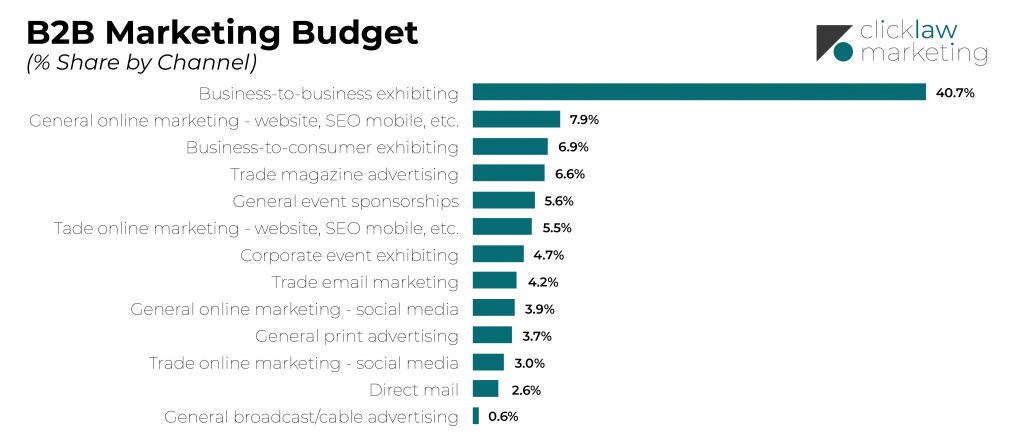
Law Firm Marketing Spend by Share
In the above point, we used the example of events being cancelled, and for a lot of law firms there will be budget allocated to marketing activities that will no longer be relevant, such as:
But, as aforementioned, at a time where much of the working world has been moved onto the online workspace many law firms will choose to keep the money saved from cancelled events in the bank, you can potentially move ahead of them by focussing your efforts on digital marketing. The demands on the internet are expected to increase during this current Covid-19 crisis, so use the abundance of additional users online to your advantage. Focus your efforts on:
All of the digital channels above are likely to be seeing higher volumes of usage in the coming weeks, so if you position your law firm in these places with your marketing, you’ll be ensuring visibility in front of your clients at a time when others are hiding.
There are other digital methods you can use to market yourself during this time. For example, add a chatbot to your website to ensure that you’re making contact with any visitors.

Legal Marketing During the Coronavirus Tips & Tricks
Right now, people are searching for as much information on the Coronavirus and its impact. Trends in the SERPs (Search Engine Results Pages) relating to working from home, employment law, sick pay, tenancy rights etc. are all through the roof. Use your knowledge in these areas to be the business that provides the answers to the questions your clients are desperately searching for. People are confused and scared, so let them find your calm voice of authority and information and they will instantly recognise your law firm as a worthwhile practice.
When you create your content, at the moment, think about the titles and keywords you’re using. Ensure that you’re not just focussing on one keyword in your content, utilise long-tail keywords and remember that Google and the other search engines love relevance and so make sure your news article or blog is relevant to the search query you think your customers will be looking for.
While we are discussing the reasons why you should continue to market during the Coronavirus pandemic, one course of action that we would strongly recommend you avoid is exploiting the situation, like this pharmacy who were selling Calpol for £20. With that in mind we would suggest you avoid:
Price gouging – Don’t hike the prices of your services related to the Coronavirus. Customers are looking to you for trust and guidance, not to be taken advantage of.
Creating ‘new products and services’ that don’t exist – Creating ‘new’ services marketed to help people during a crisis that aren’t new or useful at all, only serve to take advantage of vulnerable and scared customers and that will lead to bad relationships and reputations.
Panic Inducing Content – Instead of trying to pray on fear and worry with alarmist blogs and emails, be the voice of reassurance and guidance. This is a time to help not frighten. Your customers will thank you in the long run.
It’s important to recognise that every touchpoint with your customer is a form of marketing and customers will remember if you were the law firm that attempted to scare them into a service they neither wanted nor needed at a time of global panic and confusion. So instead, be the law firm that helped them with good advice and service when they needed it and that’s what they’ll remember long after the crisis subsides.
Everyone’s world has just got a little bit smaller, so now is the perfect time to ensure that you are set-up for Local Search Marketing. If you haven’t already got a Google My Business, get one, it is a great way to advertise your business for free, thanks to Google. You can add all your business details, get reviews from customers (recommendations are still the number one way clients choose law firms) and make sure you update the hours if they’ve changed because of Covid-19. Make sure your customers are aware of how and when they can reach you in the local area.
For more advanced local search marketing why not tailor some of your content and SEO for those in your local area and build in some localised Google PPC campaigns to narrow your focus now that your target customer base may have significantly shrunk.
Hopefully this should allow your law firm to make a good start on planning your marketing strategy during these challenging circumstances. Come back Monday for the second part of our guide to marketing your law firm during the Coronavirus thanks to our friends at ClickLaw Marketing
