
Understand Your Rights. Solve Your Legal Problems
Proceeds from the $254 million securitization were used to pay down Pawnee’s revolving warehouse line and to reduce the outstanding balance of Pawnee’s parent company, Chesswood Group Limited’s, senior revolving credit facility.
Pawnee Leasing Corporation is an equipment leasing company that was founded in 1982 and conducts business in all of the lower 48 states of America. It specialises in providing business equipment leases for equipment financing through an independent network of lease brokers.
Blank Rome LLP represented Pawnee Leasing Corporation in closing its issuance. The team consisted of Steve Whelan, Grant Buerstetta, Jeff Gimpel, John Louros, and Delaram Peimani.
An interview with Steve Whelan at Blank Rome LLP
What was unusual about this transaction?
This transaction was the culmination of an amazing process during which Pawnee closed five securitized financings in a 24-month period. The first two transactions were term loans in a securitized format, the next two were warehouse lines of credit, and finally, the $254 million deal which closed in October 2019, a rated, term securitization. I have been handling equipment finance securitizations since 1985 and seldom have seen an issuer accomplish this complete cycle of transaction format so quickly with efficient execution at each step.
Is the process you undergo different when asset-backed securities are collateralised by equipment leases and loans?
Equipment ABS transactions present additional issues that are not present in, for example, securitizing auto loans. Issuers such as Pawnee many times rely on third parties to originate the leases or loans; the third parties sell those contracts to a financial institution such as Pawnee, which has much better access to advantageous financing than the originators may enjoy. In other securitization markets, many originators sell financial assets directly into the securitization structure rather than relying on an intermediary, such as Pawnee in the equipment market. For equipment loans and larger value leases, it is customary for Pawnee or other originators to file UCC financing statements against the underlying obligor(s), and discussion invariably focuses on the dollar value of the equipment as the threshold for making these filings.
How did you ensure that this decision was the best for all parties?
The decision to perform a term securitization was a business decision made by Pawnee and its investment bankers. When Pawnee closed its revolving warehouse line of credit in August 2018 with RBC, that facility was structured in anticipation that one or more term securitizations would occur. So the documents were written to provide Pawnee with the flexibility to transfer assets from the special purpose entity (that was the borrower under the warehouse) to another SPE which would be the issuer of the term ABS. Some of the 2018 documents were readily adaptable for use in the 2019 term deal. In retrospect, the best decision was to push for a closing early in the fourth quarter of 2019 rather than waiting for early 2020. We all know what the credit markets have been like in 2020!
What issues did you and your team navigate to overcome?
Many of the documentary issues were anticipated during the creation of the 2018 warehouse facility, but others had to be addressed in 2019. One significant issue was demonstrating how Pawnee complied with the risk retention regulations promulgated by the Securities and Exchange Commission and other federal agencies. This not only required the documents to contain appropriate covenants, but also necessitated the financial advisers to structure the credit enhancement to meet or exceed the minimum risk retention amount required by the Dodd-Frank Act and related regulations.
Somewhere in the clouds, not so far away, is a place undeniably magical. A haven for adults trying to escape their imposing schedules. The very essence of ‘being on top of the world’ is simply achieved by being tucked away in the mountains, where there is a fresh glass of Grimbart Pinot Noir patiently waiting for you.
When you first cast your eyes on Hotel Villa Honegg you are greeted with humility and warmth - even during the sub-zero winter. She doesn’t suffocate you with ostentatious opulence; she slowly opens up as esoterically as any secret worth revealing to those willing to understand, to reveal her luxuriance.

Whilst keeping a watchful eye on Lake Lucerne, the Villa gracefully unveils a panoramic view, reminiscent of the fjords, that not a single person would ever tire from waking up to. You could sit on the balcony with your morning cup of coffee, simply admiring nature’s finest work and unbeknownst to you, the day will fall into the evening and you would not be slightly disappointed that the hours passed and you did nothing but gawp at the beauty that lies in front of you.

But, of course, we must not let Bürgenstock’s charm tantalise us from all else that remains on offer here. Indulging in a late breakfast in the lounge filled with freshly baked croissants and local swiss cheese makes you wonder why more places do not serve breakfast until 2pm. Whilst cosily wrapped up in the Villa’s furry blanket, an afternoon glass of Swiss Chasselas on the terrace follows, (because, why not?), right before a quick dip - which unsurprisingly lasts the entire day - amongst the clouds in the Villa’s famous infinity pool.

It is quite possibly the most photographed pool in all history, as it boasts scenery that almost feels like it is a deceiving green screen backdrop. But what photographs fail to capture is the serenity that accompanies you. Whether you are blissfully embracing the snowflakes shyly greeting your skin when encompassed by the pool’s warmth, or enjoying the happy chimes ringing from the bells on the cows grazing the grass in springtime, no photo or Instagram post will ever do justice to the tranquillity surrounding you. A little bit of quiet relaxation is just what the doctor ordered, for our busy, burdened souls and if there is a spa that enables you to forget about yesterday’s problems, then this is the one.


Deceptively, Villa Honegg has been around since 1905. And despite all of her elegance and modernity, the Villa remains to play true homage to her history and culture via our taste buds. “Gastronomy for the discerning”, the hotel’s menu downplays everything that is served in front of you. From creamy tomato soup, to succulent braised veal cheek, you can taste the 14 Gault-Millau points and appreciate the difference locally sourced, seasonal ingredients make. You can take it up a notch and spoil yourself with a wine tasting menu, journey towards a delightful postprandial paradise and finish with a cordial game of fireside chess in the lounge, before residing to your room.
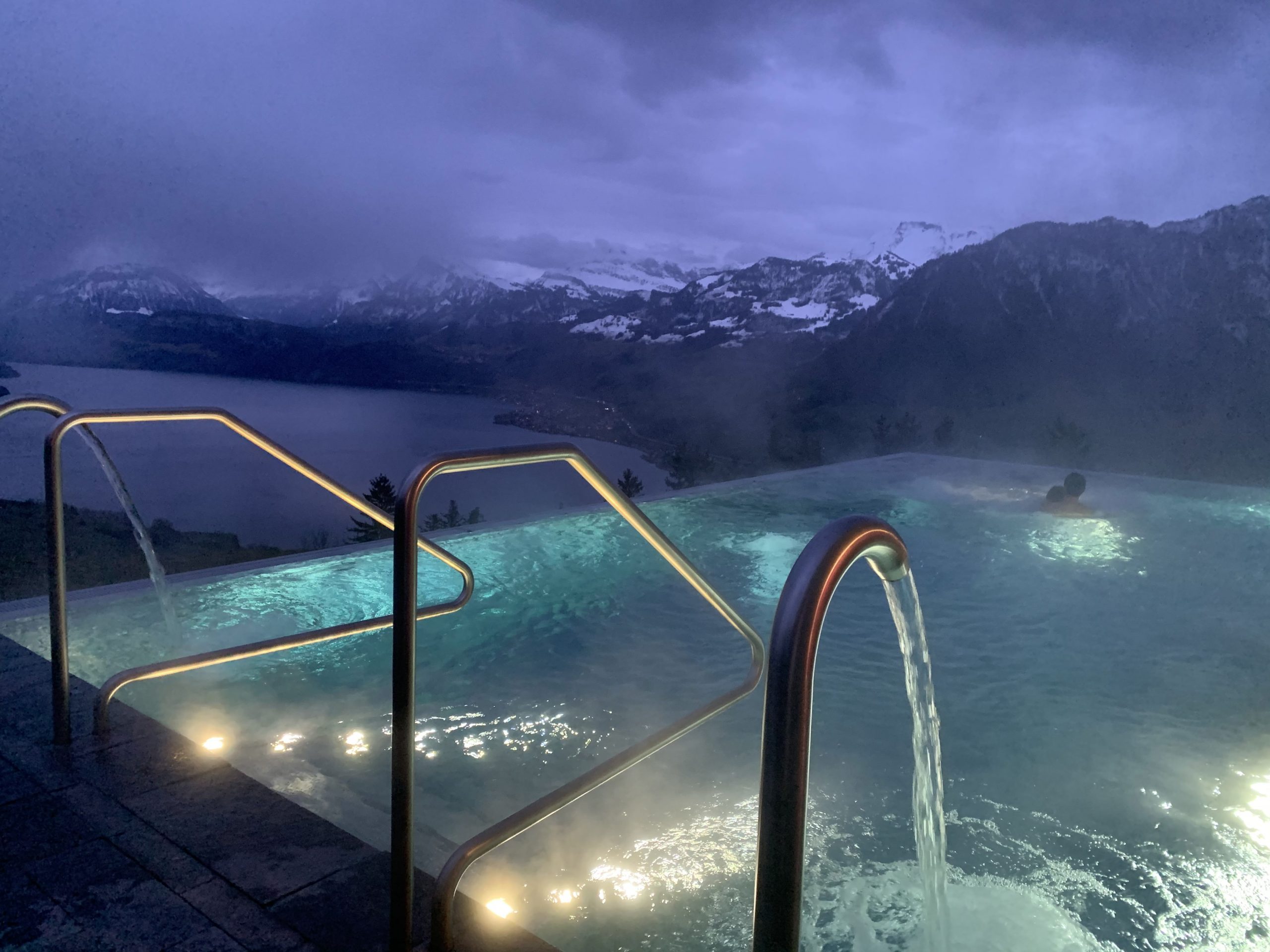
If you are not ready for the night to end, you can reunite with the outdoor pool get lost trying to count all of the stars glistening in the night sky. Or, if you are too full to float, you can head down to the Villa’s private cinema. The in-house cinema has 20 comfortable leather seats and a powerful HD projector that transforms viewings into a cinematic experience. Whether it is just the two of you in pyjamas wanting a rom-com to laugh the night away, or a group of you wanting each other’s company during a thrilling horror, the Villa’s private cinema is the ultimate way to experience luxury.

It is terribly difficult to write in words the experience you get at Villa Honegg; no words quite do it justice. But if there is anything that explains the captivating nature, it is this: Bürgenstock offers a wealth of attractions, from scenic walks up to heavenly viewpoints, to water skiing and canoeing on Lake Lucerne, the region has so much to offer; yet I, nor my travel partner, did not leave the Hotel once during our stay. We wanted to experience the Villa in all its entirety; from the (generously included) minibar in our rooms to the poolside snacks, we wanted to devour our every last moment in this hidden haven up in the Swiss mountains. If I have learnt anything, it is that Switzerland is so much more than just cheese and chocolate; it is a destination you have to experience for yourself.
Neil Williams of business crime solicitors Rahman Ravelli outlines why the Covid-19 pandemic may mean the SFO cannot return to business as usual.
While these are uniquely testing times for many of those in business, the situation is perhaps least straightforward for the Serious Fraud Office (SFO). While many in business and finance will – it is hoped – return to workplaces at some point in the near future to resume what they did in pre-virus times, it is unlikely to be so simple for the SFO.
By the time things return to anything like normal, the SFO’s version of normal may differ significantly from what it was just a few months ago. This could, given time, be an opportunity for the agency to show its mettle and expertise as it meets a variety of new or increased challenges. But any perceived failure to meet those challenges could lead to questions about its effectiveness. It is, after all, only three years ago that the then Prime Minister intended to hand the SFO’s duties to the National Crime Agency.
Such a plan was eventually dropped. But now the SFO will now have to juggle its existing workload – which it tends to tackle with mixed results – with what is certain to be a slew of new investigations arising from coronavirus.
By the time things return to anything like normal, the SFO’s version of normal may differ significantly from what it was just a few months ago.
There is likely to be a public interest in – and strong backing from the public for – investigations and prosecutions of businesses and individuals suspected of making or attempting to make fraudulent gains from the healthcare challenges posed by the pandemic. Whether this is by price fixing of pharmaceuticals or equipment, pandemic-related investment fraud, the sale of counterfeit medical products or online selling of goods at hugely inflated prices or goods that do not exist, the SFO may well have a huge amount of pandemic-related work coming its way. Having had its fingers burnt many years ago with its failed Operation Holbein investigation into pharmaceutical price fixing – which was, at the time, the SFO’s biggest ever prosecution – it may not be relishing any more such cases.
Yet there is a strong possibility such cases will arrive at the SFO’s door. As will allegations relating to those looking to use real or non-existent charities as vehicles for fraud. It would also be a huge surprise if the government’s Coronavirus Job Retention Scheme was not targeted by those in organised crime looking to make fraudulent gains. Chancellor Rishi Sunak has also acknowledged that the payment scheme for the self-employed may also be vulnerable to fraud.
The SFO, therefore, may soon have a bigger workload due to recent events. But such events may also indirectly lead to the SFO facing more challenges from the past.
Warren Buffett’s quote, “It's only when the tide goes out that you discover who's been swimming naked,’’ may not have won any awards for good taste but the point it makes remains valid – when the economy takes a turn for the worse we get to see who wasn’t as legitimate as they appeared before the bad times. The economic problems that coronavirus prompts may reveal historic fraud that would otherwise have remained hidden. And that may well produce more work for the SFO.
[ymal]
The situation at this very moment may mean that the SFO has time to examine cases that have been in the in-tray for a long time while more pressing ones demanded immediate attention. The SFO is now in a position to do some spring cleaning in relation to the cases that do not usually receive prompt action; either because they are not considered urgent or because they were simply too time consuming to make swift progress on. The SFO Director Lisa Osofsky has often spoke of her desire for her agency to move swiftly and efficiently. The lockdown may well give the agency the chance to tackle investigations that have been lingering too long for her liking.
The SFO could, therefore, view the virus-related lockdown as a blessing that gives it the chance to play catch-up on some cases. But it could equally come to regard it as a curse, if and when the avalanche of expected virus-related fraud cases arrives on its desks.
Precisely how such matters will develop is impossible to forecast with pinpoint accuracy. But what can be said with a degree of certainty is that the SFO is facing a number of challenges. They may not all be new. They may not all arrive at the same time. But how it manages the workload that COVID-19 looks set to induce will be provide a true indicator of the SFO’s own health.
New measures are now detailed in the Home Office’s guidance to make it easier for employers to carry out their compulsory right to work checks in light of the stringent social distancing measures currently in place.
Prior to the introduction of this guidance, employers were required to carry out either a manual right to work check or an online right to work check before employing a person.
Speaking to Gurjit Pall, Immigration law specialist at Thorntons, he said: “Under the new temporary measures, the UK Home Office have confirmed that right to work checks can now be carried out via video calls as opposed to the requirement of doing so in the presence of the prospective employee or existing worker.”
Employers will now be permitted to accept scanned documents or photographs of documents from prospective employees and existing workers using email or a mobile app, instead of requiring original documents to be sent to them.
“Where the prospective employee or existing worker sends a scanned copy or a photo of their original documents via email or using a mobile app, the employer should arrange a video call with the prospective employee or existing worker. The employer, during this video call, should ask the prospective employee or existing worker to hold up their original documents to the camera and check this against the digital copy of the documents sent to the employer prior to the video call.
“As per the existing requirements for right to work checks, employers will be expected to record the date the check was made, however under the new temporary measures, employers will be asked to mark the file copy of the check made with “adjusted check undertaken on [insert date] due to COVID-19”.
Where the prospective employee or existing worker has a current Biometric Residence Permit or Biometric Residence Card or status under the EU Settlement Scheme, employers will be able to use the online right to work checking service while doing the video call. It is important that employers obtain permission from the applicant prior to viewing their details.
“These are temporary measures, and employers must keep all evidence and carry out retrospective checks within 8 weeks of the Covid-19 measures ending”, expands Gurjit. “These retrospective checks will need to be carried out on existing employees who either started employment during these measures or required a follow-up right to work check during these measures.
Employers should take extra care, however, to ensure that no one is discriminated against as a job applicant or employee because they are unable to show you their documents. The Home Office Employer Checking Service will continue to be operational and should be used where the job applicant or existing worker cannot show their documents.
“Where an employer is found to be employing someone illegally and has not carried out the prescribed checks – or their temporary alternative measures - they could face substantial sanctions including but not limited to a civil penalty of up to £20,000 per illegal worker; in serious cases, a criminal conviction carrying a prison sentence of up to 5 years and an unlimited fine; closure of the business and a compliance order issued by the court.
“Caution should therefore be exercised when applying these new temporary right to work checks in practice.”
Insight from Gurjit Pall, Immigration law specialist at Thorntons
The team was led by Mr Phan Vinh Nhan, Partner, who specialises in M&A and private equity and is based in Ho Chi Minh City.
Mirae Asset-Naver Asia Growth Fund and Eastbridge Partners participated in a bidding process against other investors. This deal required extensive legal due diligence of POPS Worldwide and its Vietnamese and Thai subsidiaries. The transaction agreements were carefully tailor-made and heavily negotiated to, on the one hand, accommodate the commercial intent of the parties (among others, to minimise disclosure and leakage of information to the market and achieve the most tax efficient structure) and, on the other hand, ensure the compliance with the applicable legal requirements. Established in 2008, POPS has been providing online entertainment and kid content through multiple digital platforms such as YouTube, Facebook, Spotify, Apple Music and Amazon.
Rather than the whole assessment being postponed for an unknown timeframe, and in awareness that solicitors were informing us that they wished to continue to litigate cases, we considered the possibility of digital/ video-based assessments.
To date, we have been very pleased with the assessments we have undertaken, although naturally they have only been happening for approximately one month and we are continuing to review them.
Our first considerations
Our first consideration was Data Protection but we were aware that data protection rules had, according to NHSX IG Policy, been relaxed: “The health and social care system is going to face significant pressures due to the Covid-19 outbreak. In the current circumstances, it could be more harmful not to share health and care information than to share it. The Information Commissioner has assured NHSX that [she] cannot envisage a situation where she would take action against a health and care professional clearly trying to deliver care”.
This advice was further endorsed by the Information Commissioner’s Office, the National Data Guardian and NHS Digital: “We encourage the use of videoconferencing to carry out consultations with patients and service users. This could help to reduce the spread of COVID 19. It is fine to use video conferencing tools such as Skype, WhatsApp, Facetime as well as commercial products designed specifically for this purpose. The consent of the patient or service user is implied by them accepting the invite and entering the consultation. But you should safeguard personal/confidential patient information in the same way you would with any other consultation”.
We were aware that some of our speech and language therapy experts were very familiar in their clinical practice with the use of virtual assessments, so we were able to draw from their experiences.
We have been using Consumer Skype and recommend that our experts use this. There are, of course, other platforms available and we may consider the use of these in time. We contacted the Royal College of Occupational Therapy (RCOT) for guidance and they acknowledged (OTnews, April 2020) that “remote working usually requires extensive planning and we know that members have faced introducing new working practices without that stage”. However, they also recognised that: “…even in these times, occupational therapists need to use their clinical reasoning skills to determine what are the right tools to use at the right time”. Indeed, the RCOT continued to rapidly expand the advice in this area.
We were aware that some of our speech and language therapy experts were very familiar in their clinical practice with the use of virtual assessments, so we were able to draw from their experiences. Subsequent to us undertaking our first few virtual assessments, APIL and FOIL published the Best Practice for Mutual Co-Operation, 31/03/20 in which they stated that: “It is inevitable in the current circumstances, face-to-face examinations will be difficult to arrange. It will often be in the client’s best interests to agree to use some form of video conferencing for experts’ ‘examinations’ of the injured person. The BMA has issued guidance to medics indicating that the NHS is turning to remote consultations in order to minimise the risk of infection for staff and patients”.
Are virtual assessments suitable for all Claimants?
Whether an assessment can be carried out virtually depends on:
With the agreement of the claimant’s solicitor, we have asked that the expert contacts the Claimant prior to the assessment to ensure they have access to a telephone/ iPad/ computer on which they can video conference.
For cases where the clinical hands-on assessments are key to the opinion, they will be unable to be replicated by video means. Examples of these include:
Ultimately every case requires consideration on its merits and careful discussion with the instructing solicitor because much depends on the clinical presentation, nature of litigation/case, budget constraints, state of proceedings and client choice.
What happens prior a virtual assessment?
With the agreement of the claimant’s solicitor, we have asked that the expert contacts the Claimant prior to the assessment to ensure they have access to a telephone/ iPad/ computer on which they can video conference. At this stage, the expert also checks that the claimant is indeed happy to be assessed by these means. It has been our experience that many claimants’ solicitors have already discussed and obtained permission for this. To date, we have not, however, had any Claimant refuse a video assessment.
We do ask that where possible (and we strictly reinforce that there must be no breach in social distancing rules), for a claimant to have somebody present (e.g. a close relative living in the same household) during the assessment. This is encouraged so that they can hold the iPad/phone, such that the expert can observe the claimant in activities of daily living e.g. mobilisation, transferring and negotiating the stairs. It would be difficult for a Claimant to undertake activities of this nature safely whilst also trying to hold their phone/iPad. On some occasions, it has been possible for the lone Claimant to prop the device up and for the expert to observe their function.
Preparation by the expert is paramount and we, therefore, have the following checklist which the expert runs through with the claimant prior to the day of the virtual assessment:
What happens during a virtual assessment?
Dependent upon the quality of the broadband strength and the visual/auditory quality, some experts are using Skype for the entirety of the assessment where others have used a combination of Skype and telephone.
Our experts have been able to discuss the following with the claimant and/or family member:
Our experts have been able to objectively assess through observation:
The Skype picture can sometimes be poor, which makes it difficult to see 'micro expressions' and it is, therefore, harder to tell if a Claimant is tearful or on the verge of tears which you would see instantly in person.
The benefits of virtual assessments
Our findings, so far, are very positive with many experts reporting that they feel very able to prepare a CPR compliant report for many cases on the basis of the virtual assessment.
The challenges experienced with virtual assessments
Of course, ultimately, the most significant consideration is the reliability of the assessment findings, and the extent to which the expert considers that the assessment findings were sufficient for them to form a robust opinion on. Practice Direction 2.4 requires that: “Experts make it clear when they are not able to reach a definitive opinion, for example, because they have insufficient information”.
Experts should: “Indicate if an opinion is provisional, or qualified. Or where they consider further information is required or if, for any other reason, they are not satisfied that an opinion can be expressed finally and without qualification”.
If, therefore, an expert did find that they were unable to provide a definitive opinion because they could not observe a function, record clinical findings or the quality of the sound/image was unclear they must make this clear within their report. It is imperative that the expert informs their instructing solicitor on the measures that should be taken and to provide them with the information required. It may be depending upon the case and the circumstances, that a face to face assessment is still required at a later stage in some cases.
In conclusion, virtual assessments do have a role but should be appropriate to the claimant’s clinical condition and need, whilst contextualised to the interests of the instructing solicitor and their client, but in no way compromise an expert’s ability to discharge their responsibilities under the Civil Procedure Rules.
Will virtual assessments still have a role in the post-Covid-19 era?
At Somek and Associates, we are continuing to evaluate all of the virtual assessments that we undertake and are establishing a comprehensive knowledge base as to which cases are and are not suitable for virtual assessments. Our findings, so far, are very positive with many experts reporting that they feel very able to prepare a CPR compliant report for many cases on the basis of the virtual assessment. It is therefore possible that cases limited by budget or time, could continue to be undertaken via a virtual platform on an ongoing basis, dependent upon the nature of the case.
However, by no means does it exclude the need for in-person assessments to be undertaken. A large part of the in-person assessment, are the observations (e.g. concentration, pain, fatigue) many of which are subtle and happen from the minute the claimant opens the door. An in-person assessment of the environment will be better at identifying safety considerations, for example, the extent to which carpets are well-fitting, the suitability of lighting and presence of small internal thresholds (etc.). Furthermore, the expert witness will be considering if there are any inconsistencies in information provided with reference to what they are observing.
In conclusion, virtual assessments do have a role but should be appropriate to the claimant’s clinical condition and need, whilst contextualised to the interests of the instructing solicitor and their client, but in no way compromise an expert’s ability to discharge their responsibilities under the Civil Procedure Rules.
References
Best Practice for Mutual Co-Operation, APIL and FOIL, 31/03/20
Covid-19 Information Governance advice for Health and Care Professionals, www.tinyurl.com/NHSx-guidance
Remote working rollout sped up to keep staff and service users in touch, OT News April 2020
Jessica Thurston, Chief Operating Officer and Care and Occupational Therapy Expert, Somek & Associates
Somek & Associates Limited
9 Chess Business Park, Moor Road, Chesham Buckinghamshire HP5 1SD
01494 792711
admin@somek.com
https://www.somek.com/
Jessica qualified an Occupational Therapist in 1994 and specialised in the field of adult physical disability, with a particular interest in amputees (upper and lower limb and the management of individuals with multiple limb loss). She has been an Expert Witness for approximately 20 years.
Somek & Associates is a brand leader in providing Expert Witness services for clinical negligence and personal injury litigation, as well as other areas of dispute, involving health or disability issues including family matters, criminal cases, tribunal, coroner’s court and professional regulation issues.
The Order No 2019-1169 of 13th November 2019, incorporating the provisions of Directive (EU) 2015/2436 of 16 December 2015, has been applicable since 11 December and has introduced important changes in the French law.
First, the requirement of a graphic representation has been abandoned in order to make the application of “non-traditional” trademarks possible by updated technical means. New official fees are applicable with the possibility to file and renew for one class only. Also, the absolute grounds for refusal now include Appellations of origin, geographical indications, traditional terms for wine and traditional specialities guaranteed, and earlier plant variety denominations. In addition, provisions relating to collective trademarks are amended and certification trademarks are superseded by guarantee trademarks.
Proofs of use are now to be provided for the five-year period preceding the application date of the opposed trademark and for all the goods or services which serve as the basis of the opposition.
The opposition procedure is now available to new prior rights: company names, commercial names and domain names which do not apply only locally; if there exists a likelihood of confusion for the public; and, reputed trademarks, when the use of the later trademark without due cause would take unfair advantage of, or be detrimental to, the distinctive character or the repute of the earlier trademark.
The opposition procedure is also opened to public entities when the later trademark is detrimental to their name, image or repute or if there is a likelihood of confusion for the public. Opposition can also be filed against trademarks that are filed in their own name by an agent or representative of the proprietor of the earlier trademark without authorization from the respective person. In addition, several earlier rights may be invoked in one opposition procedure.
Proofs of use are now to be provided for the five-year period preceding the application date of the opposed trademark and for all the goods or services which serve as the basis of the opposition.
Non-use of a trademark has new consequences: The action in invalidity is inadmissible if, on request of the defendant, it cannot be proved that the prior trademark was used during the five-year period preceding the date of the action, or that there are proper reasons for non-use.
Procedural rules have been amended, including the possibility of filing several submissions and additional documents during the now maximum nine months opposition procedure.
These new provisions have been applicable against trademark application filed as from the 11th of December 2019.
Provisions relating to invalidity or revocation procedures has also entered into force on 1 April 2020.
The French PTO now has exclusive jurisdiction regarding primary actions based on absolute grounds or on the invalidity of non-use. No interest to act is required from the demanding party. The office still shares jurisdiction with Courts regarding actions based on relative grounds of invalidity. The courts remain competent in a case where there is a connected issue of unfair competition, and remain exclusively competent regarding infringement actions, and investigative, interim or provisional measures.
The application for invalidity can be based on several grounds and/or rights. The procedure is detailed in an application decree.
Non-use of a trademark has new consequences: The action in invalidity is inadmissible if, on request of the defendant, it cannot be proved that the prior trademark was used during the five-year period preceding the date of the action, or that there are proper reasons for non-use. This is also the case if the earlier trademark has been registered for more than five years, and if its owner cannot prove that their trademark was used during the five-year period preceding the application date of the later trademark, or that there were proper reasons for non-use.
The limitation period for infringement actions will now be five years from the day the right holder knew or should have known the last fact enabling him to exercise his right.
Similar provisions apply to reputed trademarks or trademarks for which distinctiveness was acquired through use.
There is no more limitation period attached to invalidity actions, with the exception of actions based on well-known trademarks in the sense of Article 6bis of the Paris Convention, for which there is a five year limitation period, except in the case of bad faith. However, the invalidity action will be inadmissible if the applicant knew the later registered trademark and has tolerated its use for five years.
The infringement action is extended to also cover the offer, the placing on the market or the possession notably of packaging, labels, marks or any other support on which the trademark is attached and merchandise in transit. The limitation period for infringement actions will now be five years from the day the right holder knew or should have known the last fact enabling him to exercise his right.
The French PTO has been working on the implementation of the invalidation procedures by recruiting and training new people. Despite the Health Emergency State, they will be available at the predicted date of 1st April. We will see soon if professionals adopt and make them theirs.
Aurélia Marie
Partner
www.bdl-ip.com
amarie@bdl-ip.com
+33 (0)1 44 18 89 00
Aurélia Marie is Head of the firm’s trademarks, designs, domain names and copyright department. She specialises in the law of distinctive signs (trademarks, company names, trade names, domain names, etc.), designs and copyright, both as regards acquiring such rights and exploiting them. She also has wide expertise in conducting due diligence reviews on portfolios of trademarks and designs, contracts, advertising law and unfair competition.
Given the current laws in action, when is coronavirus covered by workers’ compensation?
It would be a difficult and rare occurrence for private-sector employees diagnosed with COVID-19 to be covered by workers’ compensation laws. In North Carolina, as with many states, an injured worker has to show that the disease is a characteristic of and peculiar to a particular trade or occupation, and not an ordinary disease of life that the public is equally exposed to. That requirement alone seems to eliminate mostly everyone since we are in fact facing a worldwide pandemic of COVID-19. Even if an employee could show an increased risk that was specific to their trade, they would still need to prove that the employment actually caused the disease. One job sector, health care workers, may have the best chance of recovering because they are at a higher risk as a result of their jobs. But they may still have a difficult time proving that the exposure came from their job and not some unrelated activity outside of work. For most individuals that contract COVID-19, a workers' compensation claim will not be worth pursuing due to the short duration of the illness. But, given the seriousness of the disease in a small number of cases (including death), we expect to see litigation on this topic in the near future. There is a possibility that the North Carolina legislature could classify COVID-19 as a compensable event under NCGS 97-53 Occupational Disease Classification for health care workers, but that seems unlikely given the diffuse nature of the disease.
Federal employees may have better luck finding coverage under federal employee compensation rules for COVID-19 illness. The United States Department of Labor recently announced that a federal employee who contracts the coronavirus while in the performance of their job duties would have full coverage under the FECA for medical bills, lost wages and disability. The statement made it clear that exposure is not covered, but that a federal employee with a medical report from a qualified physician indicating a positive test result for COVID-19 based on an established work-related exposure, would qualify for federal workers’ compensation benefits.
What should employers be doing to avoid potential claims:
There are several excellent resources for employers, including the CDC and OSHA. Employers should also strictly enforce requirements that employees stay at home while sick and should send sick employees home immediately. By now, most employers have suspended business travel that is not absolutely necessary. Employers should also be looking for ways to avoid visits to customers’ homes and to limit customer contact with employees. When customers enter the workspace, employers should consider screening the visitors for COVID-19 exposure and sickness as well as Level 2 or 3 international travel. Employers should consider having non-essential employees work from home and should be flexible with leave for childcare with schools closed.
What can employees do to prevent potential claims:
Of course, the social distancing and hygiene guidelines should be followed. Employees should stay home if they are sick with flu-like symptoms or living with someone with these symptoms. If co-workers are sick or there is a shortage of protective equipment or cleaning supplies, the worker should report these things to supervisors immediately. Employees might suggest a remote work plan to their supervisor or suggest condensing the workweek to four, ten-hour days to lessen time in the workplace.
What other liabilities exist because of COVID-19?
I see four primary categories of liability arising from the novel coronavirus.
First, employment-related claims resulting from violations of federally mandated employee protections, such as The Family Medical Leave Act, The Americans with Disabilities Act, and the Fair Labor Standards Act. Employers also face possible claims for failure to protect employee privacy in the event an employee is diagnosed with COVID-19.
Second, claims that allege a failure to take reasonable precautions to protect customers are looming against businesses such as restaurants, daycare and nursing care facilities, airlines, or any other high-density business dealing directly with customers. Some lawsuits have already been filed against cruise lines by passengers who were exposed to COVID-19.
Third: Business litigation will be unprecedented as the disruption in the supply chain from China made it impossible for most manufacturing businesses to meet contracts. Quarantine and business closures impacted demand and caused contract breach allegations to arise on the buyer side as well. It is hotly debated whether force majeure clauses in contracts include pandemic outbreaks in their intended meaning.
Fourth: Insurance litigation will abound with countless businesses trying to utilize business interruption insurance to regain losses from forced closures and interruption in the supply chain.
What initial impact has Covid-19 had on your legal practice so far?
At Lanier Law Group, we have seen many impacts from COVID-19. Quarantine and shelter in place/at home orders mean that fewer people are driving and going to work. This naturally means that there are fewer automobile accidents and work-related injuries. Interestingly, we have seen an increase in inquiries about medical malpractice, wrongful death, and sex abuse claims. Social Security Disability claims are also expected to rise sharply in the aftermath of COVID-19 because of the devastating damage the virus causes in survivor’s lungs.
We have always employed the latest technology and tried to approach our practice in a forward-thinking manner. So, when COVID-10 struck we were ready with technology in place to transition to video conferencing and digital document signing. We are able to move our client’s cases forward by transitioning mediations, depositions, and hearings to video conference. Client’s settlement paperwork is all handled with DocuSign and funds are wired in lieu of using a paper check. These measures keep our employees and clients safe from this terrible virus.
Lisa Lanier
Attorney
I am Lisa Lanier. I have been working in personal injury law since 1992. I worked for a large firm for five years before founding Lanier Law Group, P.A. We are a statewide practice serving all of North Carolina in many areas of injury-related law, including serious automobile accidents, products liability, workers’ compensation, medical malpractice, and sex-abuse litigation. I host two weekly radio broadcasts on Two Guys Named Chris on Rock 92 and Jared & Katie on 107.5 KZL. We are developing a podcast offshoot of our nationally syndicated Lawyer Up with Lisa on The Two Guys Named Chris Show.
What are the measures that the Indian Government has proposed to protect workers/ employees in the light of the COVID-19 pandemic?
In a very significant move, the Prime Minister of India on 24 March 2020 announced a 21-day nation-wide lockdown with effect from 00:00 hours on 25 March 2020. The initial lockdown has now been extended up to 3 May 2020 by the Prime Minister, and the Ministry of Home Affairs has directed that the lockdown measures stipulated earlier continue during this period. This lockdown of nearly one-fifth of the world’s population is to ensure effective social distancing to prevent the spread of Covid-19. While the lockdown is undoubtedly essential to contain the pandemic, the impact on businesses and the economy cannot be ignored. In this regard, the Finance Minister, Ms Nirmala Sitharaman, on 26 March 2020 announced a relief package of INR 1.70 Lac Crore, under the Pradhan Mantri Garib Kalyan Yojana, especially for the underprivileged and poor population of the country. This includes the Government contributing both the employer’s and employee’s share of the provident fund contributions for the next three months in respect of the establishments/organisations with up to 100 workers, where a majority of the employees draw a monthly salary of INR 15,000 or less.
Further, the Employees’ Provident Fund Scheme, 1952 has been amended to include pandemic as a reason to allow withdrawal up to 75% of the non-refundable advance standing to the credit of the employees in the provident fund accounts or three months basic wages and dearness allowance, whichever is lower. Medical insurance cover of INR 50 Lacs (per person) has also been provided for every medical professional, health worker including inter alia nurses, doctors, technicians, paramedics, cleaning staff, ASHA workers, sanitation workers etc. State governments have been instructed to utilise the amounts accumulated in the building and other construction workers welfare fund for providing relief and economic support to the workers in light of the Covid-19 crisis.
Are there any employment law issues that should be kept in mind while implementing work from home models?
Given the lockdown, most employers have been asked to have their employees work from home where possible. The key employment law considerations that employers should keep in mind when implementing work from home are:
Hours of Work, Productivity and Performance Testing
The concept of working from home is not specifically regulated or governed by statute. Therefore, in the absence of a specific statute, the employment laws that would otherwise apply to an employee when they are working from the employer's establishment would continue to apply and an employer would have to be mindful that employees do not work beyond their regular working hours and adhere to relevant overtime requirements. In relation to performance tracking and productivity, the employer will now have to adapt the usual methods to work from home. This will include using applications to monitor their employees working remotely and requiring the employees to periodically provide summaries to their managers of the work that they are doing.
Confidentiality and Data Security
One of the primary considerations when it comes to allowing employees to work from home is confidentiality and data security. Therefore, it is recommended that employers take additional data security measures to ensure that their IT infrastructure and resources are protected. Certain employers have resorted to geo-tagging of their devices to ensure that their data security and confidentiality is not breached.
OSP Licences
To facilitate employers to allow employees to work from home, the Department of Telecommunications has, through circular dated 13 March 2020[1], issued certain relaxations in the terms and conditions prescribed for Other Service Providers (OSPs), with respect to the ability of their employees to work from home. The exemptions/relaxations were available until 30 April 2020. This circular inter alia exempts OSPs from the requirement to pay a security deposit and have an agreement to enable work-from-home options or seek prior permission to allow work from home. Further, OSPs have been exempted from the requirement of having a secured VPN from an authorised service provider. OSPs may now use secured VPNs configured using ‘static IP’ addresses by themselves to enable interconnection between the home agent position and the OSP centre with pre-defined locations.
Is India doing enough for the employment sector? What more could be done?
Given the lockdown and the general economic distress globally and in India, employers across various sectors are facing a significant cash crunch due to the lack of production and/or consumption by customers, and the ability to collect payments. This has lead many businesses to examine various cost-cutting measures to ensure that they are able to sustain their business once the lockdown is lifted. These measures would include reduction in their overheads, which includes employee salaries. In this regard, the Central Government and various State Governments have issued directives and advisories encouraging/requiring employers not to terminate their employees and pay full wages to them. While this is a commendable step and would ensure job security during the lockdown, it would have an adverse impact in the long term. Due to these directions and advisories, employers may not be able to undertake any cost-cutting measures in the short term and will have no option but to exhaust their reserves, potentially resulting in drastic steps such as winding-up businesses or looking at major restructuring in the long term. This is hazardous for the economy and employment. Therefore, it would be important for the Central and state governments to provide clarity and uniformity with regard to the directions/ advisories to employers and to allow employers, in a regulated manner, to negotiate and arrive at an understanding with their employees to allow for some short term measures such as a temporary reduction in wages or providing for employees to go on leave to reduce the liability of the company with a longer term view of retaining jobs.
Ms Nohid Nooreyezdan
Senior Partner
AZB House | Peninsula Corporate Park | Ganpatrao Kadam Marg | Lower Parel | Mumbai 400 013
Tel: + 91 22 6639 6880 | Fax: + 91 22 6639 6888 | www.azbpartners.com
As a Senior Partner based out of Mumbai, I have been with the Firm since its inception and head up the Employment Law practice. Being in the profession for over 24 years, I have advised clients from various sectors on the rapidly evolving nuances of Indian employment law.
AZB & Partners is one of few firms in the country with a dedicated Employment Law practice, with a focus on the same for more than two decades. Having witnessed and experienced the impact of globalisation and technological advancement on workforce engagement and workplace dynamics, the Firm has provided pragmatic advice and solutions to clients on the application of India’s complex employment law regime, bearing in mind the organisation’s practices, objectives and culture. In addition to our robust Employment Law practice, our industry-specific experts ensure that our advice is holistic, taking into account the nuances of various sectors. The Firm has strong Litigation, Tax and Intellectual Property practices, which provide the required support to ensure that our advice is thorough and complete. The Firm also has excellent working relations with specialized labour counsels and a Compliance and Investigation practice, bolstering the Employment Law practice, especially with respect to investigations around misconduct by senior management and workplace sexual harassment.
[1] https://dot.gov.in/sites/default/files/Relaxation%20inT%26C%20of%20OSP%2013.3.20.PDF
“Jurists and lawyers have struggled and continue to struggle to balance the health and safety needs of their local communities with the civil and constitutional rights and liberties of individuals and groups”, stated Chief Justice of California Tani Cantil-Sakauye[1] at an emergency meeting of the Judicial Council earlier this month.
“…As part of our ongoing collective efforts to flatten the curve, stem the spread of the virus and assume the responsibility delegated to us by Governor Newsom … we seek to address the issues of the faces behind the cases and those that support them seeking relief, resolving disputes or having their voice heard by the court”, Cantil-Sakauye said.
Rules have allowed courts to conduct proceedings through video feed or other remote technology—with the consent of defendants, but measures have seen in-person oral arguments being suspended, as well as the suspension of jury trials in all superior courts for 60 days. John Klopfenstein summaries below the impact it has had on criminal law attorneys and concerns he has for his clients.
The Covid-19 virus has turned the California justice system upside down. A criminal defendant who is in custody has a right to be arraigned within 48 hours of arrest. Further, he or she is entitled to a preliminary hearing within 10 court days of the arraignment to know if he or she is going to bound over for a court of jury trial and has the right to have the trial 60 days from the date of being re-arraigned after the preliminary hearing. This is called a "no time waiver" scenario.
However, with the courts being currently closed because of the Governor of the State of California issuing a "Shelter In" order, imposing social distancing measurements, the Chief Justice of the California Supreme Court has, therefore, now ordered all jury trials, both criminal and civil, to be continued to a minimum of 60 days; this means our clients are being denied due process in violation of both the US Constitution and the State of California constitution.
What that means is your client is going to spend more time in jail when it is not necessary. Given this fact, there has been some talk about releasing nonviolent felons because of the strain on the judicial system and with them being out of custody, the hope is they would then waive time and not be subject to a "no time" scenario.
The California Attorneys for Criminal Justice is urging criminal defence attorneys to fight this order by objecting to the continuance and preserving it for appeal. Obviously, the health and welfare of court employees and the public are important, but in my opinion, they do not outweigh a criminal defendant's right to fight his or her case within the constitutional rights guaranteed by our 4th, 5t h and 6th amendments of the US Constitution.
John F. Klopfenstein
Attorney at Law
9 W Gabilan Street, Suite 6
Salinas, CA. 93901
Telephone: (831) 751-3947
Fax: (831) 751-3982
John F. Klopfenstein and his firm: Law Firm of John F. Klopfenstein is located in Salinas, California, serving Monterey County, Santa Cruz County, San Benito County and Santa Clara County. John has been practising criminal law for over 27 years and has handled over 10,000 combined misdemeanours and felony cases. He has tried eight homicide cases and has tried well over 100 felony jury trials. John received his law degree from San Diego’s Thomas Jefferson School of Law and has been practising in California since 1993.
[1] https://www.law.com/therecorder/2020/04/03/how-covid-19-is-impacting-california-courts-roundup-of-services/
