
Understand Your Rights. Solve Your Legal Problems
Below Emma Jones, senior lecturer in law and member of the Open Justice team at the Open University, talks to Lawyer Monthly about the various ways you can bets plan your legal studies and get ahead of your fellow students.
One of the key differences between success and failure in legal studies is the way students organise their studies and manage their time. Getting into good habits will make for a much smoother study experience and prepare you well for life in the legal profession. Here are five top tips to managing your legal studies effectively:
Whether you keep it in your pocket and scribble in it, or note everything using an app on your smart phone, it is really important to note down key deadlines. This can include dates and times of lectures and seminars, meetings with fellow students and dates for submitting assignments. Make sure you set a reminder for at least one week in advance too, so that you can complete any necessary preparation.
If you’ve got your own room, make sure you have a desk and chair to use. If you’re in shared (or very noisy) accommodation, you might find it better to use the university library or a quiet corner in the Law School. If you are going to be studying away from home regularly, make sure you have a bag or backpack with everything in it you need to work – books, highlighters, laptop charger, etc.
Spend some time thinking about your schedule and deciding which times you will set aside for study. Make sure you are being realistic – if you are going to be out every Saturday night, then deciding to set aside Sunday mornings to write assignments probably isn’t going to work! Think about the times of day you work best and try to concentrate your study in those. Often, studying in shorter chunks with quick breaks in between is the most effective way to learn. Plan in some flexibility for those weeks when other commitments arise and try to give yourself more time than you think you’re going to need. Make sure you build in time for hobbies, seeing friends and relaxing too.
If you’ve met a deadline, or finished a piece of reading, don’t forget to build in rewards. These can be anything from a cup of tea and a chocolate biscuit to a new purchase or a big night out! Having an incentive you are working towards can really help motivate you and focus your mind.
If you are writing notes (and you definitely should be) make sure you are keeping them in notebooks or files that are clearly labelled and stored somewhere safe. Investing in post-its, index cards and sticky labels can all help you to keep track of key points. When storing information on your computer or laptop you also need to ensure you create files which are clearly named and easy to access. If you have different versions of the same document, it is really important to save these under different names (for example “draft 1”, “draft 2” and “final version”).
The best laid plans will go awry on occasion. When that happens, make sure you keep your tutors, course convenors or other appropriate people updated so that they can help you. A good idea is to try and develop a strategy for how you will catch up/get back on track and explain this to them, so that it’s clear you are trying your best to sort out the problem. When you have resolved things, make sure you spend some time reflecting on what went wrong and how you handled it, to see if there is anything you can learn for next time. Remember, you often learn more from your mistakes than your success.
The findings are from Mactavish, which reviewed every UK court case or arbitration appeal relating to payments under primary business insurance policies (excluding consumer and reinsurance cases) between 2013 and 2018. Over this period, just 32% of decisions went in the policyholder’s favour.
The majority of disputes that organisations have with their insurers are settled through private arbitration, primarily because of unfavourable (and generally unchallenged) policy terms that limit the policyholder’s options in the event of their insurer disputing a claim.
Mactavish estimates that on average it takes around three years for disputes to be resolved, and where settlements are made, they tend to be for around 60% of the original amount claimed. A massive 45% of large claims will in fact be disputed.
Mactavish’s research found the most common sectors involved in public disputes with their insurers were transport, manufacturing, construction and business services.
The main causes of insurance disputes are whether the loss is covered by the policy at all, followed by how the value of the loss should be calculated. Secondary causes of dispute are breaches of policy conditions and inadequate risk disclosure. There is also a growing trend for insurers to dispute claims because there has been late or incomplete notification from the client.
Bruce Hepburn, CEO of Mactavish said: “Our findings are disturbing for organisations that are looking to challenge their insurer’s decision not to pay-out on a claim when they perceive the decision to be unfair. However, hiring professional advisors to help in this area can greatly enhance your chances of success – both to prevent disputes arising when handling a claim and to resolve them if they do.”
Mactavish offers a range of insurance governance services to organisations including analysis and the development of a resolution strategy for a potential or actual dispute with insurers. This is as an alternative to formal litigation or arbitration.
Combining Mactavish’s policy wording, insurance law and commercial negotiation skills to assess the validity of the points in dispute, the service aims to negotiate and agree claims settlement rapidly.
(Source: Mactavish)
The legal industry faces huge challenges when it comes to workplace stress and burnout. Extremely long hours, large workloads and unrelenting requirements to meet client demands are common issues that can all affect stress levels. Unsurprisingly, in 2018 over 82% of junior lawyers reported feeling regularly or occasionally stressed with a further 26% being severely/extremely stressed.
Burnout is a state of emotional, physical, and mental exhaustion caused by excessive and prolonged stress. It can lead to physical and emotional exhaustion, detachment and reduced productivity. If you feel tired even after a good night’s sleep, no longer enjoy your job or work longer hours with an increasing to do list it is likely that you’re burnt out.
If you are experiencing these symptoms, work is a crucial starting point when it comes to making changes in your lifestyle.
There are a number of things you can do to prevent burnout and make sure you keep yourself as fit and healthy as possible. However even if you’re not currently experiencing these symptoms, it’s important that you bear these warning signs in mind and always take time out for yourself.
To avoid burnout, support systems are key. It’s common for individuals in the legal industry to avoid seeking out help, for fear of being labelled as weak or unfit for work but this can often lead to an increase in stress, working longer hours and therefore feeling even more tired. It’s crucial that line managers and senior management provide guidance and are deemed approachable so that employees feel able to discuss any issues with their mental health and wellbeing.
Lawyers should be trained in how to differentiate between pressure and stress, and develop their own mental coping strategies. Although pressure is inevitable in the working environment, and a small amount can be good for us, the legal industry is well known for long hours and heavy workloads which can be detrimental to employee health and wellbeing. Levels of pressure and weaknesses are different for everyone, so lawyers should be encouraged to develop self-awareness in order to identify the signs and symptoms of burnout.
While it is common for lawyers to work hard throughout the week and also during the weekend, this can negatively affect productivity. It’s crucial that you give yourself enough time to recharge at the weekend, so if you can, consider working an extra hour or so during the week to free up time. You should also think about what it is that helps you to rest and relax, whether it’s yoga, being outside or spending time with family, you should find out what works for you and make time for it.
With burnout most commonly caused by work, legal professionals need to make sure they have somewhere they can escape to if their stress levels are becoming too high. Whether you physically remove yourself from the source of pressure to a different room or take your lunch break outside, taking a step back will help remove the source of stress and help you to recharge.
Research in 2018 by Westfield Health shows that almost half (46%) of UK workers regularly turn up to their jobs feeling too tired to work2. Yet it can be difficult for lawyers to discuss working flexibly with their management as the industry can be perceived as traditional with inflexible working hours.
But if you know that working Monday to Friday is causing you to become increasingly stressed and burnt out, you should speak to your manager and see what the regulations are. Burnout reduces productivity, so your employer should be willing to consider your request if they’re made aware of how much it’s affecting your ability to meet client demands.
He also has a long history in the capital. The attorney general for President George H.W. Bush from 1991 to 1993, Barr in recent months has criticized aspects of the Russia investigation and defended many of Trump's actions, including his dismissal of FBI Director James Comey.
"I did not know him until recently," Trump told reporters Friday. "But he was my first choice since Day One."
If confirmed, Barr would replace attorney general Jeff Sessions, who was dismissed last month by Trump.
The president had constantly criticized Sessions' decision to recuse himself from the Russia investigation because he had been involved with Trump's campaign in 2016.
Paul Dunbar, Property Litigation Partner at Ashfords LLP said: "The ruling provides a new basis for the tenant to challenge whether their landlords’ proposals are conditional. This may increase the tenant's chances of remaining in occupation of their business premises.
This decision will require landlords to consider their position more carefully before seeking to refuse a tenant a new tenancy on the grounds of redevelopment. Following this judgment tenants are likely to scrutinise a landlord's proposals in even more detail than before."
This decision will require landlords to consider their position more carefully before seeking to refuse a tenant a new tenancy on the grounds of redevelopment.
The Supreme Court has delivered judgment in one of the most significant property law cases in many years.
In the case of S Franses Ltd v The Cavendish Hotel (London) Ltd, the Cavendish Hotel, located near St James' Park in West London, had tried to remove a tenant occupying the ground and basement floors of its hotel on the basis that it wished to carry out redevelopment works under section 30(1)(f) of the Landlord and Tenant Act 1954 ('1954 Act'). The tenant was S Franses Ltd, the well-known textile dealership and consultancy.
In short, Section 30(1)(f) of the 1954 Act entitles a landlord to refuse to grant a new lease to a tenant on the grounds that it intends to carry out works to the premises. Before this case, the landlord only needed to demonstrate a firm and settled intention to carry out the works and a reasonable prospect of carrying out that intention.
The redevelopment works proposed by the Cavendish Hotel had no logical or practical purpose (including, for example, the artificial lowering of only part of the basement floor) but were instead, by the landlord's own admission, solely designed to satisfy ground (f) in order to remove the tenant from the premises.
In effect, the Supreme Court has reshaped the intention element of ground (f) and enhanced the level of protection available to business tenants wishing to remain in their premises.
Previously, the landlord's motive was not considered relevant to ground (f). However, the Supreme Court has held that landlords’ works - and in this case those proposed by the Cavendish Hotel - may not satisfy ground (f) if the landlord's sole motive for carrying out the works is to remove the tenant. The Court held that the absence of any other motive but to remove the tenant was evidence that the landlord did not have the 'firm and settled intention' required to satisfy ground (f) but instead had merely a conditional intention i.e. it only intended to carry out the works in order to satisfy ground (f) but would not do so if the tenant left voluntarily.
Whilst 'motive' in itself continues not to be a relevant test under ground (f), the landlord's motive will be increasingly scrutinised as a means of challenging whether the landlord holds the requisite 'firm and settled intention'.
In effect, the Supreme Court has reshaped the intention element of ground (f) and enhanced the level of protection available to business tenants wishing to remain in their premises.
It is a long-established tactic for landlords (even those with genuine motives) to 'beef up' their programme of works by adding more material alterations to ensure that they satisfy the substantiality requirement of ground (f). Following this judgment, the tenant can challenge whether the landlord has the requisite intention to carry out those additional aspects of the works based on whether the landlord's sole motive for those aspects is to ensure ground (f) is satisfied. If the tenant were to be successful, those aspects of the works would be disregarded by the Court when determining if ground (f) is satisfied.
Below Lawyer Monthly hears from Jo Davies, Managing Director at VIM Group, who discusses 5 things any law firm should consider in said rebranding process.
With Gordon Dadds’ £44m acquisition of Ince & Co, we’ve already seen the creation of the largest listed law firm in the UK by revenue. At the same time, this year’s Global Alternative Legal Brand Index from Acritas reported on the dramatic growth in the strength of the Big Four’s legal brands, with Lisa Hart Shepherd, CEO of Acritas, commenting: “It’s not just PwC Legal that both old law and new law need to fear. All of the Big Four have seen significant increases in brand strength over the last 12 months.”
These factors have put brand strength in the legal sector under the spotlight, as firms undertake more time, thought and cash investment to differentiate themselves through a post-merger rebrand.
As a specialist in brand management and implementation, we have worked with professional services firms to advise them on cost-cutting, effective brand roll-outs and long-term management of brand assets. The legal sector is unique in its approach to brand as firms attempt to drive consistency across a partner model that is often fragmented – and that fragmentation is increased with a merger on the horizon.
So how can law firms create a distinct and authoritative rebrand without breaking the bank?
Law firms are often set up as ‘member firms’, whereby each firm manages its own P&L business and outreach, using the leverage of the firm they are a member of for scale.
That means a global rebrand project may not have a central funding pot to draw from, so firms have to work out how local member firms each finance the project by creating a central money pot to deploy the rebrand.
Best practice is to have a central point of control on core brand elements, as this reduces possible wastage by centralising sourcing and production, improving consistency and reducing problems at a local level. This all capitalises on cost savings due to the volume at play and ensures that the brand is deployed coherently.
Once a financial approach is established, firms need to consider how to manage the brand rollout and long-term management.
As with any other area of business, too many cooks spoil the broth! At a central level, a core team or Project Management Office (PMO) should manage priorities, timelines, quality and communication throughout. This will greatly improve cost management, coherency and overall quality of the project while removing any potential stress from the organisation. The PMO should tap into local needs, consulting with all parties to make the right decisions while retaining overall control.
As the brand rollout progresses, the PMO will empower local teams for day-to-day implementation – but local teams should still work from central principles to help maintain a coherent brand.
The firm also needs to hold a broader conversation about the brand’s character. In consumer marketing, strong brands ‘promise and prove’: they make a clear, enticing promise and they prove it in every interaction with the consumer. Law firms should take the same approach when identifying and enacting their unique brand promise, but in truth firms are not known for risk-taking or differentiation.
If the firm is looking to stand out from the crowd, it should start by assessing its strengths and building the brand around those. In the same way that lawyers cannot take a blanket approach for all clients, creating a brand should be a bespoke process that is rooted in the character, culture and location of the business and its employees.
In many firms, the culture and values of the brand already exist in the minds of senior partners – but are they shared across the firm? The key is to tease out those details in a brainstorm before agreeing them in a follow-up session. In that sense, an intelligent rebrand requires time and thought.
A law firm’s brand usually has three components: positioning, behaviour and image. It’s important to engage employees with the rebrand as they play an important role in communicating these components.
Working closely with employees through consultation sessions to assess the culture and values of the organisation will help to secure their buy-in, and employees should also be considered during the implementation stage. In some cases, employees are an untapped resource of ideas, passion and advocacy. Firms should consider how they can secure employees as brand advocates – one example of the importance of this can be demonstrated through the fact that a firm’s online visibility increases when there is an employee advocacy programme in place.
One successful example of a rebrand that engaged clients and employees alike came from Stephens Scown with their ‘love where you live’ campaign. The multichannel campaign focused on its staff as brand ambassadors – the firm’s heart and soul. Based on staff feedback, Stephen Scown reached number 12 in the 2016 Sunday Times 100 Best Companies to Work For list. Externally, the brand investment saw 795 clients converted from new enquiries.
Each firm will have their own KPIs to demonstrate success. These should be defined according to organisational objectives and measured continuously.
Key metrics to consider for law firms will include: client conversion, impact on bottom line, levels of employee engagement, external engagement (e.g. via social media) and overall cost savings.
Clear KPIs and monitoring by a central brand team will help to secure the long-term impact of the investment. The central brand team should also monitor how local member firms are implementing their brands. On the other hand, a lack of measurement and vague objectives can lead to badly spent budgets and missed opportunities.
Finally, remember that the implementation of the rebrand is not a snapshot – it’s a continuous process that requires monitoring, agility and future-proofing!
 Born to a Somali refugee in Holland, I moved to the UK when I was just ten years old. After my A-Levels, it didn’t take long for my interest in history and politics to take hold. I started to develop a strong interest in justice, and it soon became obvious that my burning passion to improve the lives of immigrants would be best served through forging a career in law.
After taking my law degree in London, I began working towards my goal of becoming an Immigration barrister. There were plenty of long days and sleepless nights, but in May last year, I was excited and relieved to receive an offer of pupillage at One Pump Court.
I was nervous on my first day; the enormity of the opportunity weighed on my shoulders when I arrived at chambers for my induction. Middle Temple is an impressive and grand place – you can feel the history around you. However, the Pupillage Officer and Chambers administrator put me at ease, and I quickly got stuck into work.
As we were taken around the building on our first day, my fellow pupil and I met the clerks and some of the barristers for the first time. It was humbling to meet these people and know that I would be working under the same roof as them. I started to feel part of something important.
My pupil supervisors are a crucial link in Chambers: it is under their supervision that we will observe and learn for the next six months and then, when those months are up, we will have the opportunity to conduct our own cases.
I am expecting the coming months to be full and varied. I have already been exposed to some real-life cases and the workings of my pupil supervisor’s practice; reading through sets of papers, observing preparation for Immigration appeals and sitting in on calls with instructing solicitors, giving me an insight into the obstacles and considerations I need to be taking into account as I work towards becoming a barrister.
Having started my pupillage so nervous, I feel that I am learning more each day about the road ahead. The next stage will involve me accompanying my pupil supervisor to court, something I have been looking forward to for as long as I can remember.
Lawyer Monthly hears from Fraser MacLean, a legal recruitment expert from MacLean Legal Search, an Executive Legal Search & Management Consultancy firm.
The below piece is an update on Fraser’s 2016 article titled ‘PwC Legal - Another Baker McKenzie’ which looked at the growth of PwC Legal in London since the 1990s. Here Fraser takes a detailed look at PwC’s operations, history, recruitment activity and similarities with other large legal firms. Many of the issues discussed here will also be relevant to EY, Deloitte and KPMG.
PwC’s legal arm is approaching the same size globally that Arthur Andersen’s reached in the early 2000s. They now have over 3,000 lawyers, and will soon be earning $1bn globally with £100m in the UK. They have leveraged the strong global PwC brand, offered clients new products and services based on innovation and technology, but also taken traditional work away from their law firm competitors. Most probably, there is still plenty of growth available from low hanging fruit, especially in the less developed markets, but, eventually, as Tantalus discovered, the fruit may frustratingly keep moving out of reach.
Quick History Lesson
Around 25 years ago, PwC had an international network of around 20 tied Law Firms. In the UK, work was initially via an affiliation with Arnheim & Co, which became Arnheim Tite & Lewis when Coopers and Lybrand merged with PwC in 1998. In 1999, after a lengthy and expensive rebrand, all affiliated Firms became known as Landwell. It was around this time that the term Multi-Disciplinary Practice (MDP) became the Big 4’s mantra and one of the main selling points used to try and attract lawyers to their ranks.
Things got a little messy in 2000, when several Tite & Lewis partners left to form KPMG-tied Law Firm KLegal. Later that year, Tite & Lewis left Landwell to form the legal arm for EY.
Between 2000 and 2002, there were a series of US corporate scandals culminating in the collapse of Enron, where there appeared to be collusion with their auditors to misrepresent their financials and mislead investors. Surprisingly, this was never proven and the only charges against Arthur Andersen were struck down in 2005 on appeal. However, by that stage, the Big 5 Firm had collapsed and ceased to exist, leaving the Big 4.
At that time, the Sarbanes-Oxley Act (SOX) Act was introduced in the USA, intended to increase corporate governance, improve financial transparency and reduce potential conflicts of interest between client and auditor. Section 201 prohibits accountants from providing legal services to audit clients (but not to non-audit clients). However, the biggest impact which never gets anywhere near the same press coverage as SOX, came from rule 5.4 of the ABA’s model rules on professional conduct, which prevented 1) a lawyer or law firm from sharing legal fees with a non-lawyer and 2) a lawyer from forming a partnership with a non-lawyer. This effectively put an end to the legal ambitions of the Big 4 in the USA.
In 2006, Landwell morphed into PwC Legal, continuing to operate as a separate legal entity. In March 2014, PwC was awarded an ABS licence, allowing it to take legal ownership of PwC Legal. In 2016, PwC Legal LLP disappeared and was integrated into PwC.
The MDP concept is not new to lawyers. It’s been around for almost 20 years now. For PwC, this is arguably its 3rd reincarnation.
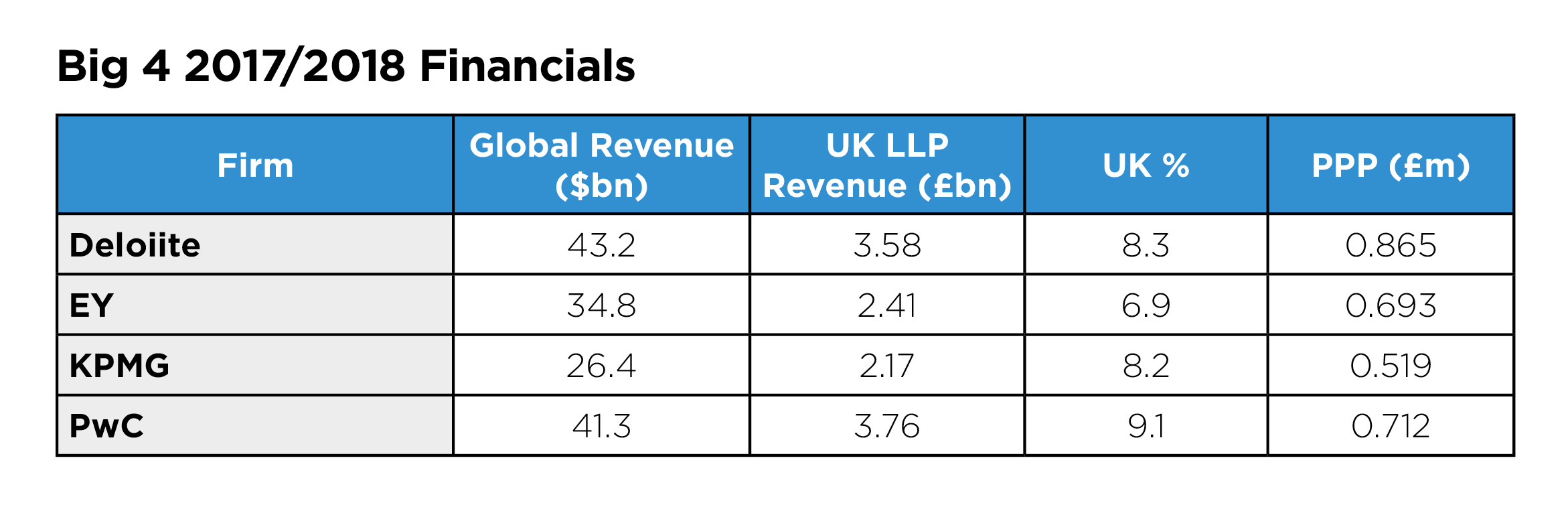
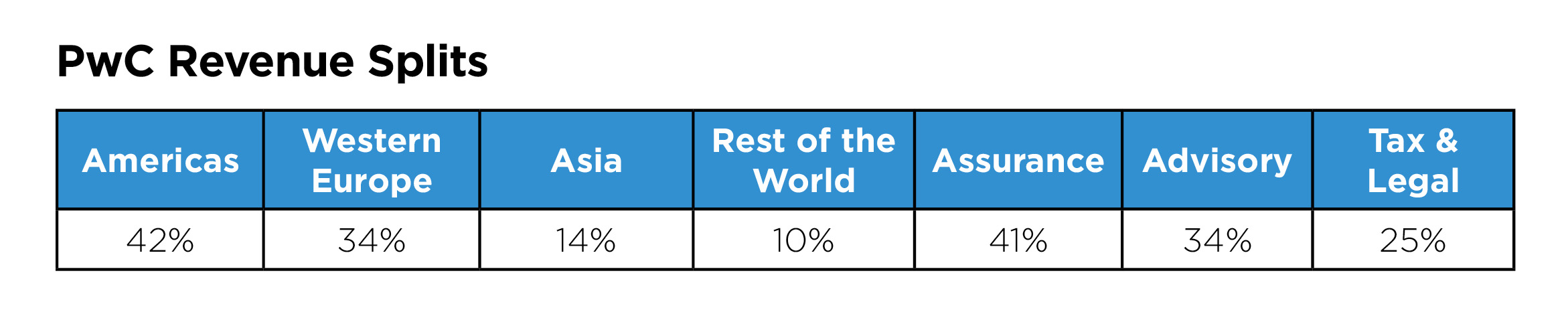 Auditing and assurance’s contribution to global revenue has been dropping year on year. In 2010, it accounted for 50%. Back then, their advisory group, split into deals advice and their strategy, management and technology consulting practices accounted for just 23% of global revenue.
In the UK, the Competition and Markets Authority (CMA) is going to investigate whether the auditing business is “competitive and resilient enough to maintain high-quality standards”. This follows on from suggestions by the Financial Reporting Council (FRC), the UK’s audit watchdog, about banning some non-audit services (NAS) and having audit-only Firms. The FRC is itself under a government review as to whether it is fit for purpose. So, there will continue to be plenty of legislative and regulatory challenges ahead.
PwC UK (includes Middle East and Channel Islands) had 915 equity partners generating pre-tax profits of £935m or 25% of annual revenue. Average distributable profit per partner was £712k with an effective tax rate of 48%.
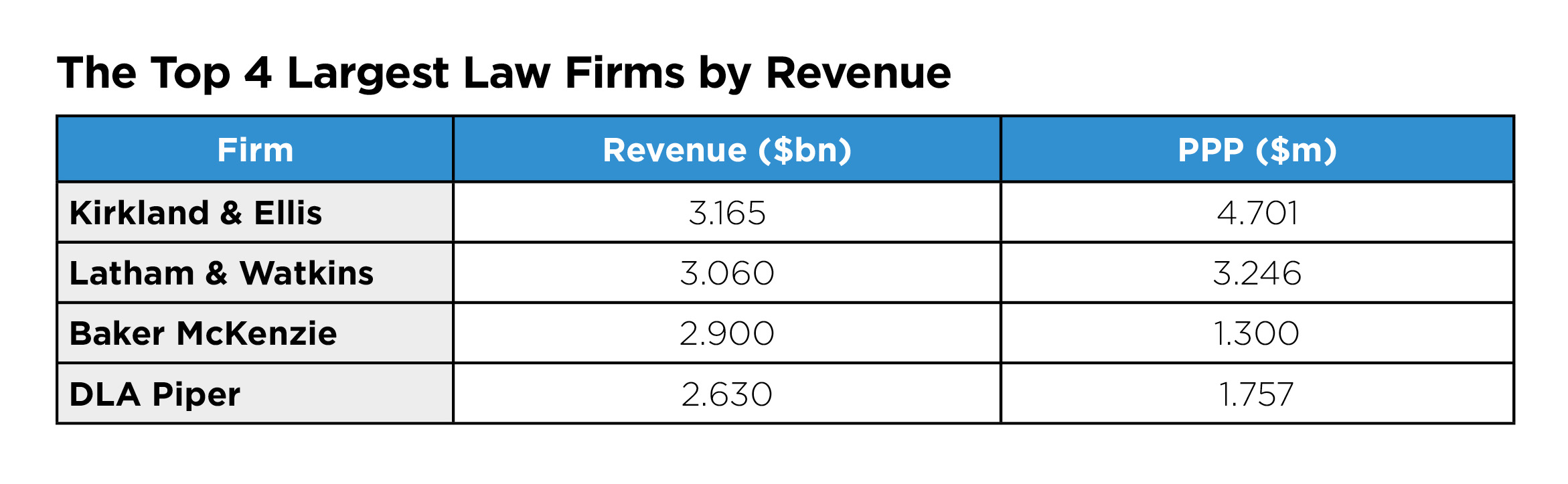 Clearly these Big Law Firms are tiny in comparison to the Big 4, but almost all of the leading UK and US Law Firms are more productive and profitable per partner and in most cases, significantly. It is highly unlikely that they will see an active Kirkland or Latham’s partner join a PwC anytime soon, but we have already seen partners join from Bakers and DLA and this is likely to continue. Another more obvious source from the global Top 10 is Dentons.
The blue bars are estimates. PwC UK Legal was absorbed into PwC in 2016 and separate accounts are no longer available. The 2020 figure of £100m was reported in 2015 as a target.
Their forecast for 2020 of £100m will put them in the Top 50 largest UK Law Firms by revenue. It has overtaken the likes of Bevan Brittan, Farrer & Co, Forsters and Howard Kennedy. It shouldn’t take long to get past the likes of Brown Jacobson, Blake Morgan, Penningtons Manches and Shakespeare Martineau. In doing so, they must be taking work away from some, if not all, of these Firms.
PwC Legal’s last full set of annual accounts were for the y/e 30th June 2016. A final set was published the following year, but PwC Legal was absorbed into PwC on 1st Oct 2016.
In 2015/2016, the average number of UK equity partners was 13. The actual average PPP was £640k with the highest profit entitlement to one of their senior partners @ £1.493m. This almost certainly means that one or several of the non-legal partners will be on something much higher and I have seen a figure of $3m (£2.3m) reported in the legal press.
Their last reported revenue was c. £70m for 2017/2018 or 1.9% of total revenue. Their Revenue per Lawyer (RPL) is c. £200,000, which is on the low side, but comparable to several mid-market Firms (see table below).
Their five main legal global practice areas are immigration law, enterprise governance and compliance, employment and labour, international business reorganisation and mid-tier M&A work. In the UK, cyber & data services, financial services, tax litigation and technology are other areas of local focus and growth.
Although legal services are contributing more every year to the overall pot (1.9% from 1.5% in 2013), it’s a reminder that lawyers are a small cog in a very big wheel. One consequence is that this makes winning internal support and investment for legal more difficult compared to other departments.
This reduced level of influence, control and importance is one of the reasons why many private practice lawyers will never consider joining these organisations.
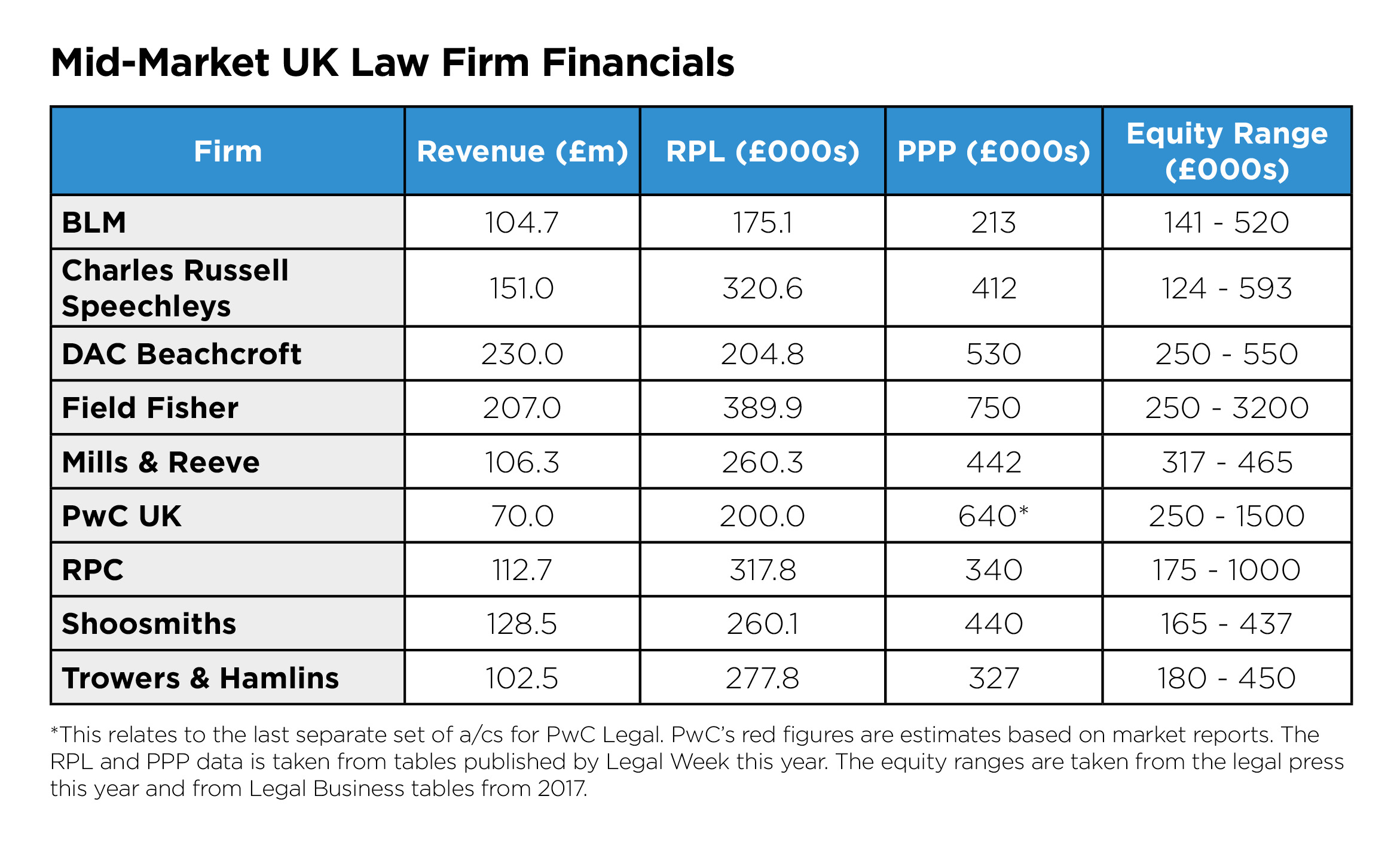
PwC clearly has the resources to offer partners at these Firms and higher up the ladder a competitive package, but in recent years, they have either decided not to spend big and/or they have been unable to attract the talent that they want.
It is surprising that, of the 100 or so KWM London partners that have found new homes at Law Firms since their European arm collapsed at the end of 2016, that not one has found a home at PwC or any of the Big 4, given they are all in growth mode and need lawyers of this quality.
PwC Legal Brand Strength - Internally & Externally
The PwC accountants and consultants are market leaders and generally regarded as some of the best in their professions. Apart from their immigration lawyers, who are ranked as Tier 1 by the Legal 500, the same cannot be said across their other legal teams - yet. Data Protection and Cyber - Tier 2. Pensions - Tier 3. Employment - Tier 4. Tax Litigation and Disputes - Tier 4.
This may well change in the years ahead, but for now there remains a mismatch in quality between the professions. The legal bar therefore has to rise to catch up with the rest of the partnership.
This can be done incrementally, gradually increasing your profile and quality base in each practice area, or by taking quantum leaps bringing in market names. The ripple or the splash. The former is less risky and less expensive but much slower. Neither guarantees successful market penetration.
The quality mismatch also creates problems re: internal client referrals. Can my in-house lawyers provide my clients with the same quality of advice and service as the Law Firms that I have been referring them to for years? If I refer my clients to my in-house legal team, I will almost certainly lose out on any reciprocal referral work.
Their MDP one-stop shop concept can only really work if there is uniformity in the quality of advice offered and provided.
London Partner & Director Lateral Hires since 2016
The table below summarises PwC’s senior lateral hiring activity over the last 3 years.
In total, there are 40+ London partners and directors who are locally-qualified solicitors. Less than 10% of these were trained at PwC. That’s a very poor stat which they must be trying to address.
They continue to struggle to hire senior lawyers in the two main transactional practice areas of Banking & Corporate.
 Traditional Law Firm models need healthy transactional practices to support service sectors like employment and tax. With the Big 4’s different model, the need for strength in these practices isn’t as necessary.
However, at some stage, the amount of work that these service sectors can generate will plateau and they will need to look at other, potentially much larger, revenue streams, like Banking and M&A. To date, this has not happened.
One of the main reasons Law Firms laterally hire transactional partners is to buy their book of business and client relationships, either by bringing in new clients or by strengthenng existing relationships. It’s also what determines how much they are worth financially to their Firms and in the market. Occasionally partners will be rejected by a Law Firm because their respective clients’ lists are in direct competition. There’s no point hiring a partner whose main client is Pepsi, when the Firm works for Coca-Cola.
Because of PwC’s size and extensive client portfolio, client conflict is more of an issue. A good fit would be partners who have experience of working for existing PwC clients.
If you opt for partners with no portable business and/or who are not proven business generators, then yes, there would be no conflicts and yes they would be less expensive, but they would be pretty much reliant on the internal market for their work. This would do nothing to make their lawyers more valuable in the eyes of the other professionals. And it doesn’t do much for your resale value either.
I am assuming that there are plenty of blue chip companies out there which PwC does not advise and is not conflicted with. If so, then hiring transactional partners who can bring some of these to the Firm would boost new revenue streams as well as increasing legal’s standing within the Firm.
 Thomas Colmer joined PwC Legal in 2016 as a partner from Osborne Clarke and then became Director 6 months later when PwC took over. There have been no other corporate partner lateral hires since senior associates, John Amberton and Peter Workman, joined in 2015 from Baker McKenzie and KWM, respectively. The department’s gearing ratio is higher than most Law Firms with at least 5 non-partners for every partner.
The quality of their lateral hires remains inferior to those in other product areas.
Around half of their corporate lawyers trained at PwC, so the quality of their training will be as important as the quality of their lateral hires. Further, the development of an associate can be strongly influenced by 1) the quality of the partners they work with and 2) the quality of the work that they do.
Surprisingly, given the above, they are now listed by the Legal 500 as a Tier 1 Firm for M&A deals up to £50m, competing against the likes of Charles Russell Speechleys, Fladgates and RPC.
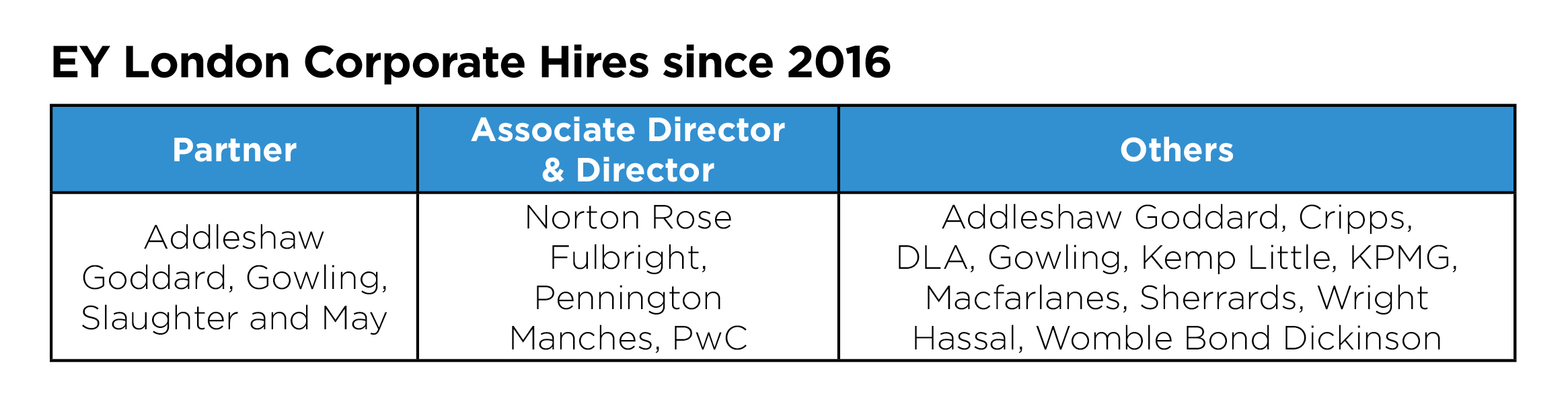 Two observations: 1) EY has been more active in hiring senior lawyers (albeit from a smaller base) and 2) their lateral hires are clearly sourced from a better group of Law Firms. Money will have been a factor, but this is principally down to the various parties and people who make up the recruitment team (internally and externally).
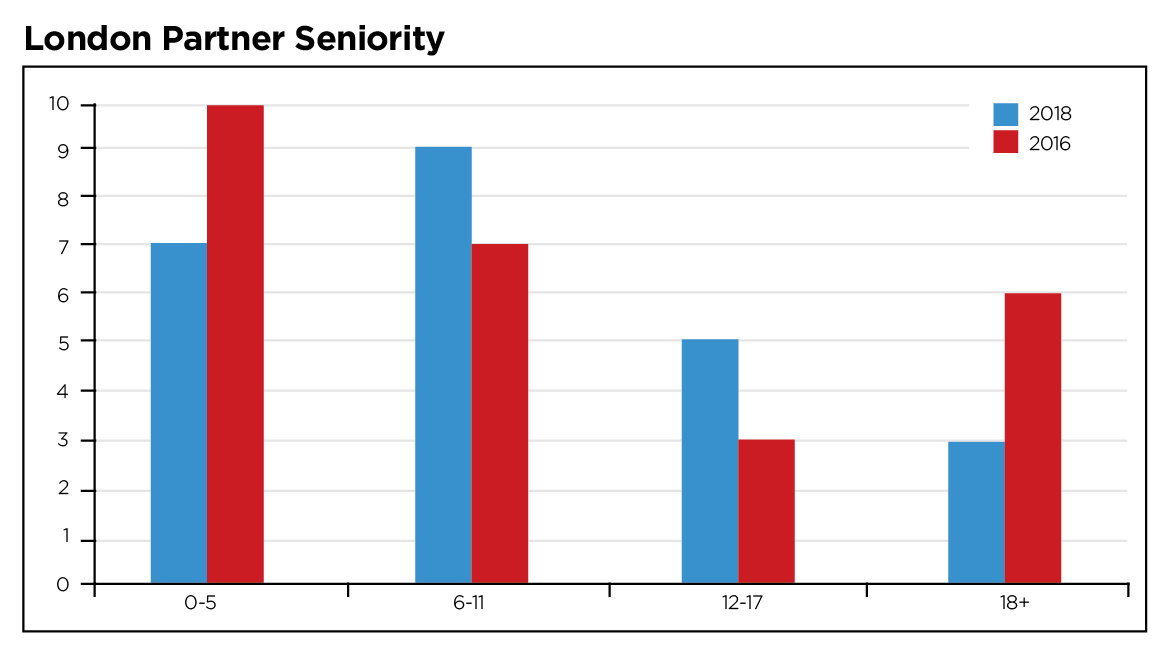 Getting the right balance of experience and youth is important and not that easy to get right. A bell curve is the ideal shape to aim for.
The seniority mix, which for several years was top heavy, now looks to have the right balance. This is partly down to a small number of internal promotions (less than 10% of their partners are PwC trainees), but more down to junior lateral hires and the reduction of senior partners. Too many senior partners in the overall mix can be 1) expensive, 2) a deterrent to the junior partners and associates and 3) lead to succession problems.
Ongoing Similarities with Baker McKenzie
Baker McKenzie London was, and probably still is, a net receiver of work through their internal market. This has resulted in a lot of their transactional partners working more as service partners. As portable business is one of the most sought after assets by Law Firms when laterally hiring partners, this has often put those BM partners at a disadvantage in the market. I suspect the same will apply to the transactional partners at PwC, the few that there are. PwC’s three corporate partner exits since 2015 have moved to Baker McKenzie, DWF and Thomas Cooper.
Lawyers, when considering their next career move, should try and factor into their decision making whether they will be more or less marketable when that next career move comes to an end.
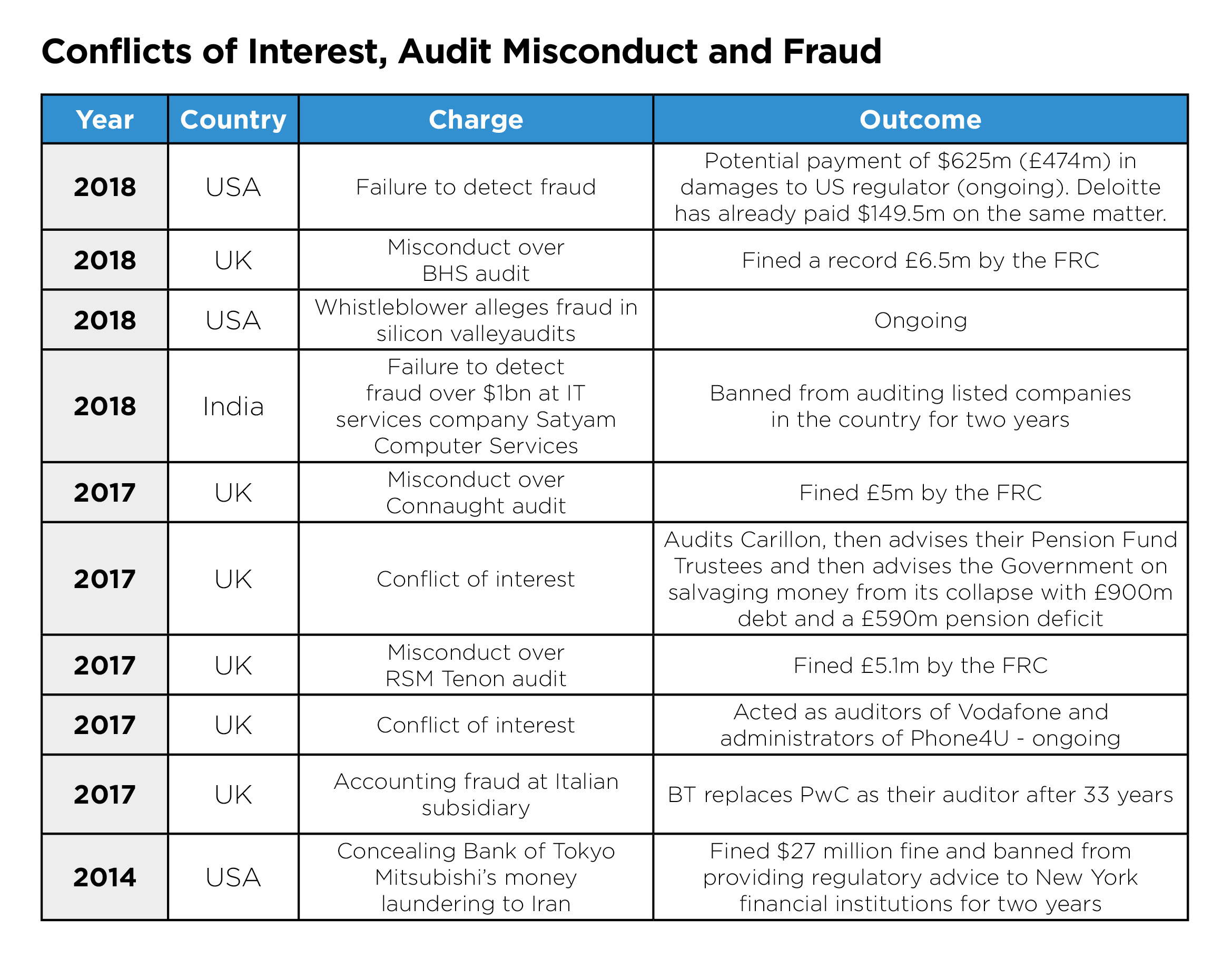 As the Big 4 get bigger, providing more and more clients with an ever-growing variety of business services, the potential for internal conflict obviously increases. As NAS contribute more and more to the money pot, the importance and arguably the quality of audit decreases. Both scenarios are leading to bigger and bigger fines and threats of new legislation.
Recent Developments
Summary
Despite various setbacks of the past 20 years, PwC’s legal services growth continues apace and is unlikely to slow down anytime soon. They are now a Top 50 Firm in the UK and heading towards a Top 5 Firm globally by number of lawyers.
Law Firms are obviously responding, and it would be safe to assume that getting themselves higher up the league tables will become more difficult and more expensive, if that is where they want to go.
Where they end up and how quickly will be a function of the legislative and regulatory landscape. For example, a loosening of the state bar rules on lawyers’ professional independence by some US states could be a game changer for growth in North America. On the flip side, another Enron scandal or a move to audit-only Firms will, once again, restrict the growth of MDPs.
The survey indicates that with Brexit on the horizon, the fight for talent has grown highly competitive, with some qualifying lawyers leaving their firm for competitors’ as soon as they’ve passed the bar.
It states that: “long term staff retention remains an ongoing challenge for private practice firms, with newly qualified lawyers in particular aware of the high demand for their skills and prepared to seek out more lucrative opportunities.”
And whether newly qualified or not, any lawyer would be in the right mind to be looking upward, as some of the most highly paid lawyers in the world are rich because of their status and firm firstly, and their work secondly.
As indicated by Lawyer Monthly’s recently introduced ‘Lawyer Rich List’, complete with celebrity lawyers and highly esteemed professionals, the legal profession has historically been, and continues to prove itself as one of the most lucrative careers to embark on.
The top three richest lawyers are Wichai Thongtang, at an estimated value of $1.8 billion, Bill Neukom at $850 million, famously known as Microsoft’s legal arm, and celebrity TV lawyer Judge Judy, known by her legal name, Judy Sheindlin, at an estimated $400 million.
You can find out more on these lawyers, how they became so rich, and learn about the remaining top 10 richest lawyers in the world on Lawyer Monthly’s ‘Lawyer Rich List’, which we will continue to update periodically.
The drive for digital transformation is now reaching the courtroom thanks to the government-driven £1bn HMCTS reform programme aimed at giving citizens a faster, fairer justice system. The replacement of those cumbersome paper bundles with electronic bundles is set to streamline court proceedings, vastly improve security and save time and money. Here, Tony Pepper, CEO, Egress Software Technologies, explains for Lawyer Monthly.
This is welcome news for local authorities, for whom petitions to the family court for the protection of vulnerable children represent significant workload and cost. Family cases have a target for completion of less than 26 weeks, therefore anything that can streamline such a complex and sensitive process is worth investment. However, as with any digital transformation project, careful planning is required to ensure goals are met and benefits maximised. As they strive to meet the Government’s targets for digitisation here are four key areas that I advise local authorities to consider when making the transition to e-bundles.
On average each local authority petition family courts 200 times each year. For each petition, highly sensitive case bundles consisting of up to 350 A4 pages are printed, duplicated, collated and couriered to the parties involved. This involves significant costs at all stages, from the ink, paper and printers used, to the administrative time needed to assemble the documents and the cost of a secure courier service. On top of this, as the case progresses, the entire bundle must be continually updated for all parties, involving further time and cost.
The case for a digital alternative is compelling. In fact, HMCTS estimates local authorities spend on average £1282.65 and 38.2 hours preparing each bundle, meaning digitisation could eliminate annual costs of around £256,530 and free up 8019 hours of administrative time.
Still, there are costs associated with moving to e-bundles and, while they won’t exceed the potential savings, they should be managed appropriately so that the solution represents the best value for public money.
Local authorities should factor in the costs of purchasing and rolling out suitable document production and pagination software, as well as secure sharing technology. The detail of the software licensing model needs close attention. If sharing software requires all parties to have a licence, costs can quickly escalate when each case can involve six or more people – a potential 1200 licences required. If the rollout involves a hardware element – perhaps providing tablets for courtroom use - make sure that the chosen software is device agnostic, so that you can get maximum use from it. Consider cloud-based software-as-a-service solutions as these are the most flexible and scalable when it comes to future proofing your investment. It’s also important to interrogate suppliers around their upgrade cycle – will future upgrades be included in your licence? What is the product roadmap?
Local authorities should factor in the costs of purchasing and rolling out suitable document production and pagination software, as well as secure sharing technology.
Hard copy court bundles are intrinsically insecure. They’re at risk of accidental loss, theft and unauthorised access. When you consider the immensely confidential and sensitive nature of family court documents and the potential harm to vulnerable children and families if they’re compromised, it’s clear security must be a primary concern.
This is just as true of electronic court documents. Fortunately, many digital systems offer far greater security and access control, plus the facility to log and audit user activity. Local authorities need to create an environment that has multiple levels of encryption, including at folder and file level. This means that, even if the solution is hacked, further security levels render the data inaccessible.
Third parties such as lawyers and social workers will need secure, controlled access to e-bundles. Security policies and procedures must be carefully created so only identified recipients can access files. The ability to amend, download and share files should be restricted to authorised personnel and the system should include a detailed audit facility that logs actions so that compliance with data handling and protection policies can be clearly demonstrated.
The work isn’t over once the judge has made their decision. There’s still the matter of what happens to all that confidential information once the case is closed. A clear benefit of e-bundles is the physical space they free up in offices and storage facilities. As one local authority puts it: “floor space is expensive and best used to accommodate staff.” Nevertheless, thought must still be given to how e-bundles will be stored and managed once cases are completed. An electronic solution should offer the facility to automatically expire user access to the e-bundle once a mandated period has expired, with the final iteration being securely stored in case it’s needed. Storage should incorporate suitable levels of encryption for data at rest.
Despite the cost and time-saving benefits that an e-bundle solution delivers there is still the issue of change management to consider and budget should be allocated for familiarisation and training for key users to ensure that the transition is smooth, and the new system embraced by all parties. This is where choosing a user-centric, logical platform that supports all stages of the legal process pays dividends. Users should be able to easily prepare, paginate and securely circulate documents and subsequent revisions from a single platform. Professionals should be able to make the same private annotations they would have made on hard copy documents to assist them in the courtroom. Finally, the process of access control, revocation and archiving should be straightforward. Anything short of this will lead to user resistance and slow the rate of adoption.
The benefits for local authorities of adopting e-bundles are clear. With careful consideration of technology features, licensing, security and storage processes, and by selecting a user-centric system, they can ensure that the vital work of child protection grows more streamlined, cost-effective and secure.
Despite the cost and time-saving benefits that an e-bundle solution delivers there is still the issue of change management to consider and budget should be allocated for familiarisation and training for key users to ensure that the transition is smooth, and the new system embraced by all parties.
At Egress we work closely with many local authorities to provide this secure environment. Invicta Law is one such example. Representing the largest county in the UK, Invicta Law, a new ABS (a regulated organisation which provides legal services) established from Kent County Council’s former in-house legal team, is committed to delivering high-quality services to its clients. A number of these services relate to the wellbeing of children, including safeguarding welfare.
Invicta Law selected Egress Secure Workspace because it offered comprehensive levels of encryption, control and auditing to ensure that sensitive data is always protected.
Within Secure Workspace users create a secure zone for each individual court case, with the ebundle uploaded into this encrypted environment. Users are then given permission to access zones and documents relevant to them, preventing a data breach caused by unauthorised access or paper copies being lost or stolen. Whenever changes are made to the bundle during the court process, a new PDF version can be easily uploaded to the zone and users immediately notified via email.
We are proud to be working with organisations like Invicta Law to help them to electronically deliver ebundles to family courts. HMCTS has shown that local authorities can make significant cost and efficiency savings by digitising court bundles – however, given the sensitivity of the material involved, it is crucial that encrypting and controlling this data is a primary objective for law firms and in-house teams looking for an e-bundle solution. We therefore see it as a key priority to help our customers achieve these costs and efficiency benefits, whilst also ensuring they can protect some of the country’s most vulnerable children from harm.
