
Understand Your Rights. Solve Your Legal Problems
Essay writing is hard as it is; now you’re in law school and it seems almost impossible to get it done. Continuing on with Lawyer Monthly’s Law School & Career features, Francine Ryan, lecturer in law and member of the Open Justice team at the Open University, provides Lawyer Monthly with the her top tips on law school essay writing.
So, it’s that time of year- trees are turning gold, the air is becoming crisper and Universities start to welcome their students to the start of a new academic year! Whatever stage you are at in your journey through Law School, you are likely to be writing a law essay this semester- here are five top tips to help you produce the perfect assignment.
‘By failing to prepare, you are preparing to fail’ Benjamin Franklin; organisation and preparation are important for successful essay writing. Firstly, gather and organise your research- think how you will use the material and create a plan that develops an answer to the question. A plan is a working document that can be refined as you write- use it to help focus your writing and ensure you have covered all elements of the question.
Preparation and writing can happen at the same time, start drafting some parts of your essay and this will identify any gaps that require further research. To meet the deadline for submission factor in enough time to research, plan, write, edit and polish your essay. Writing at the last minute is stressful and unlikely to produce your best work.
An essay needs a clear structure- introduction, main body and a conclusion. The introduction unpacks the question and tells the reader what issues the essay will address. The introduction is an opportunity to show the marker you have understood the question. The main body is a series of paragraphs that develop a logical and coherent response to the question. Each paragraph builds and develops your argument. The final paragraph is the conclusion which draws together the arguments and comes to a view on the question.
A good essay answers the question asked. It’s not a general discussion of the legal topic it should have the right balance of description and analysis. It should explain or describe legal concepts but then go on to analyse, critique and engage with the issues in the question. Answering a question about judicial precedent and judicial law making- would explain judicial precedent and then analyse to what extent it can be argued judges do or do not make law. It is important to ensure there is the right level of description to support the analysis.
Make sure you know what the word limit is before you start writing as penalties can be imposed for exceeding the word count. You should be able to gauge from your plan whether it will fit within the word count. If at this stage you have too much content you can take out some aspects of your plan or you can write the essay and then re-draft it to fit the word limit. Conversely, if the final version is under the word count go back and re-visit the question to identify any gaps in your answer.
Once you have written a draft, go back and review your work- it’s likely to need further revisions then polish your essay, make sure it flows, and carefully check there are no errors or omissions. Reading your work out loud helps to identify mistakes. Check your references both in the text and in the reference list to ensure they are complete and conform to the requirements of your University.
Remember that writing legal essays takes some practice so take advantage of the feedback you receive from your tutor; identify areas for improvement and work on them in your next essay. If you need more help seek advice and support from your University, there are also lots of books which give good quality advice, including: ‘Legal Skills’ by Emily Finch and Stefan Fafinski which is accompanied by an online resource centre.
Official figures from the recently released Insolvency Service report shows a 19% rise in UK company insolvencies, the highest quarterly level in more than four years.
The report has revealed that the number of companies becoming insolvent grew at the highest rate since 2009 during the third quarter of 2018. The construction sector has been most impacted, as 2924 construction companies were recorded insolvent in the 12 months leading to the end of quarter three, followed by the wholesale and retail trade as the second most impacted sector.
Commenting on the last Budget before Brexit, Rick Smith, Managing Director at Forbes Burton, said: “One of the key causes of insolvencies is the pressure being put on businesses in the run-up to Brexit. Some of the Chancellor’s pledges are good news for smaller high street retailers, but the main issue is that business rates overall are still too high – and there really needs to be some sort of wholesale reform to turn the high street around.
“The new digital services tax announced in the latest Budget will probably not help the high street directly as it only applies to businesses that have £500 million turnover. However, it does go some way towards levelling the playing field.
“It’s a small step in the right direction but these measures will need to go further to have any major effect.”
With the countdown to Brexit day now on, and unease being felt across the country as a clear exit plan is yet to be devised, Forbes Burton is urging businesses to address any gaps in their knowledge in these uncertain times.
Rick added: “At the minute all fingers point to the likelihood of a no-deal Brexit which will inevitably impact the UK economy for some time. Our advice to companies would be to avoid any risks, cut controllable costs and to keep an eye on the competition.
“Ahead of the Brexit decision it’s likely that costs will increase for businesses reliant on import/export trade, so it’s advisable to ensure there is a healthy kitty to aid cash flow for VAT changes and additional stock. Also, access to EU business grants will likely cease, causing some disruption as businesses seek an alternative source of funding.
“Employment is also likely to be hit hard as businesses will need to review the immigration status of employees. Brexit isn’t going away – and preparation is essential.”
For over 30 years Forbes Burton, based in Grimsby, has been helping companies with financial difficulties and insolvency issues. The company is committed to a rescue and recovery culture where possible and is well practised at guiding companies through financial hazards.
There was much fanfare last week when the Chancellor announced he would honour the Conservative manifesto pledge to raise the income tax threshold – bringing the lower rate to £12,500, and the higher rate to £50,000 – and he would actually bring this forward a year to be effective from April 2019. However, as is usually the case with the Budget, the devil is in the detail and this giveaway may turn out to be as much a trick as a treat.
What he did not announce with quite as much excitement is that there has also been a significant increase in the National Insurance band which effectively negates 39% of the income tax giveaway. This is because the 12% NI rate band has been increase from £162 to £892 per week, to £166 to £961 per week, which is the weekly income that someone earning £50,000 currently receives.
Below, Tilney gives some detailed examples to illustrate the impact of someone earning £50,000 in both the 2018/19 and 2019/20 tax-years:
| 2018/19 tax-year | 2019/20 tax-year | |||
| Earnings | £50,000 | £50,000 | ||
| Less Personal Allowance | -£11,850 | -£12,500 | ||
| Taxable Income | £38,150 | £37,500 | ||
| Basic rate tax | £34,500 x 20% | -£6,900 | £37,500 x 20% | -£7,500 |
| Higher rate tax | £3,650 x 40% | -£1,460 | £0 | |
| Total Income Tax | £8,360 | £7,500 | ||
| Difference in Income Tax | £860 | |||
| 2018/19 tax-year | 2019/20 tax-year | |||
| Weekly Income | £961 | £961 | ||
| Income at which NI becomes payable | £162 | £162 | ||
| 12% NI Band | £162 to £892 per week | -£4,555.20 pa | £166 to £961 per week | -£4,960.80 pa |
| 2% NI Band | £892 per week + | -£71.76 | Nil | |
| Total NI | £4,626.96 | £4,960.80 | ||
| Difference in NI | -£333.84 | |||
So, what the above example shows is that, despite the individual’s income tax liability reducing by £860 per annum their national insurance liability has increased by £333.84, making the net benefit only £526.16 per annum.
The situation looks even more dire if this individual was a member of their workplace pension scheme. They would be paying 3% of salary into pension (£1,500 per annum) on which they would be entitled to £600 tax relief (40%) but, as they would no longer receive any higher rate tax relief, then the pension tax relief would reduce to £300, representing a further loss to this individual, making them only £226.16 better off or only 26% of the actual income tax saving.
Commenting on the findings, Gary Smith, chartered financial planner at Tilney, says: “The main headlines following the Budget were obviously focused on income tax and how much better off higher earners would be in the next tax year. However, the subsequent increases to NI that have been announced will soak up a lot of the headline tax benefit.
“While it still stands that most will be better off following the changes to income tax, the public should be aware that the bonuses will not be as big as promised when all the other changes have been taken into account. It is important to speak to your financial adviser to ensure you have all the necessary details before making any key financial decisions for the new tax year.”
Tesla has wowed fans and automobile aficionados again by announcing new features on its line of pioneer electric cars. Elon Musk, the co-founder and CEO of Tesla Inc., teased Tesla owners with the promise of full self-driving capabilities on their cars by August 2018 – and also casually mentioned that the upcoming Tesla Roadster 2020 might have rocket thrusters.
Tesla and SpaceX Partner Up again to Provide Roadster 2020 with Rocket Thrusters
These latest announcements come in the light of what has been described as one of the greatest advertisement stunts of all-time, when, in February 2018, Musk decided to send a Tesla Roadster (in fact, his very own Tesla Roadster) into space as a dummy load for his Falcon Heavy rocket, manufactured by his other company, SpaceX. The car was occupied by a mannequin dressed as an astronaut in the driver’s seat, affectionately called the Starman, and a copy of Douglas Adam’s The Hitchhiker’s Guide to the Galaxy was stashed away in the glove compartment.
SpaceX option package for new Tesla Roadster will include ~10 small rocket thrusters arranged seamlessly around car. These rocket engines dramatically improve acceleration, top speed, braking & cornering. Maybe they will even allow a Tesla to fly …
— Elon Musk (@elonmusk) 9 June 2018
Now, it seems that SpaceX and Tesla will work together once more, as Musk took to Twitter on June 10 to inform his 21.9 million followers that the new Roadster will come with a SpaceX option package that will include roughly 10 rocket thrusters placed around the car. The new feature is designed to help with speed, acceleration and braking – and Musk teased that it might even make a Tesla fly. The news made the company’s stock rise by 5%, along with the announcement, on that same day, that all Tesla cars will begin to acquire full self-driving features in August. In response to an owner’s complaint about the car’s Autopilot, Musk stated that the issues would be fixed with the latest Version 9 software update in August, which will also signal a move away from the Autopilot’s resources being focused into increasing security and towards full autonomy.
Musk Teases Full Self-Driving Features - But Consumers still Worry about Safety
However, in view of the latest accidents involving self-driving cars, consumers around the world continue to be concerned about their safety. 50% of consumers reluctant to try autonomous cars have stated that they “wouldn’t feel safe” as the primary reason for their skepticism, while 43% were afraid that the car would make mistakes and 23% were anxious that the car might be hacked. Online applications are routinely exposed to a variety of hacker attacks, including SQL injection, cross-site scripting (XSS) and remote file inclusion (RFI), against which they can get protected by cybersecurity tools like a web application firewall which filters incoming traffic. Yet, the software used to run autonomous cars will probably be targeted by very sophisticated attacks, which has made experts talk of a “weaponization” of self-driving vehicles.
 You will find more infographics at Statista
All Tesla cars come fully equipped with the hardware they need to achieve full autonomy when the company has developed the technology far enough – including being able to “see” around 360 degrees and up to 250 meters, thanks to cameras, radars and ultrasonics. Tesla, along with other AI enthusiasts, is insisting that self-driving will actually bring more safety on the streets, and Musk seems to feel like they have reached a good level of security and are ready to move onto the next step. The news about full self-driving features being released in August has made people rave about the new direction that driving is taking.
Owning a Tesla is certainly an exercise in luxury – and the company knows how to keep its clients satisfied and excited, be it with sending the car they drive into space or by bringing space rockets to their car.
New research commissioned by the Bar Council reveals the full scale of a decade of dis-investment in justice and argues that decisions to make wholesale budget cuts cannot be blamed on austerity measures alone.
Produced by Professor Martin Chalkley for Justice Week, the research shows that a 27% real term cut to Ministry of Justice funding in the last 10 years is ‘out of step’ with reductions to other public services, and with a growth in both the economy and overall government expenditure.
Professor Chalkley said: “In the last 10 years, the size of the economic ‘cake’ available for public spending has in fact grown. Not only that, the Government’s share of that cake has stayed stable at around 40%. The austerity measures put in place following the financial crisis do not therefore explain the need for a 27% real terms cut in justice funding. Cuts to justice are clearly way out of step with what happened in other areas of public spending.”
Chair of the Bar, Andrew Walker QC, said: “This research explains the context of the enormous disinvestment in justice over the last 10 years, and highlights just how badly justice has been treated in comparison with other areas of government expenditure.
“For a system that is fundamental to a healthy democracy, society and economy, this is scandalous. The state is failing in its fundamental duty to provide justice for its citizens. Since the financial crash, governments have had to operate under some very real fiscal constraints, but it is clear they have vastly over-cut the justice budget and the public are now feeling the effects.”
Professor Chalkley’s research also shows that following a 10-year real term decrease of 34%, the CPS budget now stands at £0.5bn, which makes up just 0.05% of total public spending.
Andrew Walker QC said: “Why has the CPS taken such a hard hit, alongside criminal legal aid? With less money spent per prosecution, both the victims of crime and the innocent who are prosecuted are being let down. The Government is gambling with public safety and the rights of individuals, so it can scrimp on what is already a relatively tiny budget. As disclosure and prosecution failings showed this year, such cuts carry enormous risks.
“In the context of these figures, plans announced last month for a package of new laws, codes and panels for victims now sound rather hollow. Victims will inevitably be failed if we do not have a properly-funded criminal justice system. Without urgent re-investment, the Government risks losing public faith in its ability perform one of its most basic but essential functions: Keeping us safe from crime.”
(Source: The Bar Council)
Following on from recent news regarding facebook’s poor Q318 results, Jon Tipple, Chief Strategy Officer, Worldwide at FutureBrand, discusses further bad news for the firm.
Facebook’s disappointing Q3 results – despite strong earnings, the social media giant failed to reach analysts’ estimates on revenue, daily active users and monthly active users – reflect some difficult challenges the social media giant is wrestling with, including sluggish revenue growth and shrinking margins, as well as a steady stream of users choosing to leave the platform altogether.
Sadly, there’s more bad news for the company in the recently released 2018 FutureBrand Index, which takes PwC’s Global Top 100 companies by market capitalisation and re-orders them in terms of how strongly positioned they are for future success.
Despite still occupying a healthy eighth place in the PwC ranking, Facebook fell 37 places to 43rd position in the FutureBrand Index since it was last published in 2016 – and it’s widely perceived as one of the brands that will fall behind the most over the next three years.
This might be no more than a reflection of recent high-profile negative media coverage, but it might be more than that. The Index tells us that trust, admiration and passion for Facebook have all dropped, along with innovation and thought leadership.
The FAANG companies – Facebook, Apple, Amazon, Netflix and Google – are all about 20 years old now. In human terms they’re approaching adulthood, with all the grown-up challenges that entails. For them, this translates to issues such as data protection, privacy, corporate taxes and fake news.
The companies that score well in the FutureBrand Index – and which are therefore most strongly positioned for future success – are those that consistently align the totality of the experiences they create for all with their wider corporate purpose.
Focusing on these issues should be a priority for Mark Zuckerberg and his team if they want to arrest the decline and bring support back for the Facebook brand.
Following the disclosure of the ‘Paradise Papers’ in 2017, an onslaught of misguided moral righteousness resulted, villainising the wealthy for using perfectly legal means of investing their wealth in offshore corporations in order to achieve tax efficiency. In the process, many august journals blurred the lines between entirely legal tax avoidance and illegal tax evasion. Below Quentin Bargate, Senior Partner at Bargate Murray, explains for Lawyer Monthly.
The British Overseas Territories (BOTs) are a success for, but not limited to, the local economies of the territories concerned. Apart from yacht registration, many offer a wide range of corporate and financial services. It was regrettable that we saw yacht owners who choose to flag their vessel with an offshore flag state being pulled into the debate in the ever popular pantomime of the evil Superyacht owner who hides his wealth and avoids paying tax.
Many of the these flag states are BOTs, such as the British Virgin Islands and the Cayman Islands. They support seafarers and do vital work alongside other “Red Ensign” (i.e British) flags, but you hear little about that.
The choice of flag state should be considered one of the most important decisions in yacht ownership. It will affect the regulations that the owner and vessel are subject to including during construction, inspection, regulatory compliance regimes and, of course, taxation and liability protections. The benefits of registering a vessel under a recognised offshore flag state are clear and considerable.
A privately registered yacht with a non-EU owner can be imported into the EU under the Temporary Admission regime, allowing 18 months of operation in EU waters without having to pay VAT. This is legitimate tax avoidance. Who benefits? Not just the yacht owner but also the economies of the European countries, whether for ship repair, bunkering, victualling, restaurants, marinas and several support services.
It is vital to remember that these flag states also offer high construction, safety and employment standards, protection of British maritime law, consular services and navy, as well as commercial confidentiality.
I cannot personally think of a film where a superyacht was not used as the lair or getaway vehicle for some disreputable character. Granted, playing the villain is often the best acting role. The more we can dispel this misleading association between yacht ownership and dodgy behaviour, then the more new individuals we can encourage into this fantastic and unique world.
We need to be clear about the differences between a Flag of Convenience (FOC), which our swarthy money laundering individual might use, and a reputable offshore flag state that is subject to the laws and regulations of recognised nations with stable legal and fiscal regimes.
As a case in point, it is estimated that 80 per cent of large yachts are flagged in the BOTs that make up the Red Ensign Group (REG). The REG uses the UK’s MCA regulations for construction, safety and employment, which has a positive impact on maritime security. Additionally, it protects the ethical welfare of mariners working aboard, the marine environment and resale value of the vessel.
In today’s heightened awareness of security threats, a commercially registered vessel over 500GT flagged under a reputable offshore flag state such as the Cayman Islands, must comply with the ISPS code that sets the minimum security arrangements for ships, ports and governmental agencies. This prescribes to “detect security threats and take preventative measures against security incidents affecting ship or port facilities used in international trade”. With increased security risk, it is beneficial that these superyachts are able to respond to aid the government in detection and prevention of threats.
There is a good story to be told, but it is not being repeated often enough. It is a story of high standards, increased safety and crew welfare. It is also a story of wealth generation across Europe and beyond, and the enhancement of our own security.
Now, the pressure is on for publically searchable beneficial ownership registers. No longer will the wealthy enjoy any meaningful financial privacy, their security will be compromised and the aims of General Data Protection Regulation (GDPR) will be entirely lost. How ridiculous!
We should not let the tabloid press or leaks such as that of the Paradise Papers, obscure the bigger picture. It is the duty of all of us that know of these many benefits to get out there and tell that story.
Hungarian-American businessman and philanthropist George Soros has become a divisive figure in global politics and has been ostracised by his home country.
He was the first person targeted in the recent mail-bomb attacks against high-profile critics of President Trump in the United States, and has been the topic of numerous fake news stories and conspiracy theories.
But who is George Soros? James Wignall takes a look at the man behind the headlines.
The level of understating of forensic science among lawyers, judges, and juries is poor, according to evidence submitted to parliament by a group of researchers from Queen Mary University of London.
The researchers suggest that forensic science is contributing to injustices because of misunderstandings about matching trace evidence to a particular person.
The group have submitted evidence to a House of Lords Science and Technology Committee inquiry into Forensic Science.
The inquiry was set up to explore the role of forensic science within the UK Criminal Justice System in light of concerns over the weaknesses of current forensic methods in the delivery of justice.
The researchers involved include Professor Norman Fenton (School of Electronic Engineering and Computer Science), Dr Primoz Skraba (School of Mathematical Sciences), Amber Marks (School of Law), and Dr Ian Walden (Centre for Commercial Law Studies).
When asked about the level of understanding of forensic science within the criminal justice system amongst lawyers, judges and juries, Professor Fenton believes that there needs to be much greater awareness that all evidence is subject to potential errors.
He noted: “Errors can and do occur at every level of evidence evaluation: sampling, measurement, interpretation of results, and presentation of findings. Forensic scientists should articulate, and attempt to quantify, all such possible sources of error. And legal professionals should understand and expect this information, and probe for possible sources of uncertainty when it is not presented by the experts.”
Professor Fenton also believes that injustices are occurring widely because of misunderstandings about the probative value of forensic match evidence.
He advised: “Because many forensic traces from crime scenes are only ‘partial’ and may be subject to various types of contamination, the resulting ‘profile’ is not sufficient to ‘identify’ the person; many people would have a partial profile that matches.
“I have been involved in cases where such assertions have a dramatic impact on the judge and the jury, while even defence lawyers assume their case is impossible to defend. But to interpret this as ‘proof’ that the defendant must have been at the crime scene may be to grossly exaggerate the probative value of the evidence in favour of the prosecution case.”
Furthermore, Professor Fenton argues that the meaning of the word “match” in the context of forensic evidence needs to be re-evaluated. Currently, “a match” between two pieces of evidence is understood to mean that they come from the same source but two pieces of evidence are branded “a match” when their measured characteristics are the same (within an agreed tolerance).
The committee was also advised that lawyers and the judiciary should receive basic training in probability and statistics because the current training available is ‘suboptimal’. This would enable them to understand the statistical analyses presented, to identify any weaknesses in the analyses presented, and to avoid common fallacies such as the prosecutor’s fallacy. In forensic investigations “there is virtually always some degree of uncertainty,” Professor Fenton added.
Elsewhere in the submission, Dr Primoz Skraba highlights an emerging gap is the increasing use of demographic and personal data by companies to identify individuals, which is likely to be used in forensic science in the future.
According to Skraba: “While a company’s misidentification may result in a misplaced advertisement, the consequences in forensic science may be more severe.”
This is not limited to use by private companies; forensic technologies are being used now by agencies such as the Metropolitan Police through its Gangs Matrix, which has raised concerns around the legitimacy of using predictive tools in criminal justice.
Amber Marks noted: “Risk scores generated by police algorithms are shared with multiple agencies and this results in often stigmatic and punitive repercussions for the individual involved, including in policing, educational and medical settings, decisions on benefits and housing entitlements and deportation proceedings, while obviating the procedural safeguards of the criminal trial.”
(Source: House of Lords Website)
From exploiting Spongebob Squarepants to Kermit the Frog and making Grumpy Cat one of the richest cats after she earned $100 million in around two years, memes have taken the internet by a storm.
By being “an element of a culture or system of behaviour passed from one individual to another by imitation or other non-genetic means[1]”, the internet has famously created memes by captioning photos with quotes riddled with sarcasm to often ridicule human behaviour, and editing videos for an added humorous effect.
The bank of internet memes has endless submissions, and its popularity has spread like a more welcoming version of a 21st century plague, so it is of no surprise it has proved an effective method of advertising, to even the most known internationally renowned companies.
Take Virgin Media, for example, that used the viral photo of Success Kid as part of their advertising campaign. The photo, originally taken by the mother of the child was uploaded to Flickr, eventually became victim of witty captions and ingenious Photoshop manipulation, and took to the internet by a storm.
In the US, Denny’s – famously known for being social media ‘savvy’ – jumped in on the ‘zoom in trend’, where users have to zoom in on pictures to reveal hidden messages. If you missed out on this craze in 2017, it may make very little sense to you, however, Denny’s clever meme use managed to win the company the title of creating one of the most shared brand tweets.
zoom in on the syrup pic.twitter.com/omRBupjrXq
— Denny’s (@DennysDiner) March 1, 2017
If you are not sold on the popularity of memes, I will conclude my pitch on the power of memes with a final example. Hipchat (now Slack) used the Y U NO meme on their billboard advert, which saw traffic to their website increase by a whopping 300%[2].
They are an effective tool for marketing, especially when targeting a younger demographic, however, as you probably may have already gathered, copyright law may pose an issue. Grumpy Cat, for example, is registered with the US patent and trademark office, so her cantankerous demeanour can only be the face of your company’s meme if you gain permission.
And no one is exempt. Even the acclaimed Warner Brothers were sued after an alleged unauthorised use of clips of Nyan Cat and Keyboard Cat – famous internet memes which each spurred tens of millions of views since originally appearing online in 2011 and 2007 respectively.
So in short, using memes on a personal platform for fun and not commercial gain, may be deemed more acceptable than using memes for advertisement.
What are the copyright laws?
Firstly, a meme’s legal framework can be defined as follows:
“An internet meme is in legal terms, a derivative work, and usually [the] copyright owner is the only party with the legal right to create a derivative work.”[3]
Generally, the criteria of whether a meme is deemed as infringement is based on four things: the purpose behind the meme, i.e. if it was used for profit; the nature of the work; how much of the work has been used; and, how the use impacted the potential market for the copyrighted work[4].
So in short, using memes on a personal platform for fun and not commercial gain, may be deemed more acceptable than using memes for advertisement.
And even though the original owner to a humorous photo may not take action to sue, gambling with the idea is a risk that businesses should avoid.
And that is not where it ends, of course. Earlier this year, the EU proposed a new copyright directive, which could see even more restrictions and confusion, especially regarding our beloved memes.
Time for a New Law?
It is generally a gamble when a company hops onto the meme trend; you either win or fail. But, to make things more difficult, there are further changes on the horizons.
There are several other issues when it comes to social media advertising. With the FTC enforcing rules and regulations over the years, one of the most prominent ones regarding social media, is to ensure endorsements are not misleading.
The ambiguity between promotion or an innocent post causes several issues which the FTC, and consumers themselves. Nonetheless, social media has really paved a new path for advertising; I, for one, have noticed a shift in promoting products online, to the point where you need an influencer to state ‘not sponsored’ to be fully confident that they are not getting paid for their views on said product, even though it is required for influencers to ‘#ad’ their promoted posts.
And that is not where it ends, of course. Earlier this year, the EU proposed a new copyright directive, which could see even more restrictions and confusion, especially regarding our beloved memes.
Article 13 envisages the implementation of “content recognition technologies” to identify and remove potentially infringing material. Think YouTube’s ContentID system, but for the whole internet.
Speaking to Jack Dickerson, an Associate from EIP, he explains where the motion to update the Copyright Directive came from: “Given that the existing copyright directive is now over 17 years old, and considering how quickly the online space moves, there are few who would disagree that this is necessary. However, not everybody is enthusiastic about the actual content of the Directive which is due to be implemented next year.”
The new proposal will enforce that websites - including social media - should regulate copyrighted material that may be circulating on their platforms. Right now, it is up to those who produce the content to keep an eye on who is using their work.
Article 13, or as it is also known as: “meme ban”, is a chance for content producers to get the rights (and money) they deserve; but if websites, such as Facebook or YouTube are held liable for copyrighted content, some nifty software will need to determine what has been stolen, or what has been used in good faith.
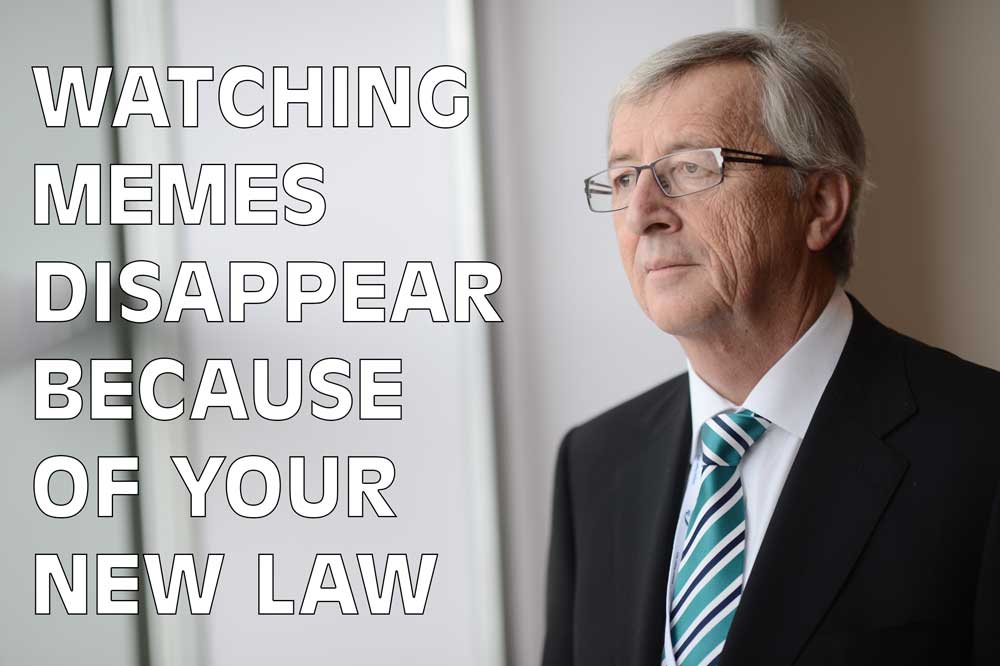
Firstly, such software may struggle to sift through millions of pages of content, and secondly, may not be able to spot parodies, creative content, and, of course, memes[5].
This could make journalists’ lives a lot harder, an increase of fake news and restriction on, again, freedom of expression on the internet.
Jack explains this further: “Article 13 envisages the implementation of “content recognition technologies” to identify and remove potentially infringing material. Think YouTube’s ContentID system, but for the whole internet.
“The threat to memes from such a system is two-fold: Firstly, existing content identification technology is far from perfect – anybody who makes a living from YouTube will be aware of how YouTube’s often overzealous algorithm demonetises content from which creators earn a living.
“Secondly, such technology may simply not be readily available to smaller platforms which may not have access to patented systems or the money and expertise to implement them effectively. These smaller platforms may have no choice but to implement blanket restrictions on post-able content, or otherwise cease competing with the big boys – further entrenching their market position.”
And where some artists will be pleased knowing that there are extra regulations in place to ensure their work is not being infringed, sceptics are worried that the directive will restrict free and open internet and give more opportunities for media giants to charge fees for posting simply links[6]: i.e., ‘link tax’ (Article 11).
Jack expands on the apprehensions towards Articles 11 and 13 and explains how in a letter dated 12 June 2018, over 70 industry experts, including inventor of the world wide web, Tim Berners-Lee and Wikipedia founder Jimmy Wales, wrote to the president of the European Parliament Antoni Tajani, urging him to vote for the deletion of the now infamous Article 13 from the proposed Directive on Copyright in the Digital Single Market, arguing that the Article represents an “imminent threat to the future of [the internet]”[7]. Three months later, on 12 September 2018, having rejected a number of tabled amendments, MEPs voted in favour of Article 13 and the similarly controversial Article 11 to the same directive, dubbed the “Link Tax”, both of which, subject to internal discussion on the final wording, will enter into force some time at the start of 2019.
Unless computers learn to identify humour or mockery, which doesn’t seem terribly likely, some human judgment will still be necessary to ensure that CRT solutions are proportionate and fair to both the copyright owner and the public at large.
As Julia Reda stated[8]:
“The Commission wants to generate income for European publishers by allowing them to charge internet platforms for displaying snippets of their content to users. Stated targets are Google, Facebook, Twitter and Pinterest, who use such snippets in the course of linking to news articles.”
This could make journalists’ lives a lot harder, an increase of fake news and restriction on, again, freedom of expression on the internet.
However, not all is bleak. We heard from Dr Sean Jauss, Partner at IP law firm Mewburn Ellis, who shared this thoughts on the matter: “The Directive will not ban memes, but it may stifle them.
“For one, a lot of copyright work is licensed under free access terms. Likewise, the copyright in (very) old content may have expired. Sometimes copyright is waived. Such content could be used in memes.
“For another, there are exemptions from copyright infringement that may apply to many memes, specifically the right to parody and satire. These exemptions were, perhaps ironically from the perspective of some users, included in EU law by an earlier copyright directive, the InfoSoc Directive. To benefit from the parody exemption a meme will need to evoke the existing work and be an expression of humour or mockery, both of which are cornerstones to many memes.
For example, what will an individual in one country with comparatively strict content filters see when a friend in another country is able to upload content which would be restricted in the first country and what effect will this have on the ability of users to share information and ideas; how will it impact the ‘social’ aspect of social media?
“The difficulty is whether the “content recognition technologies” (CRTs) will be able to distinguish between infringing works and parodies. Unless computers learn to identify humour or mockery, which doesn’t seem terribly likely, some human judgment will still be necessary to ensure that CRT solutions are proportionate and fair to both the copyright owner and the public at large.”
With the vote for the Directive not being finalised until Spring 2019, we cannot know for sure whether witty memes could see companies being penalised, but what we do know, is that where social media reaps benefits, it also brings a suitcase full of more dilemmas for the legal sector to solve.
As Jack concisely concludes, in an ideal world, a modern Copyright Directive would seek harmony between the rights of Information Society Service Providers, Rightsholders and Individuals, however, the time for accommodating this at the EU level has passed. It will now be up to the governments of member states to find this balance through national legislation, the result of which will be legal uncertainty and additional hurdles to overcome for service providers wishing to operate Europe-wide. For example, what will an individual in one country with comparatively strict content filters see when a friend in another country is able to upload content which would be restricted in the first country and what effect will this have on the ability of users to share information and ideas; how will it impact the ‘social’ aspect of social media?
[1] https://www.google.co.uk/search?q=what+is+a+meme&oq=what+is+a+meme&aqs=chrome..69i57j0l5.1515j0j7&sourceid=chrome&ie=UTF-8#
[2] https://digiday.com/marketing/5-memes-that-made-it-into-ads/
[3] https://thelawtog.com/memes-violate-copyright-law/
[4] https://www.socialmediatoday.com/content/copyright-conundrum-memes-social-advertising
[5] https://www.bbc.co.uk/news/technology-44412025
[6] https://edgylabs.com/how-exactly-new-eu-copyright-directive-kills-memes
[7] https://www.eff.org/files/2018/06/12/article13letter.pdf
[8] https://juliareda.eu/eu-copyright-reform/extra-copyright-for-news-sites/
